Manting Park & the Grand Buddha Temple Jinghong: Tickets, Hours & Why to Go Late
If a Banna itinerary only has room for one half day in town, I'd spend it on Manting Park and the Grand Buddha Temple. The reasoning is practical: they're side by side, one is paid and one is free, and you can walk between them. Manting has more than 1,300 years of history as the royal garden of the Dai kings; the Grand Buddha Temple is the worship centre for Buddhists across Xishuangbanna. Together they cover both the "king" and the "Buddha" threads of Dai culture. And because it's inside Jinghong, there's no long drive — ideal on arrival day or before an early departure.
There's one common misunderstanding, though. Plenty of people treat Manting as "a park to stroll around," finish in half an hour and declare it unremarkable. Its value isn't size, it's pace: Manting is for slow walking, for late afternoon, for sitting down.
This guide covers tickets and hours, how to link the two sites, when the light is best, and where it fits in a Banna plan.
🛕 First: Manting Park and the temple are two different places
- Manting Park (Manting Imperial Garden): paid, about ¥40 per person, open roughly 08:00–17:00. The site of the Dai royal garden, with Dai-style architecture, a statue commemorating Premier Zhou Enlai taking part in water splashing, and bodhi trees planted by Thai royalty as a symbol of China–Thailand friendship
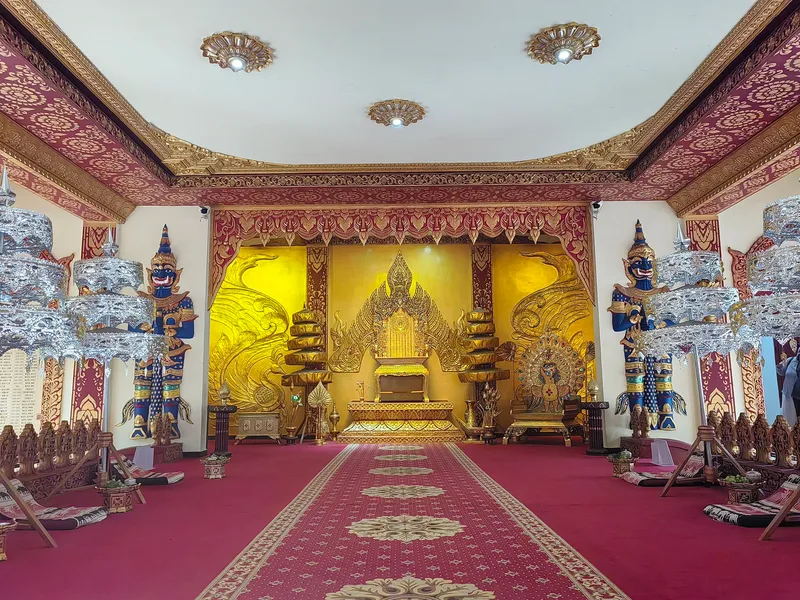
- Grand Buddha Temple: adjacent to Manting, free, open roughly 08:00–17:30. The centre of Theravada Buddhism in Xishuangbanna, with gold roofs and white walls that photograph beautifully
- Water Splashing Square: right next to both, on the main in-town route, free and open all day
One detail: you can reach Manting from the temple side, but entering Manting still requires a ticket. Don't assume a side gate gets you in for free.
🎫 Tickets and hours (confirm on official channels for the current year)
- Manting Park: about ¥40 for adults; concessions for seniors over 60 and students; free for young children and the very elderly
- Grand Buddha Temple: free
- Water Splashing Square: free
- Hours: Manting about 08:00–17:00, temple about 08:00–17:30
- Recommended time: 2–3 hours for both; half a day if you linger and take photographs
⏰ Best time to go: late afternoon, full stop
This deserves its own section because it decides the whole experience.
- Morning: quieter and cooler, good if you want to study the architecture in peace
- Midday: worst. The sun is fierce and shade inside the park is limited; overhead light flattens photographs
- After 16:00: the best window. The light softens, the gold roofs and Dai eaves pick up depth, and the crowds begin to thin
So my standard sequencing is: Wild Elephant Valley or the botanical garden in the morning, back to town in the afternoon, Manting and the temple late, then the Gaozhuang night market in the evening. It runs in one direction, avoids the worst sun, and makes a comfortable Banna day.
🗺️ A route without backtracking
- Enter via the Grand Buddha Temple (free; see the Theravada architecture first — the gold roof is at its best in low sun)
- Walk through to Manting Park (buy a ticket; focus on the royal garden site, the Dai buildings and the Zhou Enlai statue)
- Do a slow circuit and find a shady bench to sit on for a while
- Exit to the Water Splashing Square, then head on to Gaozhuang for the evening
This order works because it's free first, paid second, built architecture before open garden — which suits both the light and your energy.
⚠️ Common mistakes
- Going at midday and being too hot to look at anything
- Assuming one ticket covers both — one is paid, one is free
- Dressing too scantily for the temple — Theravada temples have a basic dress code; cover shoulders and knees, and remove shoes inside halls
- Finishing in thirty minutes and calling it dull — this is a slow-walking kind of place
- Shouting inside the temple or photographing monks — respect local custom
- Expecting the Water Splashing Festival — on an ordinary day you're visiting a garden; for splashing, go to the Dai Ethnic Garden or come during the festival
🧭 Where it fits
- Arrival afternoon: if you don't want a long drive after landing, Manting + temple + Gaozhuang is the gentlest opening
- Last half day: do the distant sights first and leave town for the end
- During the festival: an entirely different game — read Xishuangbanna Water Splashing Festival Guide first
- Evening: continue to Gaozhuang Xishuangjing Starlight Night Market
- Dai village life: give another half day to Dai Ethnic Garden
A few closing thoughts
Manting isn't the kind of place that makes you gasp. It's the kind that slows you down. What stays with me is the late afternoon: day-trippers heading for the exit, a handful of people left inside, light coming through the trees at an angle, the upswept eaves of the Dai buildings picked out clearly, and the sound of the temple in the distance. You sit on a bench with nowhere to be — that kind of ease is genuinely rare on the road.
The value is also straightforward: forty yuan for a royal garden with more than a thousand years behind it, plus a free Theravada temple next door. Most Banna sights cost an hour or two of driving each; Manting is one of the few you can simply walk to, which makes it very useful with elderly relatives, small children, or a compressed schedule.
The only thing to remember is not to go at midday. The Banna sun doesn't negotiate. The same garden at 16:30 and at 12:30 are a category apart.
Craving a worry-free yet free-spirited journey?
Don't want to build the itinerary yourself? Talk to our senior travel designers and get a route and quote built for you.
Get your free route plan and quote
Last updated: October 2026 Author: RoamFun Senior Travel Consultant Questions welcome at: vip@roamfun.net

RoamFun Senior Travel Consultant
Travel DesignerProfessional travel consultant, curating the most practical travel guides for you.