Mangshi Golden & Silver Pagodas: Tickets, Why to Go at Dusk & a One-Day Plan
Mangshi is my favourite staging city on the western Yunnan route. It's the capital of Dehong Dai and Jingpo Autonomous Prefecture, known in Dai as "Menghuan," meaning "the place where the sky first lightens." Palms line the streets, the air smells of grilling meat and spices, and at moments it feels closer to Southeast Asia than to China. The landmark you see from almost anywhere in town is the pair of pagodas on Leiyarang Hill — the golden Menghuan Pagoda and the silver one beside it.
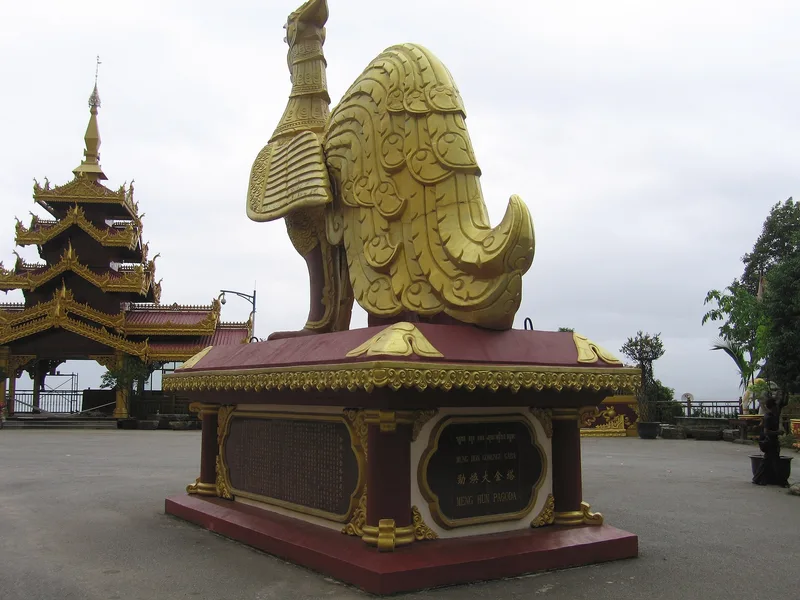
The golden pagoda rises about 73 metres with a base roughly 50 metres across, making it the tallest Theravada stupa in China. The silver pagoda stands next to it, and the two together form Mangshi's signature image.
This guide covers tickets, whether to do both, when the light is best, how to get up the hill, and how to spend a day here.
Two reminders up front: Mangshi is a border area, so carry photo ID; and the pagodas are at their best in the evening — going up at midday means harsh light and a lot of regret.
🛕 Golden or silver: do you need both
- Menghuan Golden Pagoda: the main stupa, large-scale, in a South Asian Dai palace style with fine Buddha images inside. The tallest Theravada stupa in China, about 73 metres high with a 50-metre base
- Menghuan Silver Pagoda: adjacent, white, more contemporary in style, and striking in contrast when framed with the golden one
- My advice: do both. They're right next to each other, and seeing only one always feels incomplete — gold and silver together is the shot Mangshi is known for. If time is truly tight, do the golden one
🎫 Tickets and hours (confirm on official channels for the current year)
- Golden Pagoda: about ¥50 per person
- Silver Pagoda: ticketed separately, with combination tickets available (combinations vary by platform)
- Recommended time: 2–3 hours for both
- Documents: border area — carry photo ID
⏰ Best time: dusk, and here's why
This gets its own section because it decides what you photograph.
- Morning: flat light, few people, fine if you want a quiet look at the architecture
- Midday: worst — overhead light and full exposure
- After 17:00: the best window. The low sun turns the golden pagoda warm gold while the silver one stays cool white, the contrast is at its strongest, and from the hilltop you can look out over Mangshi and the hills beyond
So here's how I normally structure the day: markets and Dai food by day, up Leiyarang Hill for the twin pagodas around 17:00, then barbecue in the evening. Temperature, light and pace all line up.
🚗 Getting up the hill
- Self-drive or taxi: straight to the car park on Leiyarang Hill — easiest by far
- Car with a driver: half a day of private car in Mangshi is inexpensive, and it ties the pagodas to the in-town stops neatly
- Walking up: it's a slope and it's hot; don't do it with children or elderly relatives
🗺️ One day in Mangshi
- Early: a bowl of clear-soup beef rice noodles (the local breakfast standard), then the morning market
- Late morning: wander the old town, small sights like the tree-engulfed pagoda
- Midday: a proper Dai lunch — sapie, ghost chicken, hand-grabbed rice, pineapple rice. See Mangshi Dai Food Guide
- Afternoon: back to the hotel through the hottest hours
- After 17:00: Leiyarang Hill, both pagodas, wait for sunset
- Evening: barbecue and a paw luda to finish
⚠️ Common mistakes
- Going up at midday — too hot to enjoy, and the photographs are flat
- Doing only the golden pagoda and missing the shot Mangshi is famous for
- Wearing too little — these are religious sites: cover shoulders and knees, remove shoes inside halls
- Photographing Buddha images and monks aggressively — ask first, or simply don't
- No ID — there are checks in border areas
- Treating Mangshi as just a place to sleep — it genuinely deserves a night
- Thinking the golden and silver pagodas are one building — two separate stupas, separately ticketed
🧭 Where Mangshi sits on the route
- Mangshi (1–2 days): twin pagodas plus Dai food, as the first or last stop in the west
- Ruili (1–2 days): Moli rainforest, One Village Two Countries, Jiegao Port. See One Village Two Countries Guide
- Tengchong (2–3 days): volcanoes, war memorial, Heshun, hot springs
- Distances: Mangshi → Ruili about 100 km (1.5–2 hours); Mangshi or Ruili → Tengchong is longer, so allow a day for that leg
A few closing thoughts
Mangshi has a particular character: a border capital that feels entirely unhurried, full of tropical planting, slow-paced and cheap to eat well in. Many travellers treat it as a place to sleep before pushing on to Ruili or Tengchong, and I think that's a waste — at least give it one evening on Leiyarang Hill.
That evening sticks in my memory: the sun dropping behind the hills, the golden pagoda lit up, the silver one cold white beside it, wind coming through the saddle, and the city's lights switching on one by one below. You stand there with nowhere to be. That kind of ease is scarce on this route.
Two hard reminders: bring ID, and go at dusk. Get those two right and Mangshi is a safe bet.
And if you have five or six days in western Yunnan, my sequence is one night in Mangshi, a day in Ruili, two days in Tengchong — with the pagodas on the evening of the Mangshi day. Eat by day, watch the pagodas at dusk, barbecue at night. That's the rhythm this city actually runs on.
Craving a worry-free yet free-spirited journey?
Don't want to build the itinerary yourself? Talk to our senior travel designers and get a route and quote built for you.
Get your free route plan and quote
Last updated: October 2026 Author: RoamFun Senior Travel Consultant Questions welcome at: vip@roamfun.net

RoamFun Senior Travel Consultant
Travel DesignerProfessional travel consultant, curating the most practical travel guides for you.