Mangshi Dai Food: Sapie, Ghost Chicken, Leaf Banquets & How to Eat for Two Days
If you ask which Yunnan city is most underrated, Mangshi is always on my list. It's the capital of Dehong Dai and Jingpo Autonomous Prefecture, known in Dai as "Menghuan" — "the place where the sky first lightens." Plenty of travellers stay one night and leave for Ruili or Tengchong the next morning, missing the best eating on the whole route.
Mangshi's food works because it combines the sour-hot freshness of Dai cooking with the rougher grilled-and-pounded style of the Jingpo, plus a Burmese influence on the side. And it's cheap: a few dozen yuan a head buys a seriously substantial meal.
This guide covers what the signature dishes actually are, how to order on a first visit, which flavours outsiders find hard, and how to eat well across two days.
One expectation to set: the food here isn't delicate, but it has character. Sour, hot and bitter are all delivered directly, and nothing is softened for tourists. Frowning at the first mouthful is normal — give yourself two meals to adjust, and by the third you'll be asking which place does the bitter sapie best.
🍜 Know what you're ordering
Sapie The soul of Mangshi Dai cooking — essentially a dipping sauce or dressing. The common versions are lemon sapie (sour, hot, refreshing) and bitter sapie (made with bitter water, with a returning sweetness; this is the one outsiders most often can't handle). You dip raw vegetables, rice noodles or grilled meat into it. The whole point is that bowl: sour, hot, bitter and aromatic stacked together. First order: start with lemon sapie; try the bitter version only if that goes well.
Ghost chicken A Jingpo classic. Chicken is boiled, shredded and dressed cold with lemon juice, bird's-eye chilli, coriander and garlic. Sour, hot and appetising — the highest acceptance rate among outsiders and almost impossible to get wrong.
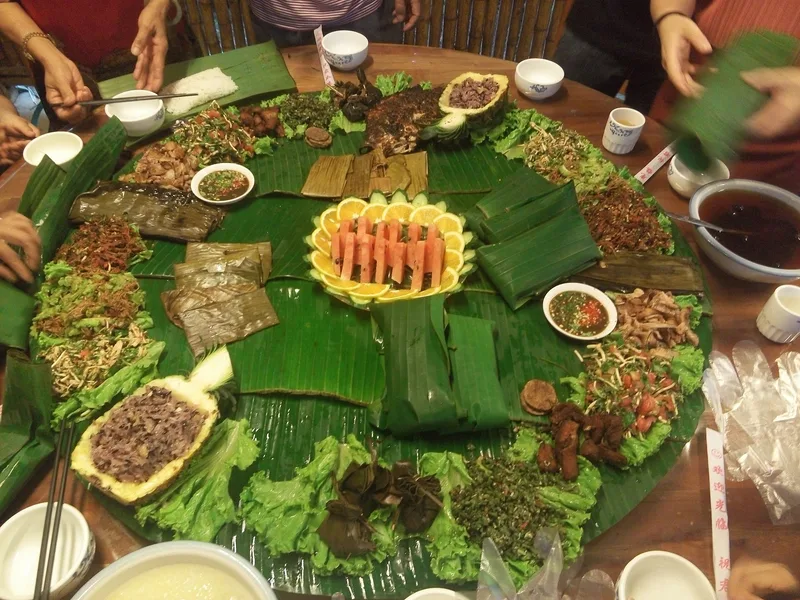
Hand-grabbed rice A spread laid out on a banana leaf: grilled meat, grilled fish, pounded dishes, sticky rice and dips, eaten by hand. Best for three or more people — a couple will never finish it.
Leaf banquet A Dehong-style feast where vegetables, meat, cold dishes, pounded dishes, grilled items and leaf-wrapped parcels are all served on green leaves. Strong visually and ritualistically, and plenty of Mangshi locals will drive out to the countryside for a proper one. Tip: check the location and whether you need to book; for places out of town, hire a car.
Paw luda The most distinctive local cold drink, jokingly called "Mangshi's Starbucks": coconut or milk base with sago, shredded coconut, dried bread and condensed milk. Sweet, cold, fragrant, and exactly right in hot weather.
Also worth trying
- Clear-soup beef rice noodles: the local breakfast standard — get up early for one
- Pounded chicken feet: sour, hot, crunchy
- Pineapple rice / purple sticky rice in pineapple: a sweet palate cleanser
- Burmese-style milk tea: strong tea, plenty of milk
- Grilled pork belly, lemongrass grilled fish: the backbone of the night market
⚠️ Ordering on your first visit without regrets
- State your chilli tolerance up front. Dai food is genuinely hot; if you can't take it, say "less chilli" or "no bird's-eye chilli"
- Be careful with bitter sapie. The bitterness comes from bitter water — people who love it are hooked, but most first-timers grimace
- Watch the raw items. Some sapie is served with raw meat or raw shrimp; anyone with a sensitive stomach should avoid the raw versions
- Structure the order: one cold dish (ghost chicken or pounded chicken feet) + one sapie + one grilled item + a starch + a paw luda. That's the safest order for two or three people
- Hygiene: favour busy places and open kitchens where you can see the prep — cold dishes depend entirely on fresh ingredients
- Don't over-order. Portions are bigger than they look, especially hand-grabbed rice and leaf banquets
🗺️ Two days of eating
Day one
- Morning: clear-soup beef rice noodles
- Midday: a proper Dai meal (ghost chicken + lemon sapie + grilled fish + pineapple rice)
- Afternoon: paw luda and Burmese milk tea
- Dusk: up Leiyarang Hill for the pagodas (and to walk it off). See Mangshi Golden & Silver Pagodas
- Evening: barbecue and pounded chicken feet
Day two
- Morning: the market, for tropical fruit and spices
- Midday: hand-grabbed rice, or a leaf banquet in the countryside (book ahead / hire a car)
- Afternoon: on to Ruili, stopping at a market town on the way
💡 Practical notes
- Timing: locals eat breakfast early and the noodle shops are busiest in the morning; night markets and barbecue cluster in the evening
- Price: cheap overall — from a few dozen to a hundred-odd yuan per head for a very good meal
- Transport: for countryside leaf banquets, hire a car; public transport is impractical
- Stomach: carry basic stomach medicine. Sour, hot, cold and raw in succession is hard on a delicate constitution
- Payment: most small places take mobile payment; keep some cash as a backup
- Border area: carry photo ID — there are checks along the roads
🧭 Where Mangshi fits
- Mangshi (1–2 days): pagodas plus Dai food, slow-paced
- Ruili (1–2 days): Moli rainforest, One Village Two Countries, Jiegao Port. See One Village Two Countries Guide
- Tengchong (2–3 days): volcanoes, war memorial, Heshun and hot springs — see Tengchong Hot Springs & Heshun
Many travellers treat Mangshi as "somewhere to sleep on the way through." I generally push for at least one full day: eat by day, pagodas at dusk, barbecue at night. Do that and Mangshi hasn't been wasted.
A few closing thoughts
Mangshi's food has a distinctive quality: it isn't refined, but it has personality. The bitterness of sapie, the sourness of ghost chicken, the smoke of the grill — all direct, and none of it softened to suit visitors. That's both its strength and its barrier. Disliking it at first is normal; concluding it's "not good" on that basis is a mistake.
My advice: start with mild or medium heat and give yourself two meals to adapt. Plenty of people frown through the first, get into the second, and by the third are hunting down the most authentic bitter sapie in town.
And don't chase only the famous places. The best food in Mangshi is often in small shops packed with locals at breakfast, unprepossessing from outside, where the broth has been going for decades. See where the locals are sitting and sit down too.
If I had to rank it: clear-soup beef noodles at breakfast first, ghost chicken and lemon sapie second, hand-grabbed rice or a leaf banquet third, paw luda and barbecue to finish. Follow that order for two days and you'll have the city's palate figured out.
Craving a worry-free yet free-spirited journey?
Don't want to build the itinerary yourself? Talk to our senior travel designers and get a route and quote built for you.
Get your free route plan and quote
Last updated: October 2026 Author: RoamFun Senior Travel Consultant Questions welcome at: vip@roamfun.net

RoamFun Senior Travel Consultant
Travel DesignerProfessional travel consultant, curating the most practical travel guides for you.