
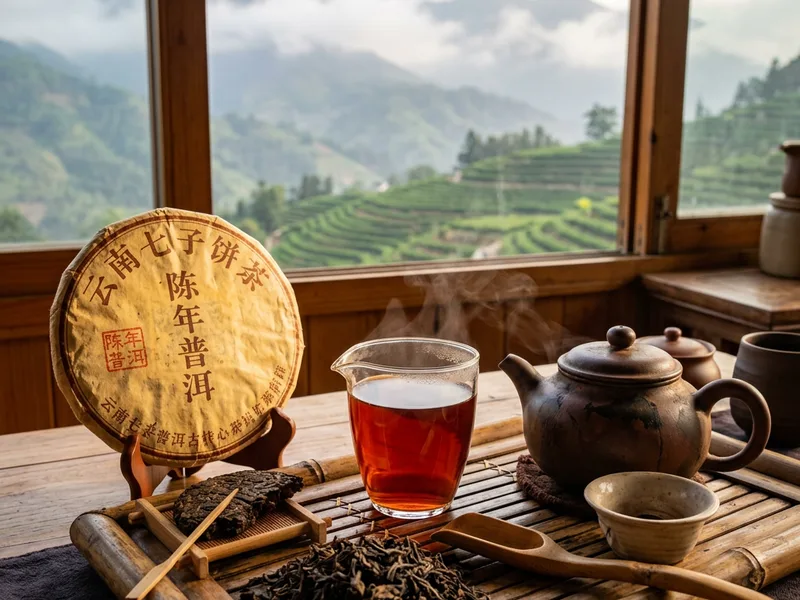
How to Choose Pu-erh Tea: Raw vs Ripe, Which Mountains, and What to Pay (Beginner's Guide)
Walk into any Yunnan tea shop and face the walls of "Banzhang," "Bingdao," "Old Banzhang ancient-tree" — the first instinct of every beginner is confusion: do I buy raw or ripe? Is the mountain real or fake? What price isn't a rip-off?
This guide breaks down choosing Pu-erh into four questions: ①raw vs ripe ②how to read mountain areas ③what's a reasonable price ④where to buy without getting scammed. By the end, you'll know that for your first Pu-erh purchase, 500 RMB is more than enough.
🍃 Step 1: Raw or Ripe? Get This Clear First
Pu-erh comes in raw (sheng) and ripe (shou), with completely different processes and flavors. Neither is better — it's about what suits you:
| Comparison | Raw (Sheng) | Ripe (Shou) |
|---|---|---|
| Process | Sun-dried mao cha pressed into cakes, unfermented | Wet-piling fermentation (accelerated aging) |
| Liquor color | Yellow-green → golden, redder with age | Deep red, clear and bright, like red wine |
| Taste | Marked astringency, fast sweet aftertaste, strong energy | Mellow and smooth, sweet and glutinous, no astringency |
| Strength | Strong; sensitive stomachs should limit fresh raw tea | Gentle, stomach-friendly, for all ages |
| Aging value | Better with age; good for collecting | Ages too, but with less change |
| Best for | Experienced drinkers, would-be collectors | Beginners, women, elders, daily drinking |
How to pick your first cake:
- Daily drinking with a sensitive stomach → ripe Pu-erh (pick a 5-8 year old one; the fermentation smell has dissipated and it's mild and smooth)
- Want to experience that tea-energy sweetness → raw Pu-erh (pick new tea within 3 years; the astringency is followed by a clear sweet aftertaste)
- Want to age your own → raw Pu-erh; store 5-10 years for surprises
🏔️ Step 2: How to Read Mountain Areas. Don't Get Fooled by Names
Pu-erh values "mountain areas" — soil, elevation and climate across different regions shape the flavor. But this is exactly where beginners get fleeced: "Bingdao" and "Old Banzhang" are everywhere, while true ancient-tree tea has minuscule annual production.
The Three Core Producing Regions at a Glance
| Region | Iconic Mountains | Flavor Profile | Market Price (357g cake) |
|---|---|---|---|
| Xishuangbanna (Menghai, Mengla) | Old Banzhang, Bingdao, Yiwu | Banzhang bold, Bingdao rock-sugar sweet, Yiwu soft-sweet | Old Banzhang/Bingdao ancient trees: thousands to tens of thousands; genuine ones are rare |
| Lincang | Xigui, Bingdao (part) | High aroma, honey note, rock-sugar sweet | Xigui 1000-5000 RMB |
| Pu'er (formerly Simao) | Jingmai, Qianjiazhai | Orchid fragrance, honey note | Jingmai 300-1500 RMB |
Mountain Advice for Beginners
- Don't chase famous mountains for your first cake: genuine Old Banzhang and Bingdao ancient-tree cakes start at several thousand RMB apiece — over 90% of what's sold is blended or counterfeit, and beginners can't tell the difference anyway
- Best value picks: Yiwu (soft-sweet, easiest entry), Jingmai (obvious orchid fragrance, friendly price), Mengku (Lincang's representative, good aftertaste)
- "Region" beats "mountain" for practicality: buying "Menghai County, Xishuangbanna" or "Lincang" region tea gives stable quality and transparent pricing — far less risk
💰 Step 3: What's a Fair Price? The Logic of Pricing
Beginners: remember these bands and you basically avoid the big traps:
| Tier | Price (357g cake) | Position | Best For |
|---|---|---|---|
| Daily-drinker | 50-150 RMB | Mainstream-factory entry raw/ripe, standard process, stable taste | Everyday drinking, colleague gifts |
| Drinking-grade | 150-500 RMB | Mid-tier factory, famous-mountain blends, clear regional character | Personal upgrade, friend gifts |
| Premium | 500-2000 RMB | Ancient-tree pure material, single-mountain tea | Elders, entry-level collecting |
| Sky-high | 2000+ RMB | Genuine famous-mountain ancient trees | Collector experienced drinkers; beginners beware |
⚠️ The anti-scam logic: any "ancient-tree tea" under 50 RMB is a scam — the raw material cost alone rules it out; and "Old Banzhang" priced at 200 RMB is almost certainly riding the name. For your first purchase, the 200-500 RMB tier from the big factories (Xiaguan, Dayi, Zhongcha) is the safest.
Factory Brands for Beginners
- Dayi (TAETEA): the #1 Pu-erh brand; 7542 (raw) and 7572 (ripe) are the benchmark products — buy blind without worry
- Xiaguan Tuo Tea: veteran state-owned factory; Xiaofa Tuo and raw tuo classics, great value
- Zhongcha (China Tea): a central-enterprise brand with orthodox process; good for gifting
🏬 Step 4: Where to Buy Without Getting Scammed?
Reliable Channels, Ranked
- Brand stores / official flagship stores: Dayi, Xiaguan and Zhongcha stores online and offline — the most consistent quality
- Professional tea markets: Kunming's Xiongda Tea City, Kangle Tea City, Yunnan Tea Culture City — deep waters, but legitimate merchants let you taste; taste before you buy is the iron rule
- Tea mountains / origin: go to Menghai in Xishuangbanna or Jingmai in Pu'er to drink tea straight from the source — but you need to find the right farmer/co-op
- Scenic-area specialty shops: ❌ be careful — inflated prices, questionable quality
The 4 Standard Moves When Tasting
- Smell the dry leaves: a clean tea aroma is enough (ripe Pu-erh carries a light aged note); musty or sour smells are immediate rejects
- Look at the liquor: raw should be golden and clear, ripe deep red and bright; cloudy or dull means no good
- Taste: smooth entry, no off-flavors, clear sweet aftertaste = good; bitter with a "locked throat" (numb tongue) is inferior tea
- Check the wet leaves: the infused leaves should unfurl, be elastic and even; lots of broken bits means rough processing
🎁 Gift Match Guide
| Scenario | Recommendation | Budget |
|---|---|---|
| Everyday gift for elders | Dayi 7572 ripe Pu-erh (5-8 years old) | 200-400 RMB |
| Beginner gift for a friend | Jingmai raw / Yiwu raw | 300-800 RMB |
| Gift for boss/client | Dayi premium series / mountain-area gift box | 800-2000 RMB |
| Aging your own | Dayi 7542 raw (store 5+ years) | 300-500 RMB/cake |
📋 Beginner Anti-Scam Checklist
- Don't trust "20-year-old aged tea": genuine aged tea is rare on the market and pricey; a "20-year aged tea" for a few dozen RMB is always fake
- Don't buy "tea king tree" merchandise: mostly marketing gimmicks
- Check the packaging: genuine cakes carry a production license (SC number), factory name/address and raw-material origin on the wrapper — never touch unlabeled products
- Weigh it: a standard cake is 357 g; be suspicious if it's off by more than 5 g
- Taste before buying: any shop should let you taste first — walk out of any that won't
💬 What Our Travelers Say
"The first time, I was fooled by an 'Old Banzhang ancient tree' in a tea market. Later I followed this guide's recommendation and bought Dayi 7572 ripe Pu-erh as my daily tea — fragrant, smooth, and just over 200 RMB lasted me a year. Beginners really shouldn't touch famous mountains." — Acha, Chengdu ⭐⭐⭐⭐⭐
"I followed the advice and bought on-site at the Jingmai tea mountain. The farmer brewed it for us before packing; under 300 RMB a kilo with that amazing orchid fragrance. My friends back home said it beats stuff sold at 800." — Laoye, Guangzhou ⭐⭐⭐⭐⭐
Pu-erh Tea Is Yunnan Time You Drink
In a single cake of tea lies the rainforest of Xishuangbanna, the mountain mist of Lincang, the orchid of Pu'er, and the slow passing of time. Once you learn to choose, what you bring home isn't just a box of tea — it's a piece of Yunnan.
Want a "tea mountain + ancient village" Yunnan tea journey? A senior trip designer can plan the route.
Craving a carefree yet free-spirited trip?
Don't want to plan it yourself? Contact our senior trip designer now for a tailor-made route and quote.
Get a free road book and quote
Updated: August 2026 Author: RoamFun Senior Travel Consultant Questions? Contact us: vip@roamfun.net
Craving a worry-free yet free-spirited journey?
Don't want to plan it yourself? Contact our senior trip designer now for a route and quote tailored to you.

RoamFun Senior Travel Consultant
Travel DesignerProfessional travel consultant, curating the most practical travel guides for you.