
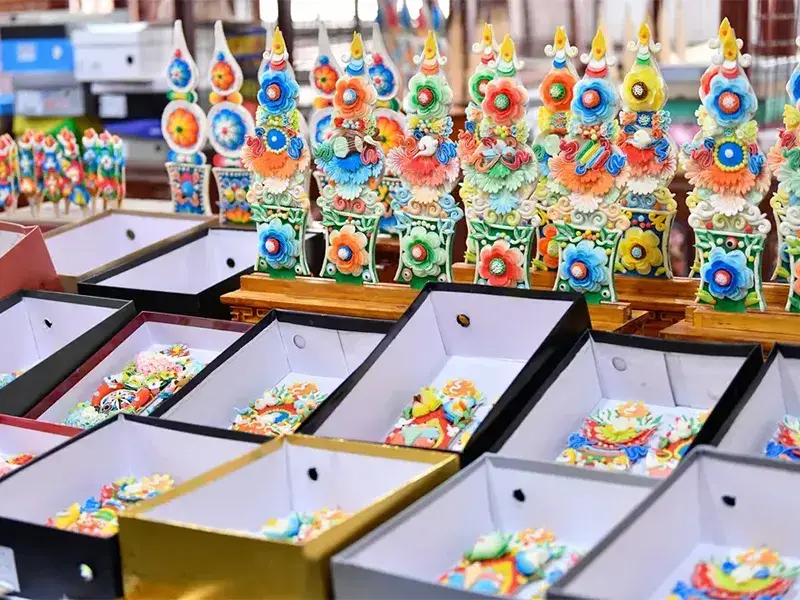
Straight Talk! Where to Buy Authentic Tibetan Handicrafts? Stop Believing the "Stories" on the Streets of Lhasa
Last month, I finished leading a group along the Sichuan-Tibet Highway to Lhasa. While doing the kora around Barkhor Street, I watched countless tourists get pulled into street-side shops, listening to shopkeepers spin tales of "blessed by great lamas" and "purely handcrafted," only to spend thousands on machine-made wholesale goods shipped from Yiwu or Nepal.
Trust me, when you truly want to bring home a piece of Tibetan handicraft that can be passed down and carries warmth—whether it's Tibetan incense, pulu (Tibetan woolen fabric), thangka, or Tibetan silver jewelry—don't gamble at tourist spots. The real intangible cultural heritage artisans and authentic old shops are hidden in the deep alleys where locals buy incense and get their clothes tailored, or in government-backed intangible heritage cooperatives. Today, no exaggeration, I'll lay out all the shopping routes and anti-scam tips our team has figured out over more than a decade of exploration.
📍 Don't Rush Out! Essential Information First
| Item | Key Details |
|---|---|
| Best Shopping Areas | Chengguan District, Lhasa (Old Town intangible heritage workshops, Zangre Road, Chongsaikang Market) |
| Recommended Time | Set aside half a day to a full day. Walk with local pilgrims, don't rush |
| Core Anti-Scam Rule | Compare three shops, don't listen to stories, avoid pricey items (dzi beads, high-grade amber) |
| Difficulty | ★☆☆☆☆ (Tests your resolve—just don't get brainwashed by stories) |
🗺️ Hard-Earned Shopping Itinerary—Just Follow Along
Morning: Dig into the old city alleys, find real Tibetan incense and handwoven pulu
- 09:30-11:00 【Minzhulin Tibetan Incense Shop】or 【Old incense shop next to the Lower Tantric College】
- Blogger's tip: Don't buy those brightly colored, pungent industrial incense sticks from street vendors. Authentic Tibetan incense is made from cypress wood bricks ground into paste on water mills, hand-kneaded with dozens of Tibetan medicinal herbs like rhodiola and saffron. The scent is deep and calming. Locals buy from Minzhulin or established local brands—a box costs a few dozen yuan, burns for a long time, all-natural and gentle on the lungs.
- 11:00-12:30 【Traditional tailor shops in Jiri Alley or South Barkhor Street】
- Anti-scam reminder: Those "Tibetan scarves" on the street for a few dozen yuan are all synthetic fiber. For authentic handwoven pulu (woolen fabric handwoven from pure wool), go to the alleys where locals have Tibetan clothes made. It feels slightly stiff and rough, but that pure wool texture and plant-dye colors simply cannot be replicated by machines. A handmade shawl will last a lifetime.
- 09:30-11:00 【Minzhulin Tibetan Incense Shop】or 【Old incense shop next to the Lower Tantric College】
Afternoon: Watch live demonstrations at intangible heritage cooperatives, witness the "masters' showdown" at Chongsaikang
- 14:30-16:30 【Tibet Intangible Cultural Heritage Experience Park / Karma Palsho Thangka Academy】
- Real experience: Never buy thangka from street stalls. Authentic thangka uses ground minerals like turquoise and lapis lazuli as pigments—one painting takes months or even years. At proper academies, you can watch artists draw line by line. Even a few-hundred-yuan line drawing (uncolored sketch) or a small masterpiece is a hundred times better than those gold-traced photocopies sold at tourist sites.
- 16:30-18:00 【Chongsaikang Market (look only, don't buy unless you know someone)】
- Vibe & environment: This is Lhasa's largest distribution hub for antiques and daily goods. Countless Tibetan elders clutch strings of amber or red coral, trading right there—the street atmosphere hits you in waves. Unless you're an expert, just enjoy the spectacle and soak in the vibe. Don't reach for your wallet.
- 14:30-16:30 【Tibet Intangible Cultural Heritage Experience Park / Karma Palsho Thangka Academy】
🎒 Veteran Shopper's Kit: Bring What Matters, Not More
- **Cash**: Mobile payment is widespread in Lhasa, but for deep-alley old shops or Chongsaikang stalls, carry some hundred-yuan bills and change. You'll often get unexpected "old customer" discounts.
- **Strong flashlight / phone torch**: Essential for examining turquoise, amber, and silver details (hand-polishing marks, natural mineral inclusions). Don't make decisions under the dim warm lighting inside shops.
- **Sturdy cloth bag**: Tibetan handmade incense is brittle, and handwoven textiles snag easily. Bring a durable cloth bag to pack your treasures safely—don't crush them in a hard backpack.
💡 Heart-to-Heart Truths (Anti-Scam Guide)
About road conditions and transportation: If you're heading to Shannan near Lhasa (e.g., to Zhanang for authentic Minzhulin incense or handmade pulu), or to Shigatse for Tibetan knives, the main roads are well-paved now, but high-altitude mountain roads have countless sharp curves. Fortunately, our team drove a Tank 300 this time—the chassis is solid, stable on high-altitude passes and rough gravel roads, with a large trunk packed full of handwoven Tibetan carpets and crafts our team members found. Minimal bumping, no backaches.
"Truths" about handicrafts:
- "Tibetan silver" is not pure silver: The vast majority of so-called "Tibetan silver" on the market is actually white copper or alloy, with extremely low or zero silver content. It's a traditional craft style. If you spend hundreds thinking you got pure silver, you lost. Genuine Tibetan handmade pure silver jewelry is called "foot silver" (pure silver), with hand-chiseled uneven marks, priced by gram plus craftsmanship.
- Don't hunt for bargains on dzi beads and turquoise: Don't expect to buy old dzi beads or top-grade raw turquoise for a few hundred yuan on Lhasa streets. 99.9% of hundred-yuan dzi beads are modern agate fired as crafts. Fine as decoration, but don't take them seriously.
📸 Don't Shoot Blindly—These Angles Are Stunning
- Chongsaikang Market second-floor overhead shot: Around 4-5 PM, sunlight slants into the market. Use a telephoto lens for close-ups of Tibetan folks gathered below examining antiques—the light and shadow are incredibly cinematic.
- Handwoven pulu loom in old alleys: With the artisan's permission, photograph along the warp and weft lines—capture those calloused hands shuttling back and forth. That's the real warmth of Tibet.
💬 Classic Questions Asked 800 Times (FAQ)
- Q: What do you recommend for ordinary tourists who want authentic, affordable souvenirs?
- A: Most recommended: Tibetan incense and handmade textiles (small tapestries, pulu coasters). These have high counterfeiting costs and relatively low margins, plus they carry genuine local Tibetan flavor. Buy from incense factory shops affiliated with major monasteries or established Lhasa brands—just a few dozen yuan each, foolproof for gifts or personal use.
- Q: I've read Tibetan knives are beautiful. Can I buy one and bring it home?
- A: Authentic Shigatse Lhatse Tibetan knives are indeed national-level intangible cultural heritage—extremely sharp and exquisitely crafted. But note: Tibetan knives cannot be brought on planes or trains, and cannot be shipped via regular courier. If you buy in Lhasa or Shigatse, the shop must ship via special security channels with real-name registration. Always confirm shipping qualifications before purchasing.
- Q: How to tell a hand-painted thangka from a machine-printed gold-traced one?
- A: Simplest trick: shine a phone flashlight from the back of the thangka toward the front. If it's hand-painted on cotton, the uneven mineral pigment thickness creates irregular line marks and pigment seepage shadows on the back. Machine-printed backs are either completely opaque or uniformly translucent. Also, hand-painted thangka has a faint ox-glue or pine resin scent, not industrial ink smell.
🪵 If We Don't Go Now, We'll Grow Old
Tibet's truly soulful handicrafts were never coldly churned out on assembly lines. They were made by mothers spinning wheels beside dim sweet-tea houses, by painters holding their breath under butter lamps. They carry the plateau wind, the warmth of hands, and Tibetan people's reverence for faith.
Exploring these hardcore intangible heritage routes hidden in Lhasa's deep alleys alone is exhausting, and you might easily pay "tuition fees." If you can't be bothered to plan, or want to customize a no-rush, no-scam, pure-enjoyment hardcore off-road small group, message our route designers anytime (1V1 customization). We'll take you deep into intangible heritage artisans' workshops to see the real Tibet. We'll be waiting for you in Lhasa.
Updated: June 2026 Author: RoamFun Senior Travel Consultant Questions welcome: vip@roamfun.net
Craving a worry-free yet free-spirited journey?
Don't want to plan it yourself? Contact our senior trip designer now for a route and quote tailored to you.

RoamFun Senior Travel Consultant
Travel DesignerProfessional travel consultant, curating the most practical travel guides for you.