Shigatse + Tashilhunpo Monastery Deep Guide: Tibet's Second City, Done Right
If Lhasa is Tibet's public face, Shigatse is its inner soul. Lhasa is the Dalai Lama's seat; Shigatse is the Panchen Lama's seat. These two living Buddha lineages form the core of the Gelug school of Tibetan Buddhism—most people know the Dalai Lama but not the Panchen Lama, yet in Tsang (the greater Shigatse region), the Panchen Lama's influence exceeds the Dalai Lama's.
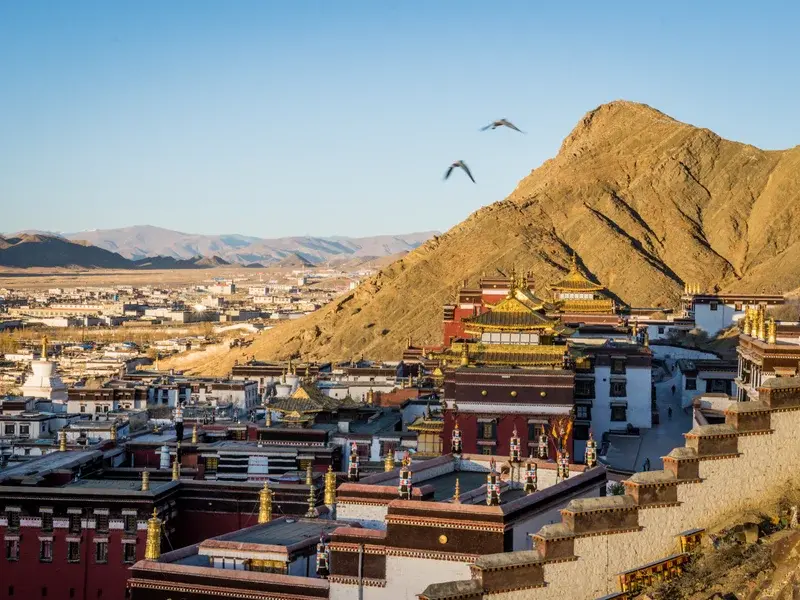
Shigatse sits at 3,860m, slightly higher than Lhasa. The city spreads along the Nyangchu River, and Tashilhunpo's golden roofs are visible from anywhere in town—the landmark of landmarks. I've been to Shigatse three times: first for Tashilhunpo, second for Gyantse Dzong, third for the Nyangchu Valley's autumn colors. Each visit revealed something new.
🛕 Tashilhunpo Monastery: Tsang's Potala
Founded in 1447 by the First Dalai Lama, Gendun Drup, Tashilhunpo is one of the six great Gelug monasteries. From the Fourth Panchen Lama onward, it became the seat of successive Panchen Lamas.
How it differs from Potala Palace:
- Potala is a combined political-religious palace; Tashilhunpo is purely religious.
- Potala limits daily visitors; Tashilhunpo has no limit—you can spend the entire day inside.
- Potala is dense with tourists; Tashilhunpo is virtually empty—the afternoon I visited, fewer than 30 tourists roamed the entire complex.
Core highlights:
Maitreya Chapel (most stunning): A 26.2-meter copper statue of the Future Buddha Maitreya, cast from 110 tons of bronze and gilded with 6,700 taels of gold—China's largest indoor bronze Buddha. Looking up from its feet, the oppressive scale exceeds even the Leshan Giant Buddha—because it's indoors, the space compresses the figure, making it feel even larger. Five floors, each offering a different viewing angle.
Panchen Lama Stupa Chapels: Contains the combined stupa of the Fifth through Ninth Panchen Lamas and the stupa of the Tenth Panchen Lama, Choekyi Gyaltsen—the most important Tibetan Buddhist leader of modern China, whose gold stupa was state-funded after his passing in 1989. Its specifications rival the Dalai Lama stupas in Potala.
Tsokchen Assembly Hall: Tashilhunpo's main hall, seating 2,000 monks for simultaneous chanting. Morning prayers at 6:30 AM—hundreds of monks chanting together, deep resonant voices reverberating through stone walls.
Debate Courtyard: Monks debate daily 3-5 PM. Not performance—genuine academic debate. Hand-clapping and foot-stomping are signature Gelug debate gestures.
Admission: RMB 100 (peak), RMB 55 (off-peak). Go in the afternoon—fewer people, better light.
🏰 Gyantse Dzong: Tibet's Alamo
Gyantse lies about 90 km east of Shigatse. During the Second British Invasion of Tibet in 1904, Tibetan forces held Gyantse Dzong for over two months, fighting British Maxim machine guns with matchlock muskets. Out of ammunition, the defenders chose to leap from the cliffs rather than surrender. The film Red River Valley is based on this history.
Admission: RMB 30. Visit together with Pelkor Chode Monastery at the dzong's base—famous for its Kumbum Stupa ("100,000 Buddha Pagoda"). Pelkor admission: RMB 60.
🗺️ Shigatse 2-Day Classic Route
| Time | Day 1 | Day 2 |
|---|---|---|
| Morning | Lhasa → Yamdrok Lake → Karola Glacier | Tashilhunpo morning prayers |
| Noon | Lunch in Nagarze | Tsokchen Hall + Maitreya Chapel |
| Afternoon | Gyantse Dzong + Pelkor Chode | Nyangchu riverside stroll |
| Evening | Stay in Shigatse | Return to Lhasa or continue to Everest |
💡 Notes on Shigatse
Shigatse is more authentically Tibetan than Lhasa. Lhasa has modernized considerably; Shigatse preserves Tibetan culture more completely. If you came to Tibet seeking Tibet, Shigatse delivers what Lhasa increasingly can't.
Continue west from Shigatse: 150 km to Lhatse County—the junction for Everest and Ngari. Shigatse is a starting point, not the end.
💬 What Do Our Travelers Say?
"Tashilhunpo's Maitreya Buddha froze me in place. A 26-meter bronze Buddha before you, your head barely reaching its ankle. Not intimidating—compassionate, serene. I stood alone in the chapel for nearly half an hour. That atmosphere—Potala Palace doesn't have it." — Chengdu A Fei ⭐⭐⭐⭐⭐
"The Gyantse Dzong story silenced my husband. He never reads information boards, but he went through the entire anti-British memorial hall start to finish. Coming out, he said, 'I never knew Tibet had this history.' Standing at the cliff edge where the soldiers jumped, the wind rattling the prayer flags. Awe." — Changsha Xiao Ou ⭐⭐⭐⭐⭐
Shigatse Has Tibet's Other Beauty—Quiet, Deep, Unspoken
If Lhasa is Tibet's past and present blooming simultaneously, Shigatse is Tibet's foundation. On this Tsang plateau, faith and daily life are the same thing. Next time you come to Tibet, give Shigatse two days.
Want a stress-free and free-spirited journey?
Don't want to plan? Contact our senior travel designers now for your custom itinerary and quote.
Last updated: July 2026 Author: RoamFun Senior Travel Consultant Questions? Reach us at: vip@roamfun.net
Craving a worry-free yet free-spirited journey?
Don't want to plan it yourself? Contact our senior trip designer now for a route and quote tailored to you.

RoamFun Senior Travel Consultant
Travel DesignerProfessional travel consultant, curating the most practical travel guides for you.