Tibet Photography & Pilgrimage Guide: How to Capture Faith and Landscape in One Photo
Tibet is a place photographers love and hate. Love it because any random roadside is enough to shoot for a year—Potala Palace light and shadow, Jokhang pilgrims, Namtso starry sky. Hate it because you know that raising your camera to snap someone doing full-body prostrations feels wrong.
This isn't a mindless "20 must-shoot Tibet spots" list. What I want to talk about is—within the bounds of respect, how to capture Tibet's faith and landscape simultaneously in one warm photo.
🚙 Veteran's Straight Talk: Photography Needs "Freedom"—Buses Can't Give You That
The core of great Tibet photography isn't gear—it's whether you can be at the right place when the right light arrives.
Tour buses can only stop 15 minutes at fixed viewpoints—what if the light hasn't come yet? What if those 15 minutes are exactly when the noon light is harshest?
A Prado in Tibet means you set your own pace. The driver knows the best arrival time for each spot—7 AM at Jokhang for morning light, 4 PM at Yamdrok for angled light. The car can pull over anywhere safe—because the most beautiful scenes aren't at attractions, they're on the road between them.
Even more crucial—an experienced driver will tell you: "Don't shoot here." Not because the scenery is bad, but because pilgrims are doing prostrations nearby, and shoving a lens in their face is disrespectful.
🗺️ Hard-Earned Itinerary: One Photography Theme Per Day
Lhasa: Faith and City
Jokhang Pilgrims (Documentary Style)
- Time: Early morning 6:30-8:00. Morning light + low-angle side light gives pilgrims a golden halo around their silhouette.
- Focal length: 70-200mm telephoto, shoot from a distance. Don't shove the camera in people's faces.
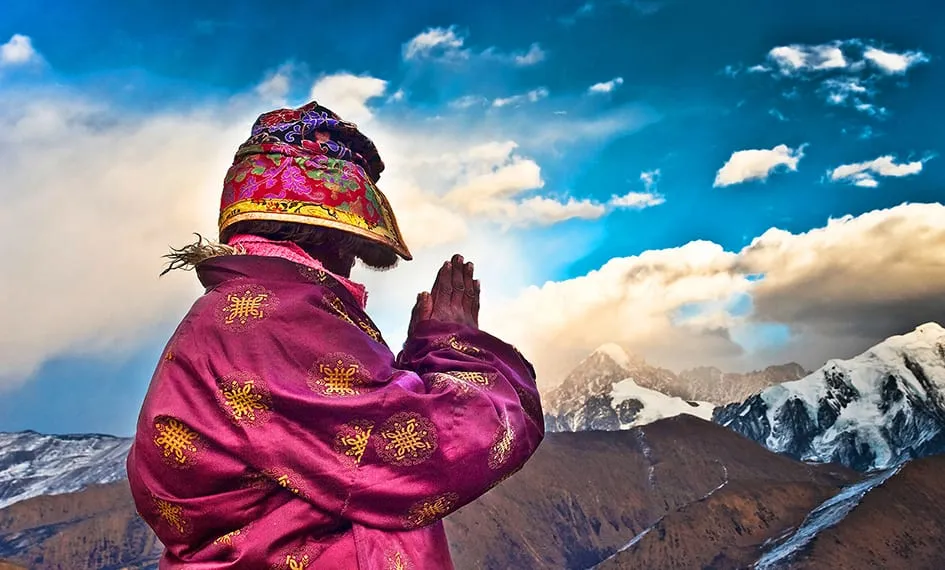
- Technique: Only shoot backs, only hands, only prayer wheel details. Not shooting faces is the most basic respect for pilgrims. If someone clearly doesn't want to be photographed (turns away or waves), immediately lower the camera, put palms together in apology.
- Advanced: Focus on details—a hand gripping prayer beads, a forehead touching the ground during prostration, the worn marks on a prayer wheel's copper surface. These tell 100x more story than a face shot.
Potala Palace Light & Shadow (Landscape + Human Element)
- From Zongjiao Lukang Park: 8-9 AM, Potala Palace north side + lake reflection + weeping willow foreground.
- From Barkhor Street rooftop: Find a sweet tea house with a rooftop (like upstairs at Guangming Gangqiong). 4-5 PM, Potala Palace peeks out at the end of an alley—Tibetan houses + distant palace, layered urban depth.
Monastery Series: Serenity and Solemnity
Sera Monastery Debate (Dynamic Human Element)
- Time: 3-5 PM. Sunlight slants in from the west, strong light-shadow contrast.
- Focal length: Medium telephoto (85-135mm), stand by the debate courtyard wall. Focus on the questioner's raised right arm about to clap—the moment before the clap, arm raised high, robes flying, tension at maximum.
- Technique: Shutter 1/500s or faster to freeze the clap. No flash—breaks the mood, disturbs monks. Don't stand in the courtyard center—blocks the monks' debate movement.
Ganden Monastery Sunrise (Landscape)
- Time: Depart Lhasa 5:30 AM, reach opposite hillside by 6:50. Sunrise 7:00-7:30.
- Focal length: Wide angle (16-24mm) for sea of clouds + monastery panorama, telephoto (70-200mm) for monastery details + cloud details. Bring both.
- Note: 4300m altitude + sub-zero morning—don't skimp on thick gloves. Frozen fingers can't press anything.
Nature Series: Lakes and Snow Mountains
Yamdrok Lake (Colors of Water)
- Morning (front-lit): Lake's blue is most saturated. Use a CPL polarizer to eliminate surface reflections—blue becomes impossibly deep.
- Afternoon (backlit + side-lit): Green layers emerge—from deep blue gradient to turquoise. Low angle near water surface, use ripples as foreground.
- Baidi Village lakeside: Drive along the west shore to Baidi Village. Almost no tourists—quietly wait for light changes alone. Try a timelapse—the lake's color shifting over half an hour rivals cinematic effects.
Namtso Starry Sky (Night)
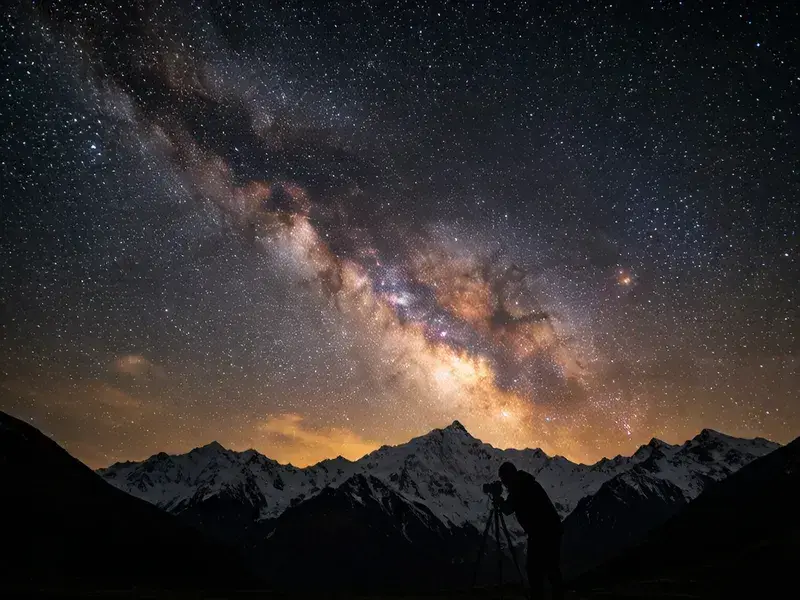
- Time: 3-4 AM when the Milky Way is brightest. Check rise/set times with an app (like Star Walk) beforehand.
- Settings: Large-aperture wide-angle lens (f/2.8 or wider), ISO 3200-6400, shutter 15-25 seconds, manual focus to infinity.
- Foreground: Prayer flags, mani stone mounds, tents, your companion's silhouette—starry sky with foreground tells a story.
Everest Golden Sunrise (Ultimate Challenge)
- Time: Sunrise (6:00-7:30, varies by season), sun from behind you lights up Everest's face—golden mountain. Sunset (19:00-20:30) for Everest silhouette + sunset glow.
- Focal length: 70-200mm telephoto. Everest is 8848m, base camp is ~20km from the summit. Wide angle makes the mountain look small. Use telephoto to fill more than half the frame with Everest—only then does it have visual impact.
- Advanced: Shoot Everest + Rongbuk Monastery + prayer flags in one frame. Prayer flags as foreground, Rongbuk Monastery as mid-ground, Everest as background—three layers create an Everest postcard.
On the Road Series: All Walks of Life
- Roadside pilgrims: If you must shoot, get out of the car, walk over, greet, smile. If you know a few Tibetan words ("Tashi Delek" + "May I take your photo?"), ask. If they nod, shoot. If they shake their head, thank them and leave.
- Tibetan children: Show them your photos (flip the camera screen)—they're thrilled to see themselves on camera, all defenses drop. Then shoot for the most natural smiles.
- Animals: Yaks, Tibetan antelopes, Tibetan wild asses. Telephoto (200mm+) from a distance—don't chase them, don't honk to scare them, don't alter their behavior for a photo.
🎒 Practical List: Tibet Photography Gear
⚠️ Don't say I didn't warn you: Tibet's temperature swings + dryness + wind will destroy your gear. Keep spare batteries in inner pockets for warmth (batteries drain fast in cold). When bringing gear from cold outdoors to warm indoors, seal the camera in a plastic bag for half an hour before taking it out—prevents internal lens fogging from temperature difference.
- Camera body: Full frame (good high-ISO performance, big advantage for astrophotography)
- Lenses: Wide-angle 16-35mm + telephoto 70-200mm
- Tripod: Lightweight travel tripod (essential for stars and timelapse)
- CPL polarizer (eliminates snow mountain and lake reflections)
- Spare batteries ×3 (cold + all-day shooting)
- Camera rain cover (lifesaver in rainy season and snow)
- Air blower + cleaning pen (dust is everywhere)
💡 Heart-to-Heart Truths
Before photographing people, ask yourself one question: "If someone held a camera up to my mom while she was kneeling and praying at a grave, how would I feel?" If the answer is "I'd want to punch them"—then don't shoot pilgrims. If you absolutely must capture it, only shoot backs, only hands, only prayer wheels—these images are far more powerful than faces.
Tibet's most beautiful photos aren't about technique: They're the most ordinary moments—the wrinkles on the hands of the woman pouring you sweet tea in a tea house, the elderly person doing kora alone on the hillside behind Tashilhunpo, the prayer flags blown by the wind at Yamdrok Lake. These aren't captured by settings—they're earned by being in that place, at that time, waiting.
A great photo set = the art of elimination: You shoot a thousand photos in Tibet, and picking ten satisfying ones is pretty good. Why? Because you try to shoot everything. Learn subtraction—today only shoot "light," today only shoot "people," today only shoot "color." Limiting yourself keeps you from drowning in Tibet's overwhelming richness.
📸 Don't Shoot Blindly—These Spots Are Stunning
- Jokhang Temple door lintel: 7:30 AM, the first ray of light illuminates the golden Dharma wheel and reclining deer above the temple door—gold + blue sky + morning light. Use 70-200mm telephoto for detail.
- Barkhor Street prayer wheels: 4 PM side light, the copper surface of prayer wheels reflects like a flowing band of light. Use slow shutter (1/15-1/30s) to capture the sense of "motion."
- Namtso prayer flags: Five-colored flags dancing in the wind, lake water and snow mountains as background. High shutter (1/1000s) to freeze the flags' fluttering moment, wide-angle upward shot.
💬 What RoamFun Travelers Say
"My most satisfying Tibet photo wasn't shot at a viewpoint. It was on the way to Everest—a Tibetan antelope appeared from nowhere, standing by the road. We locked eyes for five seconds. The camera was in my hand, but I didn't raise it. Sometimes the best image doesn't need to be stored on an SD card." — Beijing, photographer Da Li ⭐⭐⭐⭐⭐
"At Jokhang, I followed an elderly man doing prostrations for half a kora, never pulling out my camera. When he finished and stood up, he saw me and smiled. I said 'Tashi Delek.' He said 'Tashi Delek.' That smile was more precious than any photo in my camera." — Shanghai, Xiao Song ⭐⭐⭐⭐⭐
The Best Photos Aren't in the Camera—They're in Memory
After more than a decade in Tibet, I've shot over ten thousand photos. Looking back, the most satisfying ones aren't those with the best light—they're the scenes where, after taking the shot, I put down the camera, stood there, and looked for a long time with my own eyes.
Technique can bring scenery home, but only your eyes can capture "the feeling of that moment."
Want a worry-free yet free travel experience?
Don't want to plan? Contact our senior customizers now for your exclusive route and quote.
Updated: June 2026 Author: RoamFun Senior Travel Consultant Questions welcome: vip@roamfun.net
Craving a worry-free yet free-spirited journey?
Don't want to plan it yourself? Contact our senior trip designer now for a route and quote tailored to you.

RoamFun Senior Travel Consultant
Travel DesignerProfessional travel consultant, curating the most practical travel guides for you.