Everest Base Camp Complete Guide: How Ordinary People Get There, Where to Stay, and What to Bring to See Golden Sunrise
First, a reality check: Everest Base Camp isn't somewhere you just show up and see Everest. Days with a full clear view of the mountain number fewer than 50 per year. The other 300+ days, it's either shrouded in clouds or blasted by wind and snow.
But that doesn't mean you won't see it—you can "pick your days."
This guide breaks down everything: how to get your border pass, how to buy tickets, tent vs. Rongbuk Monastery accommodation, which season offers golden sunrise, and what time to wake up for starry sky photography. Read this before going to Everest, and your odds double.
🚙 Veteran's Straight Talk: On the Road to Everest, the Vehicle Matters Most
Lhasa to Everest Base Camp is about 600km. The first 400km (Lhasa-Shigatse-Lhatse) is paved and easy. But from Lhatse to Tingri, you enter mountain roads—Gyatsola Pass at 5248m, many curves, dangerous driving. Past Tingri county town, the Everest Road is all washboard and gravel, with 99 switchbacks climbing Gawula Pass.
Tour buses can't handle washboard roads (insufficient ground clearance, bone-rattling). Driving yourself? After 6 continuous hours of mountain roads above 5000m, you'll be exhausted by the time you reach base camp—who has energy to look at Everest then?
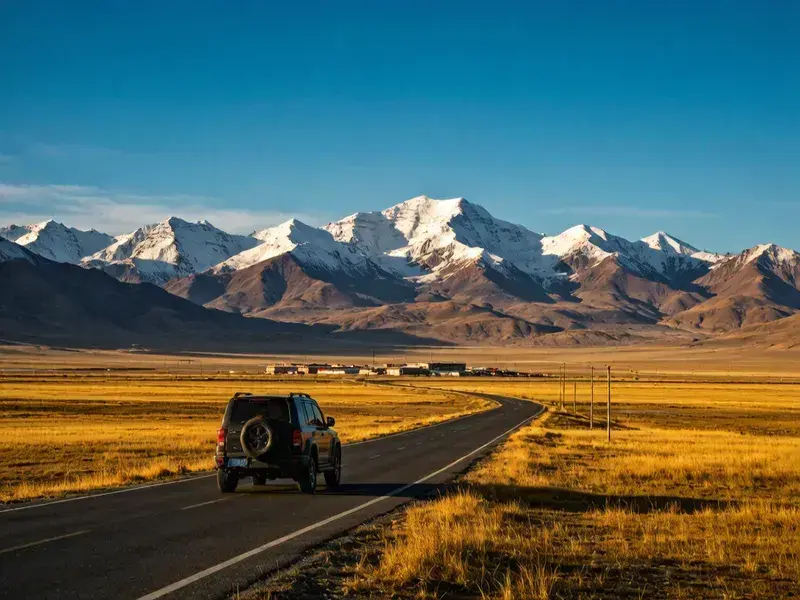
So the most reliable way to Everest: Prado for the whole journey. High ground clearance, good off-road capability, large rear space for reclining rest. You arrive at base camp energized and ready to see the mountain, not collapsed in the seat.
🗺️ Hard-Earned Itinerary: 4-Day Everest Express Route
Day 1: Lhasa - Yamdrok Lake - Shigatse
- Itinerary tip: Online guides tell you to stop in Gyangzê for Tsong Castle and Palkhor Monastery. Tsong Castle is worth it, but Palkhor Monastery's 100,000 Buddha Pagoda is better with a telephoto lens—the pagoda has over 10,000 small Buddha niches, and telephoto reveals the details.
- Veteran's advice: Stay on Shandong Road in Shigatse—many hotel options, convenient dining. Walk to the kora path behind Tashilhunpo Monastery for a panoramic view of Shigatse's main city.
Day 2: Shigatse - Lhatse - Tingri - Everest Base Camp
- Itinerary tip: Gyatsola Pass (5248m) is one of the highest points. Stop for only 5 minutes, snap a photo, and descend. Past Tingri county town at Qie Village checkpoint, border passes are inspected most strictly—your border pass must say "Tingri County" or "Everest Base Camp". Many passes that only say "Shigatse Region" are rejected and sent back for reprocessing.
- Road warning: The ~100km Everest Road from Tingri to base camp has 99+ switchbacks (truly uncountable). Full washboard road, only 30-40km/h.
- Veteran's advice: Gawula Pass is the most important viewpoint on the way to Everest—on a clear day, you can simultaneously see 5 peaks above 8000m: Everest (8848m), Lhotse (8516m), Makalu (8463m), Cho Oyu (8201m), and Shishapangma (8012m). This panorama is called the "8000m Club Family Photo."
Day 3: Everest Base Camp In-Depth Experience
Accommodation choices:
- Tent lodge area: ~5000m altitude, 100-150 yuan/bed, tents have yak dung stoves for heating. Pros: close to Everest, great stargazing angle. Cons: cold (minus teens is normal), toilet is 50m away (outdoor dry latrine), showering is basically impossible.
- Rongbuk Monastery guesthouse: ~2km from base camp, ~5100m altitude, better conditions than tents (rooms, electricity), 200-300 yuan. Cons: slightly farther from Everest, need to walk more for night stargazing.
- Veteran's advice: Stay in the tent lodge—though conditions are the roughest, you can get to the core shooting area in seconds when you get up at 3 AM for stars. This experience happens only a few times in life—worth one night of discomfort.
Itinerary tip: Oxygen cylinder rentals at base camp are expensive (200 yuan/tank+). Buy two cylinders in Shigatse or Lhatse before departing (40-60 yuan/tank). Use oxygen when blood saturation drops below 80%—don't tough it out.
Day 4: Everest - Shigatse - Lhasa
- Best viewing times:
- Sunrise (6:00-7:30, varies by season): Sun rises from behind you (east), light hits Everest's face—golden mountain.
- Sunset (19:00-20:30): Sun sets in front of you (west), Everest becomes a massive silhouette, sky gradient from orange-red to deep blue.
- Veteran's advice: Sunrise for golden mountain, sunset for silhouette. Experience both.
🎒 Practical List: Everest Base Camp Must-Haves
⚠️ Don't say I didn't warn you: Everest Base Camp is 360-degree cold—summer nights can hit -5°C, winter -30°C. You can't overemphasize warmth.
- Documents: ID + border pass (must say "Tingri County Everest Base Camp")
- Clothing: Heavy down jacket + thermal underwear + 2 pairs wool socks + thick gloves + ear-covering hat + 10 body warmers
- Medicine: Portable oxygen cylinders ×2 + ibuprofen + glucose + motion sickness pills
- Photography: Tripod + spare batteries ×2 (fast drain in cold) + cable release + wide-angle lens (for Milky Way)
- Other: Thermos + high-calorie snacks + wet wipes (for when you can't shower)
💡 Heart-to-Heart Truths
Seeing Everest depends heavily on season: April-May and September-October have the highest visibility—more clear days, fewer clouds. July-August is rainy season—Everest is often blocked by clouds. Waiting two days at base camp only to see the mountain's foot isn't worth it. November-February has clear days but is too cold—minus 20-30°C is normal.
Base camp has no real toilets: All are dry latrines and temporary facilities. Daytime is manageable, but at night with minus teens temperatures, walking 50m from a warm tent to the toilet—that's the real "extreme sport." Drink less water after dinner, save hydration for daytime.
At Everest's foot, accept nature's temperament: Don't expect hot showers, WiFi, or hot meals at base camp. Eating a bowl of instant noodles facing Everest is this place's most authentic and precious experience. You're at one of the closest places to the sky on Earth—don't judge it by city standards.
Starry sky photography tips: 3-4 AM when the Milky Way is brightest. Camera settings: ISO 3200-6400, aperture f/2.8 (the larger the better), shutter 15-25 seconds, manual focus to infinity. Before shooting, use a headlamp or phone screen to light-paint the foreground (tents, prayer flags) for 1-2 seconds.
📸 Don't Shoot Blindly—These Spots Are Stunning
- Gawula Pass panorama: Wide-angle 16-24mm, 5 peaks above 8000m lined up. Before 9 AM front-lit, crystal clear.
- Everest golden sunrise: 6:30-7:30 AM at base camp core area, 70-200mm telephoto. Don't only shoot wide-angle panoramas—telephoto compresses Everest + foreground prayer flags for more depth.
- Everest starry sky: 3-4 AM, walk 200m from base camp toward Rongbuk Monastery (avoid tent lights). Tripod + large-aperture wide angle, Milky Way arching over Everest—one photo worth all the hardship.
- Rongbuk Monastery + Everest in one frame: Rongbuk is the world's highest monastery (5154m). Stand at the monastery entrance, shoot southeast—monastery foreground + Everest background, culture + nature.
💬 What RoamFun Travelers Say
"At base camp, clouds never cleared by evening. I thought I wouldn't see it and packed up the camera. At 7:40 PM, the clouds suddenly cracked open, and Everest's peak emerged—golden. Everyone in the tent screamed. Those 30 seconds are enough to remember for a lifetime." — Shenzhen, A Wei ⭐⭐⭐⭐⭐
"Before going, I debated whether to stay in a tent—afraid of cold, dirt, sleeplessness. At 3 AM I got up and saw a sky full of stars sprinkled over Everest—the Milky Way arching over the world's most magnificent sight. Cold? Who cares. Worth it." — Hangzhou, Xiao Chuan ⭐⭐⭐⭐⭐
Everest Won't Run Away, But Your Courage Might
Going to Everest Base Camp doesn't require you to be a mountaineer, an athlete, or even an experienced outdoorsman. You only need two things—a properly issued border pass, and a heart that wants to see this mountain with your own eyes.
Want a worry-free yet free travel experience?
Don't want to plan? Contact our senior customizers now for your exclusive route and quote.
Updated: June 2026 Author: RoamFun Senior Travel Consultant Questions welcome: vip@roamfun.net
Craving a worry-free yet free-spirited journey?
Don't want to plan it yourself? Contact our senior trip designer now for a route and quote tailored to you.

RoamFun Senior Travel Consultant
Travel DesignerProfessional travel consultant, curating the most practical travel guides for you.