Don't Rush to Everest Blindly! Wrong Transportation Choice Means the Whole Family Suffers on the Road
Trust me, when you've bounced along hundreds of kilometers and your car reaches Gawula Pass, and Everest and that row of 8000m+ peaks suddenly loom before you—in that instant, you're completely struck, feeling everything was worth it. But many people get excited in Lhasa, blindly book a cheap tour or rent a small sedan and charge toward Everest—only to end up vomiting from altitude sickness halfway, or wasting precious time on repairs and backing up due to unfamiliar road conditions and poor vehicle condition. Those online guides that make going to Everest sound like a stroll in the park—don't believe them. Lhasa to Everest is nearly 700km one way, over mountains and passes, altitude jumping from 3650m to 5200m. How you go and how much you spend—there's deep knowledge here.
📍 Don't Rush Out! Essential Information First
| Item | Key Parameters & Realistic Expectations |
|---|---|
| Best Season | April-May (spring, clear and few clouds), September-October (crisp autumn, high probability of seeing the main peak). July-August is rainy season—Everest often shrouded in fog, a wasted trip. |
| Recommended Days | Round trip typically 4 days (Lhasa-Shigatse-Tingri-Everest-Shigatse-Lhasa). Rushing guarantees altitude sickness. |
| Per-Person Budget | 1200-4500 yuan (depends on shared ride, group tour, or premium custom off-road charter). |
| Difficulty | ★★★★☆ (Roads are good, but 108 switchbacks test drivers; high altitude is a hard physical challenge). |
🗺️ 4 Transportation Options Decoded—Just Follow Along
There are currently 4 mainstream ways to reach Everest. Despite online hype, each has its painful side—choose wisely.
1. Private Off-Road Charter (Most Hardcore, Most Comfortable—For Quality-Focused Travelers)
- Real experience: This is our team's top recommendation. Picked up from your Lhasa hotel, the entire journey follows your pace—stop for photos whenever the scenery is good. Fortunately, our team drove a Tank 300 this time—solid chassis. Although the main roads are well-built now, there are always detour sections or riverside rough roads. High chassis, strong 4WD, no backache. Plus, professional Tibetan veteran drivers know altitude sickness response, with large steel oxygen cylinders on board.
- Road anti-scam: From Tingri to Everest, you cross Gawula Pass—the famous "108 switchbacks" are all hairpin turns. Non-veteran drivers will be dizzy and disoriented. Don't cheap out on charters with unlicensed private cars—if something happens, insurance won't pay.
- Reference cost: 4-day whole vehicle 6000-8000 yuan (including fuel, tolls, driver's meals and accommodation). Split 4 ways, 1500-2000 yuan per person.
2. Train + Shigatse Car Rental/Charter (High Cost-Effectiveness—For Budget-Conscious Freedom Seekers)
- Real experience: Take the morning Lhasa-Shigatse train (about 2.5-3 hours), tickets only 64 yuan. At Shigatse, pick up a rental car at the train station for self-drive, or find a local car to Everest. This saves the boring Lhasa-Shigatse driving stretch.
- Afternoon anti-scam: Shigatse is already at 3800m. Don't cheap out on an underpowered small sedan for rental. The road to Everest is uphill the whole way, and at high altitude, engine power is already greatly reduced. Small engines roar but don't move, making overtaking extremely dangerous.
- Reference cost: Train round trip 128 yuan + Shigatse off-road rental 3 days ~1200 yuan + fuel and tolls 800 yuan. 2 people, about 1100 yuan per person.
3. Local Shared Ride / Business Van Pure Play (For Solo Independent Travelers)
- Real experience: Many Lhasa hostels or licensed travel agencies can arrange 7-9 seat business vans (like Maxus or Buick GL8). If everyone in the car is similar age, the trip is fun and social.
- Where to stay: With shared rides, the driver only drives—you book accommodation yourself online in advance. Note: Everest Base Camp now only allows stays at Tashizom Township guesthouses or base camp black tents. Tent conditions are rough—walls let wind in on all sides. If you're cold-sensitive or cleanliness-conscious, stay in Tashizom Township.
- Reference cost: Shared seat round trip, 800-1200 yuan per person.
4. Traditional Bus Group Tour (Least Recommended—Commando-Style Self-Punishment)
- Real experience: Those 30-40 person bus tours. Temptingly cheap (hundreds of yuan including meals and lodging), but basically all rushing and shopping stops. Buses are slow—wake you at 5 AM, arrive at 11 PM.
- Blogger's rant: With that many people in one bus, if one person gets altitude sickness and vomits, the whole bus catches the smell and anxiety. You're here to enjoy—don't pay to suffer.
- Reference cost: 4-day all-inclusive tour 900-1500 yuan (low-price tours always have hidden costs).
🎒 Veteran's Suitcase: Bring Right, Not More
Everest Base Camp is at 5200m, with an annual average temperature below zero. Don't be fooled by Lhasa's daytime short-sleeve weather—not bringing enough clothes to Everest will freeze you to tears.
- **Documents**: ID (mandatory), **Border Travel Permit** (obtain at your registered residence or in Lhasa, fill in "Shigatse City - Everest Scenic Area"). Without this permit, you can't even leave Shigatse.
- **Clothing**: 3-in-1 hard shell jacket (with thick fleece liner), lightweight down jacket, windproof warm hat (altitude sickness often starts from a cold head), thermal underwear, hard-sole hiking boots.
- **Medicine**: Glucose (rapid energy replenishment), ibuprofen (headache miracle drug), saridon, altitude safety tablets or rhodiola (start one week early—useless if taken last minute), fenbid.
- **Electronics**: Large-capacity power bank (phones drain extremely fast in cold), spare camera batteries, power strip (very few outlets in base camp tents).
💡 Heart-to-Heart Truths (Anti-Scam Guide)
About road conditions and speed limits: The entire Everest Highway is now paved—sedans can indeed drive it. But the issue is speed limits. Tibet has very strict zone speed limits—many places where you could drive 120, the limit is 70. Don't speed—12 points gone in an instant. Also, the Gawula Pass descent has continuous hairpin turns—use low gear for engine braking. Sustained braking causes overheating and brake failure.
About altitude sickness and hot water: Don't expect hot showers at Everest Base Camp. High altitude itself means no showering—catching a cold can cause pulmonary edema. The black tents at base camp are heated with yak dung stoves—if the fire goes out at midnight, it's extremely cold. If you're traveling with elders or children, listen to me: after sunset or stargazing, have the driver take you down to Tashizom Township (4200m) or Tingri county town to sleep. One extra hour of driving buys you a peaceful night's sleep instead of calling an ambulance at midnight.
📸 Don't Shoot Blindly—These Spots Are Stunning
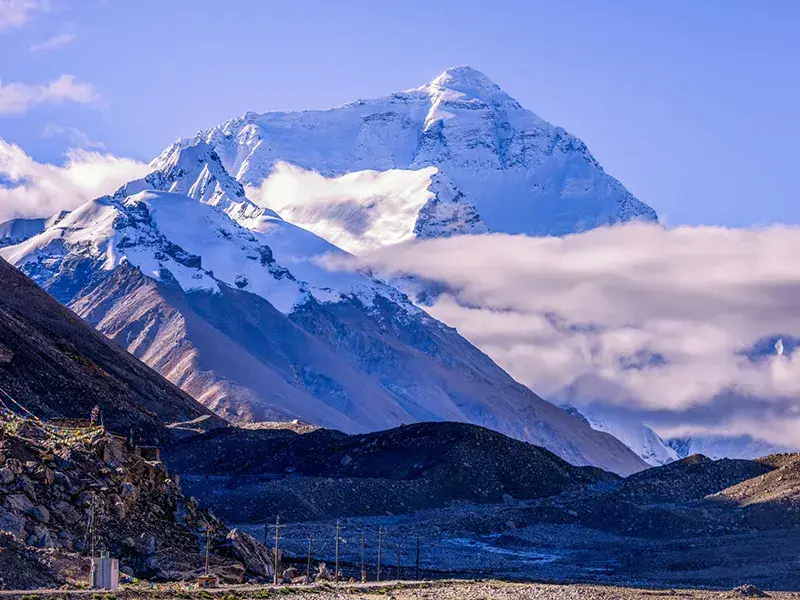
- Gawula Pass (Viewing Platform): Arrive around 2-4 PM. This is the world's only pass where you can simultaneously view four 8000m+ peaks (Makalu, Lhotse, Everest, Cho Oyu). Use a 70mm+ lens, with the winding "108 switchbacks" as foreground and the snow mountain range as background—visual impact is unreal.
- Everest Monument (8848.86m): Base camp's core photo spot. Around 7-8 PM (varies by season), at sunset, golden sunlight hits Everest's north face—this is the awe-inspiring "golden mountain." Shoot from a slightly crouched angle, looking up, to frame the monument and main peak together.
- Base Camp Black Tent Area Stream Bank: If you're lucky and it hasn't dried up, morning or evening you can capture Everest's reflection in the water—very quiet and sacred.
💬 Classic Questions Asked 800 Times (FAQ)
- Q: Can a sedan really drive to Everest?
- A: Yes. The roads are very well built now. However, it's extremely not recommended. There are many zone speed cameras along the way, and occasional rockfall or road subsidence with gravel. Sedans have low ground clearance—if you hit the oil pan in a remote area, you're stuck. Plus, sedans have low seating position—long bumpy rides are brutal on your back.
- Q: Will I definitely get altitude sickness at Everest? Do I need to bring oxygen?
- A: At 5200m, 90% of people will have some degree of headache and chest tightness. This is normal. Buy portable oxygen cylinders at a Lhasa pharmacy before departing (about 15-20 yuan each), 2 per person. If you're on our custom off-road vehicle, we carry hospital-grade large steel cylinders of medical oxygen—that's what truly works.
- Q: Can I bring a 7-year-old child or 60-year-old elder?
- A: If they've been in Lhasa and Shigatse for 3+ days with no discomfort, they can go. But absolutely do not overnight at base camp! After sunset, immediately descend to Tashizom Township for accommodation. Life is no joke—lower altitude sleep allows the body to recover quickly.
🪵 Written at the End—Your Scenery Is Already on the Way
Everest isn't an ordinary destination. It asks you to pay a physical price in exchange for a lifetime of visual awe. Choose the right transportation, and half the journey is already won. Don't waste energy arguing with unlicensed drivers or suffering in a stuffy bus.
Exploring these hardcore Tibetan routes alone is indeed exhausting—just getting the border pass, picking a reliable vehicle, and planning altitude retreat routes can cost you sleepless nights. If you can't be bothered to plan, or want to customize a no-rush, pure-enjoyment, safe off-road small group, message our route designers anytime (1V1 customization). Reliable vehicles, trustworthy drivers—we'll be waiting for you in Lhasa.
Updated: June 2026 Author: RoamFun Senior Travel Consultant Questions welcome: vip@roamfun.net
Craving a worry-free yet free-spirited journey?
Don't want to plan it yourself? Contact our senior trip designer now for a route and quote tailored to you.

RoamFun Senior Travel Consultant
Travel DesignerProfessional travel consultant, curating the most practical travel guides for you.