Leshan Giant Buddha Cultural Deep-Dive: It's More Than Just a 71-Meter Buddha
The mountain is a Buddha; the Buddha is a mountain.
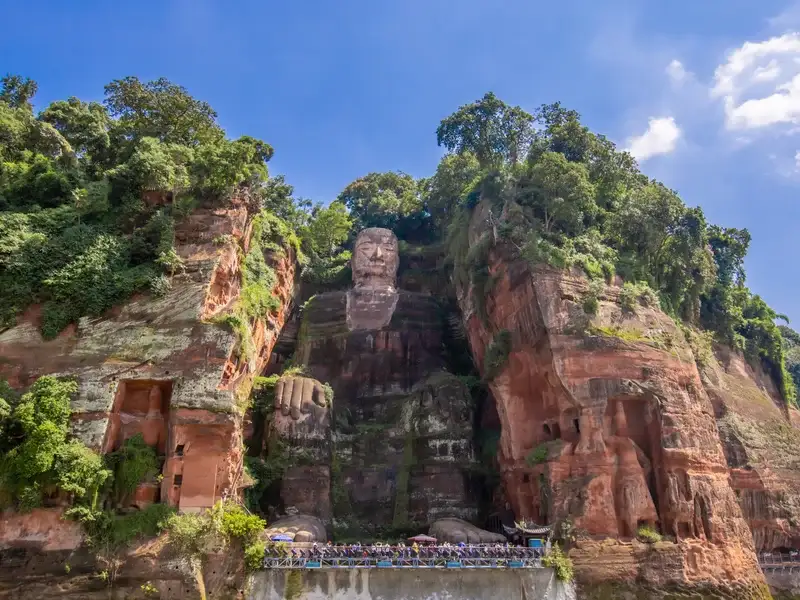
The Leshan Giant Buddha was carved from a cliff face beginning in the first year of the Kaiyuan era of the Tang Dynasty (713 AD). It took 90 years and three generations of craftsmen. At 71 meters high—if that doesn't compute, remember this: its ear canals can fit two adults standing shoulder to shoulder, and its instep could host a mahjong table. But what makes Leshan truly compelling isn't the scale—it's how you look at it and what you eat afterward.
This isn't a Wikipedia entry. This is what you learn after visiting several times.
🗺️ Leshan One-Day Highlights
| Time | Activity | Focus |
|---|---|---|
| 8:00 | Arrive at North Gate | The earlier the better—beat the tour buses |
| 8:30-10:00 | Descend the Nine-Turn Plank Path to Buddha's feet | Best window: fewer people + great light |
| 10:00-11:30 | Lingyun Temple + Steles + Dongpo Pavilion | History behind the Buddha |
| 11:30-12:30 | Lunch: crossed-leg beef | Leshan's culinary soul |
| 13:00-14:30 | Eastern Buddha Capital / Wuyou Temple | Pick one—details below |
| 15:00-16:00 | Three Rivers Confluence viewpoint | Min, Qingyi, and Dadu rivers converge |
| 16:30 | Wrap up, or take a river cruise | A completely different perspective |
🏛️ Four Ways to See the Buddha
Each reveals something completely different.
Method 1: Nine-Turn Plank Path (Classic)
Descend from the Buddha's right shoulder to its feet along a cliffside plank path carved into Lingyun Mountain. Wide sections fit two abreast; narrow sections require turning sideways.
Key advice:
- Be at the gate at 8 AM sharp: The plank path is the bottleneck. Peak season queues start at an hour. At 8 AM, you might share it with only a few early-bird foreigners.
- Top to bottom only: You enter at Buddha-head level and descend. No going back up.
- Linger at the feet: Looking up at 71 meters from the base is the only way to truly feel its scale. The Buddha's toenail is bigger than your hand.
- ~40 minutes total (without queueing).
Method 2: River Cruise (Easiest)
Board from Leshan Port. The boat cruises to the Three Rivers Confluence and pauses directly in front of the Buddha for 3-5 minutes.
Pros: Full Buddha view + the mountain itself resembles a reclining Buddha from a distance (Lingyun Mountain's silhouette looks like a lying Buddha, with the Giant Buddha positioned exactly at its heart). Cons: Only a distant river-level view—no "standing at the feet" intimacy.
RMB 70/person. ~40 minutes total.
Method 3: Overhead Shot (Special Angle)
From the platform to the Buddha's right, look straight down. You'll see the 1,051 spiral hair coils atop its head—each individually carved. The ancient craftsmen designed an ingenious drainage system: the grooves between the coils are hidden water channels.
Method 4: Guided Tour (Deep Dive)
The details are in the guide's explanation:
- The Buddha's ears and nose are actually made of wood (not stone), covered in plaster. The cliff rock was too poor at those positions, so the craftsmen used wood-core plaster technique.
- The robe's folds are actually drainage channels—rainwater flows along them rather than pooling on the Buddha.
- The real purpose was "taming the waters"—the Three Rivers Confluence created deadly rapids during flood season, causing frequent shipwrecks. Monk Haitong's Buddha project was essentially a hydraulic engineering work: excavated rock filled the river, altering the currents.
Hire a guide (RMB 100) or rent the audio tour (RMB 20). Without one, the Buddha is just a big rock.
🗿 Eastern Buddha Capital: There's Another Mountain Behind the Buddha
Eastern Buddha Capital sits in the rear hills of Lingyun Mountain, a stone-carved Buddha-themed scenic area within the same park system as the Giant Buddha. Yet 90% of visitors leave after seeing the main Buddha.
Highlights:
- Reclining Buddha: 170 meters long, the world's largest cliff-carved reclining Buddha. Honestly, the full view is hard to see due to its position.
- Ten Thousand Buddha Cave: A cave full of Buddha statues—Burmese and Chinese styles mixed, with a curious aesthetic tension.
- Underground Palace: Three subterranean levels tracing the Buddha's life from birth to nirvana in stone carvings.
Worth it? If you're genuinely interested in Buddhist sculpture art, yes. If just sightseeing with limited time, skip.
Tickets: RMB 80 (combined ticket discounts with Giant Buddha area).
🏯 Wuyou Temple: Where the Real Zen Is
Wuyou Temple sits on Wuyou Mountain across from Lingyun Mountain, a hundred times quieter than the Giant Buddha zone. Built in the Tang Dynasty, contemporary with the Giant Buddha, it's one of the "Four Great Buddhist Monasteries of Sichuan."
Highlights:
- Thousand-year-old temple, zero commercialization, monks chant daily
- The best Three Rivers Confluence panorama—better angle than the Lingyun Mountain viewpoint
- No admission fee (donation box only)
How to get there: Exit the Giant Buddha area south gate, walk 1.5 km along the river, cross an ancient stone bridge. This path has almost no tourists—river breeze, very pleasant.
🌊 Three Rivers Confluence: Leshan's Foundation
From the viewpoint atop Lingyun Mountain, watch the Min River (slate-gray), Qingyi River (jade-green), and Dadu River (muddy-yellow) converge below. Three colors entwined, sharply distinct—Leshan's most under-appreciated natural spectacle.
Best viewpoint: "Jingxiu Pavilion" to the right of Lingyun Temple. Wider view than the paid observation deck, no jostling for position.
Flood season vs. dry season: July-August, all three rivers roar at full volume, spectacular. December-February is dry season—the Buddha's feet fully emerge above water (flood season high water can reach the ankles).
📅 When to Visit
| Season | Rating | Why |
|---|---|---|
| Mar-May | ⭐⭐⭐⭐ | Spring flowers, green rivers, one of the best seasons |
| Jun-Aug | ⭐⭐⭐ | Rainy season + summer crowds, but rivers at their most dramatic |
| Sep-Nov | ⭐⭐⭐⭐⭐ | Clear autumn skies, highest visibility, best season |
| Dec-Feb | ⭐⭐⭐ | Fewest people, but overcast, heavy river mist |
Time of day: Morning at 8 AM for the scenic area (eastern light, Buddha's face well-lit). Afternoon for the river cruise (front-lit photos from the water).
🍜 What to Eat in Leshan
Leshan is a Sichuan cuisine stronghold and the birthplace of crossed-leg beef. All recommended spots verified by locals:
1. Crossed-Leg Beef (Qiaojiao Niurou) "Gushixiang" in Suji Town is the most famous, but swarmed by tourists. Locals prefer "Feng Sinang Qiaojiao Niurou" (Jiaxing Road branch)—richer broth than Gushixiang. Order crossed-leg beef + blood tofu + steamed beef with rice flour, ~40-60 RMB/person.
Correct eating method: sip the broth first (simmered with 20+ Chinese herbs), then dip in dry seasoning (chili powder + Sichuan pepper powder + salt). Don't pour the chili into the soup.
2. Sweet-Skin Duck (Tianpi Ya) Leshan specialty. Try "Zhao Yazi" (Old Park branch) or "Ji Liuniang." Duck skin coated with an amber sugar glaze—eat hot for crispy skin, tender meat.
3. Tofu Pudding (Doufunao) Completely different from the northern version—tofu pudding + steamed beef + fried noodles + peanuts + chili oil. Try "You Feichang Doufunao," a long-established shop.
4. Pot-Skewered Chicken (Boboji) "Ye Popo Boboji" is Leshan's most famous, but locals prefer "Jiazhou Jiumei." The red-oil base is more classic than the Sichuan pepper base.
🛏️ Where to Stay
Leshan is compact—one day is enough, overnight usually unnecessary. But if staying:
- Riverside hotels (300-500 RMB): River-view rooms overlooking the Min River nightscape
- Old town guesthouses (150-250 RMB): Old Leshan character, close to food streets
High-speed train from Chengdu East to Leshan takes ~50 minutes—day trip is completely doable. Driving: ~1.5 hours.
💬 What Do Our Travelers Say?
"I've been to the Leshan Giant Buddha three times now, each visit completely different. The first time was a high school tour group rush. The second time was on my own, taking it slow. The third time was with my parents. Following our recommendation advice, we descended the Nine-Turn Plank Path to the Buddha's feet. Looking up at those 71 meters, I almost cried—the feeling can't be captured in photos. I strongly recommend everyone come at least once, and stand at the Buddha's feet looking up." — Hangzhou Lin Jie ⭐⭐⭐⭐⭐
"What surprised me most about Leshan wasn't the Buddha—it was the food! The crossed-leg beef in Suji Town made me question all the versions I'd had before. We followed our recommendation advice and went to Feng Sinang's place. The broth was so rich it could coat a bowl—first time I'd seen beef soup with such depth. Then Zhao Yazi's sweet-skin duck and the tofu pudding—gained three pounds in three days in Leshan. A city that perfectly merges Buddhist culture with everyday street life—so rare." — Beijing Ah Tao ⭐⭐⭐⭐⭐
Leshan Is Not a Place to "See" the Buddha—It's a Place to "Meet" Him
Among China's giant Buddha carvings, Leshan isn't the most exquisite (Yungang and Longmen win on craftsmanship), but it's the most awe-inspiring—because it sits at the Three Rivers Confluence, feet in the rushing waters, has been sitting for 1,300 years. The moment you stand at its feet, history and the river both flow toward you.
But Leshan is more than a Buddha. This is the birthplace of Suji crossed-leg beef, sweet-skin duck, and tofu pudding—the thousand-year living spirit of ancient Jiazhou city. Visit Leshan, see the Buddha, eat the food, savor the culture—three things, none can be missed.
Want a stress-free and free-spirited journey?
Don't want to plan? Contact our senior travel designers now for your custom itinerary and quote.
Last updated: July 2026 Author: RoamFun Senior Travel Consultant Questions? Reach us at: vip@roamfun.net
Craving a worry-free yet free-spirited journey?
Don't want to plan it yourself? Contact our senior trip designer now for a route and quote tailored to you.
RoamFun Senior Travel Consultant
Travel DesignerProfessional travel consultant, curating the most practical travel guides for you.