
Spent 400 Yuan on "Local Specialty" at Jiuzhaigou's Entrance—Turned Out to Be Six-Month-Old Pre-Made Meals. Read Before Ordering
The restaurants lining Jiuzhaigou's entrance—honestly, seven out of ten are tourist traps. Menus boast "Authentic Tibetan Yak Hot Pot 198/person"—the broth is seasoning packet mixed with water, the meat is frozen yellow beef of unknown age.
But is there really no good food at Jiuzhaigou? There is. Good food is in those places with no English menu, where the owner is a Tibetan auntie, tucked away on the town's edge. I've been to Jiuzhaigou 20+ times and eaten my way through them all.
🚙 Veteran's Straight Talk: Avoid Restaurants at the Scenic Entrance
One big principle—the street facing Jiuzhaigou's main gate is called "Goukou Commercial Street." Over 30 restaurants on this street—my unscientific count: about 25 cater to tourists, 5 serve locals.
Tourist trap features are obvious: touts at the door, menus in Chinese-English-Korean, prices generally double the city. Local spots are harder to find—signs maybe only in Tibetan and Chinese, narrow storefronts, remote locations—but taste and price are honest.
| Dining Scenario | Recommended Area | Characteristic |
|---|---|---|
| Eat near scenic area | Zhangzha Town (3km from entrance) | Local gathering area, fair prices |
| Most authentic experience | Songpan Ancient City (90km from entrance) | Yak meat paradise, millennium-old city |
| Staying at entrance, don't want to travel | Goukou back alleys | Find Tibetan-run small shops |
🗺️ All Worthwhile Jiuzhaigou Area Eats Marked
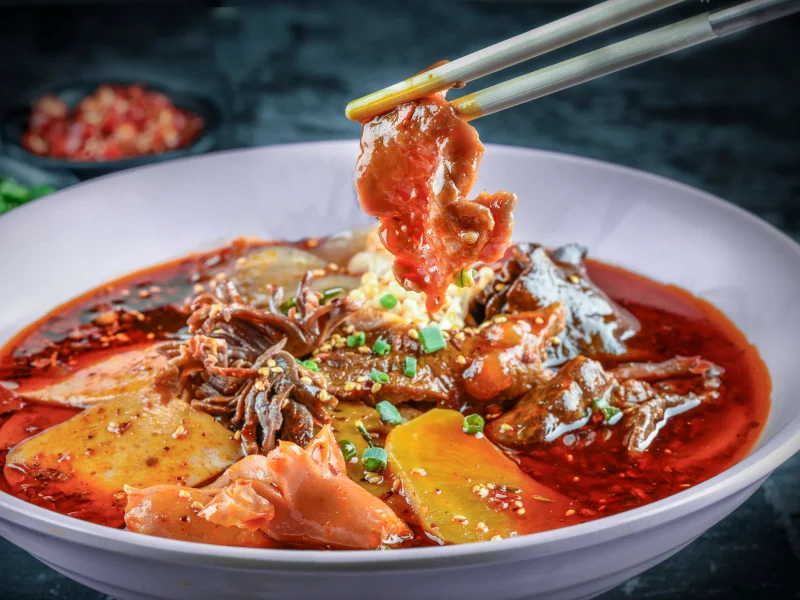
🥩 Yak Beef—Jiuzhaigou's Soul Ingredient
Coming to Jiuzhaigou without eating yak is like not coming at all. How to tell real from fake? Remember two things—
First, real yak beef muscle fibers are coarser than yellow beef—sliced, you can see visible white membrane texture. Yellow beef is tender but lacks chew; yak has chew but isn't tough. Second, yak beef broth is milky white with a natural meat aroma—not the artificial fragrance of seasoning packets.
- Veteran's recommendation: In Zhangzha Town, a Tibetan-run yak soup pot shop—small storefront, owner named Cairang. Yak delivered fresh from pasture every morning, broth simmered 7-8 hours with bones. Per person 80, eat till stuffed. Located on Zhangzha Town main road, turn west into a small alley, red sign, often a Tibetan mastiff tied outside (doesn't bite, don't worry).
- Anti-scam: Those lavishly decorated Tibetan restaurants at the entrance—a plate of "yak beef" for 188—likely frozen yellow beef. Real yak in Jiuzhaigou costs 60-100 per person.
🫕 Tibetan Clay Pot Hot Pot—100 Times Better Than Regular Hot Pot
Tibetan clay pot hot pot is completely different from Sichuan hot pot. The pot is ceramic with a chimney-like charcoal tube in the center. Broth is yak bone-simmered, piled with yak slices, plateau potatoes, wild mushrooms, tofu, and glass noodles. No dipping sauce needed—the broth alone is memorable all day.
- Note: Authentic Tibetan clay pot comes with pre-arranged ingredients—not for dipping. Everything is already cooked through—you just fish and eat.
- Veteran's advice: Have clay pot in winter at Jiuzhaigou—outside minus 10, inside around the charcoal pot drinking hot broth—that happiness is unavailable in any five-star hotel.
🍛 Tibetan Fried Rice—20-Yuan Surprise
A shop I found beside Zhangzha Town market—the owner is a Tibetan auntie who speaks only basic Mandarin. Her Tibetan fried rice is stir-fried with butter, adding yak minced meat, barley grains, and scallions, sprinkled with tsampa flour before serving.
- Itinerary tip: Don't buy 50-yuan "yak fried rice" at the scenic entrance. Authentic Tibetan fried rice doesn't use regular rice—it's stir-fried with barley and tsampa, completely different texture and aroma.
- Veteran's advice: Pair fried rice with butter tea—perfection. Butter tea may taste gamey on first sip, but by the second you can't stop. On the plateau, butter tea is excellent—warms the stomach, replenishes energy, prevents altitude sickness.
🐟 Cold-Water Fish—Only Available Around Jiuzhaigou
Jiuzhaigou's alpine cold-water fish, scientifically "Plateau Naked Carp," is unique to the upper Minjiang River. Firm texture, almost no fishy flavor—excellent steamed or in soup.
However, due to ecological protection in recent years, many areas prohibit fishing. If you see "Wild Jiuzhai Cold-Water Fish 288/fish" on a menu—it's almost certainly fake—either not wild, or not this species.
- Veteran's advice: If you want to try, find restaurants with aquaculture licenses. Songpan Ancient City has several chain fish restaurants using farmed cold-water fish—similar taste, much fairer prices.
🎒 Practical List: What to Eat and Avoid at Jiuzhaigou
⚠️ Don't say I didn't warn you: Those "Tibetan Song & Dance Banquet + Buffet" packages at the entrance—200-300 per person, lip-synced performances, mass-produced buffet food. This isn't dining—it's an IQ tax. For good food, walk to the back alleys yourself.
- Must eat: Yak soup pot, Tibetan clay pot hot pot, butter tea, Tibetan fried rice, barley cake
- Try: Butter tsampa (Tibetan daily staple, sesame-paste-like texture), ginseng fruit yogurt
- Order with caution: Entrance "wild fish," suspiciously cheap "yak beef," song-and-dance banquet packages
- Don't touch: "Yak skewers" from tricycles at the entrance—likely duck or pork impersonating yak
- Bring yourself: Buy water and dry food in Zhangzha Town before entering the scenic area—you know the prices inside
💡 Heart-to-Heart Truths
Jiuzhaigou's best yak beef isn't at the entrance—it's in Songpan. 90km north of Jiuzhaigou, Songpan Ancient City has an "Amdo Yak Restaurant"—no sign, no online reviews, not even a proper menu. The owner asks what you want, you say "soup pot," he goes to the kitchen and freshly cuts yak, 20 minutes later serves a pot of milky-white broth. The best yak beef I've had in western Sichuan.
An easily overlooked thing—roadside stalls selling barley cakes toward Zhangzha Town from the entrance—5 yuan each, freshly griddled, crispy outside, soft inside. Buy two before entering the valley—100 times better than instant noodles inside. But eat them hot—they harden when cold.
If you're on a tour group, the "partner Tibetan restaurant" your guide takes you to is likely giving kickbacks. Not that you can't go, but be aware—of the 200-300 per person yak hot pot, at least half is the guide's commission. To save money, eat on your own—Jiuzhaigou isn't impossible to walk around.
📸 Food Photography
- Tibetan clay pot hot pot: Steaming when served—phone portrait mode close-up, broth steam and ingredient colors create great texture. Bokeh the background, keep only pot and steam.
- Butter tea: Tibetans drink butter tea from dark wooden bowls—golden butter tea poured in, side lighting, oil-painting quality.
💬 What RoamFun Travelers Say
"Jiuzhaigou's scenery was amazing, but entrance food was disappointing. Glad I read this guide before departure—taxied straight to Zhangzha Town, that Tibetan clay pot hot pot blew away all six of us, 90 per person." — Shanghai, A Wei ⭐⭐⭐⭐⭐
"Found that Amdo Yak Restaurant in Songpan! Not easy to find, but asked a local uncle. That yak soup pot was the freshest broth I've ever had—went in winter, warmed my whole body after drinking." — Guangzhou, Xiao Ya ⭐⭐⭐⭐⭐
Scenery Feeds the Eyes, Food Feeds the Stomach
Jiuzhaigou's beauty is awe-inspiring, but beyond the entrance street, you'll find another kind of awe—Tibetan culinary traditions lasting centuries, not packaged "specialty food" but what locals make in their own kitchens daily.
Take time to find those shops without English menus—what you eat is far more than a meal.
Don't want to research where to eat, how to avoid traps?
Leave Jiuzhaigou food exploration to us—20-year Sichuan veterans take you to the most authentic, avoiding all tourist traps.
Updated: July 2026 Author: RoamFun Senior Travel Consultant Questions welcome: vip@roamfun.net
Craving a worry-free yet free-spirited journey?
Don't want to plan it yourself? Contact our senior trip designer now for a route and quote tailored to you.

RoamFun Senior Travel Consultant
Travel DesignerProfessional travel consultant, curating the most practical travel guides for you.