
Kaiping Diaolou & Chikan: Tickets, Which Village to See & How to Plan a Day
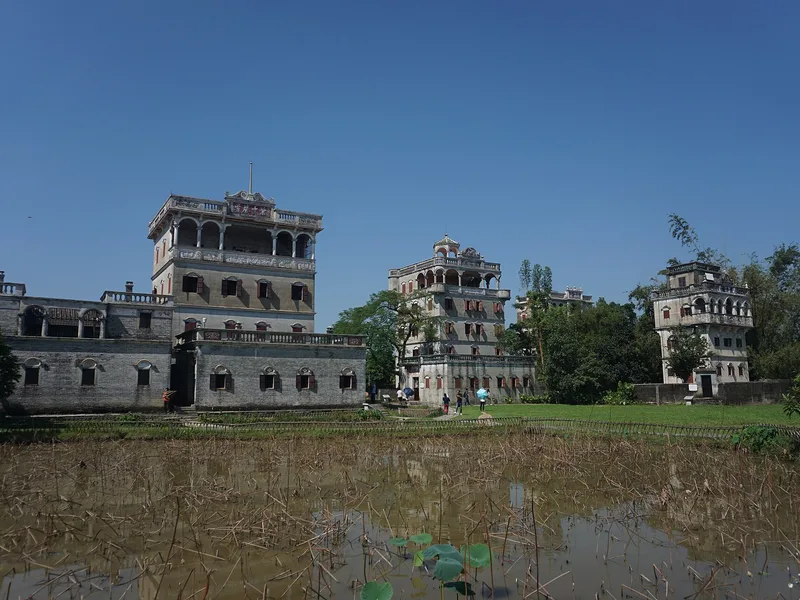
The Kaiping diaolou carry more weight than anything else on this Guangdong route — they're a UNESCO World Heritage site, and one of the few heritage-grade landmarks Guangdong has. These multi-storey defensive towers, scattered across rice fields and bamboo groves, were built by emigrants who returned home. Part fortress, part statement, they mix Roman columns and arches with Chinese roofs in a way that looks genuinely strange.
They're also very easy to misunderstand. The towers are spread over several villages, each ticketed separately, and plenty of visitors drive in, stop at one village at random, photograph two towers and leave, then decide it was "nothing special".
This guide covers how the ticketing works, how the villages differ, whether Chikan is worth the time, how to get there, and how many days to allow.
The key point first: the diaolou are scattered, not one gated park with a cluster behind one entrance. Decide which villages you're going to before you set off, rather than driving around guessing.
🏰 What the diaolou are
- Status: World Heritage, a type of multi-storey defensive dwelling unique to the Kaiping emigrant region
- Background: built from the late Qing into the Republic era by emigrants who returned from overseas, designed against banditry, mixing Chinese and Western architecture
- Scale: over a thousand towers survive in Kaiping, spread across villages and towns
- What to look at: not only the towers themselves, but their relationship with the rice fields, villages and bamboo — they were built to stand in the fields
🎫 Tickets and the combination pass (confirm on official channels for the current year)
Kaiping operates a combination-ticket system, roughly as follows:
- Zili village cluster: about ¥50–78 per person (varies by channel and season), open about 08:30–17:30
- Li Garden: about ¥80
- Jinjiangli cluster: about ¥50
- Chikan film studio: about ¥30
- Combination ticket: commonly about ¥180, covering several of the above, valid for two days (exact composition and price follow official notices)
How to buy sensibly:
- Only seeing Zili: buy the single-site ticket
- Two or more sites: the combination pass is almost always cheaper, and being valid two days means no rushing
- Only half a day: Zili alone is enough — don't be greedy
📍 How the villages differ
- Zili village: the top recommendation, essential on a first visit. Fifteen heritage towers stand together in rice fields, and Mingshi Tower can be entered. It's the best place both for photographs and for feeling the scale of a "tower cluster"
- Li Garden: a private garden villa, a Chinese-Western hybrid residence. A different thing from the towers — people who like gardens and architectural detail will enjoy it
- Jinjiangli: a well-preserved village with Rui Shi Lou as its best-known tower, and fewer visitors than Zili. Good if you want quiet
- Majianglong: backed by bamboo with a pond in front, the prettiest setting of all, favoured by photographers
My ranking: Zili first, then Jinjiangli or Majianglong, with Li Garden depending on your interests. If you only have time for one, make it Zili.
🏘️ Is Chikan old town worth it
- What it is: an emigrant-region arcade town built along the Tan River, recently renovated and reanimated
- What to see: the arcade buildings, the long covered walkways beneath them, the riverside, emigrant culture
- Who it suits: people who like slow wandering, photography, and finding somewhere to eat
- Caution: it is a different thing from the diaolou — the towers are out in the fields, Chikan is a town on the river. Don't assume that visiting Chikan means you've seen the towers
My verdict: add it if you have time, skip it if you don't. What's good about Chikan is the atmosphere and the completeness of its arcade streets — but it isn't the diaolou themselves.
🗺️ How to plan it
Option 1: a day trip from Guangzhou
- 08:00 leave Guangzhou
- 10:00 arrive at Zili (allow two hours)
- 12:30 lunch in town (eel rice is the local dish)
- 14:00 Jinjiangli or Majianglong (1.5 hours)
- 16:00 Chikan arcades if there's energy left
- 17:30 drive back
Option 2: two days, one night (recommended)
- Day 1: Zili + Li Garden, stay in Tangkou or Chikan
- Day 2: Jinjiangli or Majianglong + Chikan, back in the afternoon
- Why it works: the combination pass lasts two days, so there's no rushing, and you can photograph the towers in the morning fields
🚗 Getting there
- Driving: Guangzhou → Kaiping is about 2–2.5 hours, and it's the recommended option (the sites are spread out; a car makes all the difference)
- Train plus taxi: Kaiping South station is reachable, then taxi or a hired car to the sites — but you still need a vehicle between them
- Hired car or day tour: the easiest answer if you don't want to drive
- From Shunde or Foshan: about 1.5–2 hours, so it links neatly with the food route
⚠️ Common mistakes
- Assuming the towers are one attraction, then discovering they're spread over several villages
- Judging the place after one village — the different villages feel quite unlike each other
- Trying four sites in one day and spending it all on the road
- Visiting two or more sites on single tickets, which costs more than the pass
- Thinking Chikan counts as seeing the diaolou, then realising the towers were elsewhere
- Arriving at midday — the fields have almost no shade and the light is flat for photographs
- No car and no hired driver — getting between the sites is genuinely awkward
🧭 Where it fits on the winter route
- Guangzhou (1–2 days): morning tea, old districts. See Cantonese Morning Tea Guide
- Foshan + Shunde (1–2 days): lion dance plus a city of gastronomy
- Kaiping (1 day): the diaolou and Chikan
- Zhuhai (1–2 days): the warm coast to finish. See Zhuhai Winter Coast Guide
Kaiping sits best in the middle: cities and food before it, coast and warm weather after, and emigrant history in between — the change of pace does the route good.
A few closing thoughts
What moves me about Kaiping isn't any single tower, it's their relationship with the rice fields. You stand on a ridge path in Zili, water and rice in front of you, a few grey towers behind, and on top of those towers a Roman dome mixed with a Chinese eave. That strangeness has a reason: these were people who left to work a century ago and brought the world they'd seen back to the village they were born in.
So my suggestion: don't treat them purely as a photographic backdrop. Get a guide or read up on the emigrant history first, then stand in the fields and look back at the towers — it's a completely different feeling.
On scheduling, two days and a night is the comfortable answer, and at the very least don't squeeze Kaiping into a "quick look on the way" — it's over two hours from Guangzhou, and if you come, come properly. Last reminder: the combination pass lasts two days, the sites are spread out, and a car helps enormously.
Craving a worry-free yet free-spirited journey?
Don't want to build the itinerary yourself? Talk to our senior travel designers and get a route and quote built for you.
Get your free route plan and quote
Last updated: October 2026 Author: RoamFun Senior Travel Consultant Questions welcome at: vip@roamfun.net

RoamFun Senior Travel Consultant
Travel DesignerProfessional travel consultant, curating the most practical travel guides for you.