The Truth About 'Must-Drive G318': Don't Blindly Set Off for Tibet as a Beginner
"The drive of a lifetime on the 318" — you've seen this phrase on TikTok, Xiaohongshu, and your friends' circles over 100 times. The photos show Zeduo Mountain's golden sunrise, Maoya Grassland's wildflowers, and Ranwu Lake's snow mountain reflections. Every feed is a highlight reel, edited to cut out the fear, the cold, and the quiet panic at 4,800 meters.
But nobody shows you — the off-road vehicle that slid out on a Zeduo Mountain curve due to black ice, the tourist carried down from Dongda Mountain Pass due to altitude sickness, or the sedan with smoking brakes on the Nu River 72 Bends. Nobody shows you the two-hour queue at the only gas station in a county, the passenger who quit at Litang because the altitude crushed their spirit, or the tow truck that re-invoices your "drive of a lifetime" at a rate you didn't budget for.
The 318 is beautiful. But the price behind that beauty — the triple test of body, vehicle, and wallet — you'd better know it all before departing. This isn't a scare piece; it's the reality check the marketing never sends. Read it once, and you can decide whether to drive it, join a convoy, or fly to Lhasa and drive the easiest stretch — all legitimate, all wonderful, if you choose with open eyes. The 318 doesn't require everyone to be a hero; it only requires everyone to be honest about what they're taking on. The people who regret the trip are never the ones who prepared too much — they're the ones who believed a hashtag and packed a tank of wishful thinking. This guide is that wishful thinking's antidote, written so your first 318 is your best one, and your arrival at Lhasa is a beginning, not a rescue.
🚙 Honest Advice: The 318 Isn't an Ordinary Road Trip — It's an Extreme Crossing
The G318 Sichuan-Tibet Highway spans 2,200km, crossing 14 mountain passes above 4,000m. Before Everest Base Camp, this was the world's highest-average-altitude highway. Calling it a "road trip" is like calling a marathon a "walk" — technically true, dramatically misleading.
On flatland long-distance drives, when you're tired you just rest at a service area. On highland long-distance drives — you're tired because your blood oxygen is dropping. Above 4,000m, blood oxygen is only 60% of lowland levels; reaction speed, judgment, and attention all decline comprehensively. You're not just tired; you're mildly impaired, and the road around you is still doing its worst.
The Prado + experienced driver combination is the optimal solution proven over a decade on the 318. High ground clearance handles rough roads, 4WD crosses icy passes, and spacious interior prevents long-drive fatigue. The experienced driver knows which section is most dangerous during rainy season, which pass is safest to cross at what time — this information comes from dozens of trips, not from GPS navigation. It's the difference between reacting to the road and knowing it before you reach it.
🗺️ 318 Truths, One by One
Altitude Sickness Truth: It's Not About Whether You Can Handle It — It's About Giving Your Body Time
The core determinant of altitude sickness isn't your physique — it's the speed at which you ascend from low to high altitude. Flying from Chengdu to Lhasa, you ascend 3,100m in 2 hours — your body can't react in time. Driving the 318, you climb from 500m to 3,650m over 8 days, and most people have almost no reaction. Ascending slowly is the most effective altitude sickness prevention strategy. Keep daily altitude gain to 300-600m, and choose low-altitude county towns for overnight stays. The travelers who suffer most are rarely the weakest — they're the ones who rushed.
Road Condition Truth: Good and Bad Roads Alternate, but the Bad Parts Are Genuinely Bad
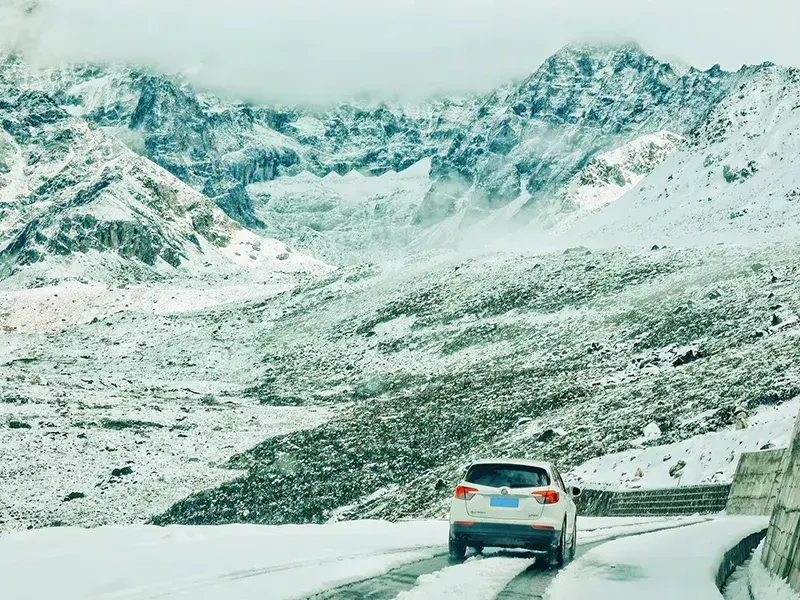
Most of the 318 is paved, but the Markam-Zuogong section, Haizi Mountain section, and Nu River 72 Bends — washboard roads, gravel, and black-ice curves are a sedan's nightmare. During rainy season (June-August), landslides and mudslides are daily occurrences; in winter (November-March), black-ice sections are 10 times longer than in summer. The good stretches lull you into speeding; the bad ones punish you for it. Drive the asphalt like it's asphalt, and brake the moment the surface changes.
Cost Truth: Carpooling Is Actually Better Value Than Driving Yourself
True cost of self-driving the 318: fuel ~1,800 RMB + vehicle wear and depreciation at least 2,000 RMB + towing from 5,000 RMB if needed. That's not counting the mental cost of worrying about road conditions. Carpooling a Prado for 8 days costs 2,500-3,500 RMB per person — someone else handles all road conditions while you enjoy the scenery. If you don't own a vehicle built for this road, the "cheaper to drive myself" math usually falls apart the moment the undercarriage scrapes.
Gear Truth: 90% of "Tibet Travel Gadgets" Are Useless
Before departure, you frantically shop online — vehicle oxygen generators, satellite phones, rooftop tents. After the trip, you find the most useful items were ibuprofen (headache), thermos (hot water), and glucose (energy). Everything else sat untouched in the trunk the whole way. The 318's most reliable gear is boring: hydration, warmth, and a clear head. Spend your gadget budget on a good jacket and a second spare instead.
🎒 What You Actually Need
⚠️ Don't say I didn't warn you: Catching a cold on the plateau = high risk of pulmonary edema. Recover from any cold before departing. If you develop fever or cough on the road, descend immediately and see a doctor — don't tough it out at altitude.
- Ibuprofen + glucose + cold medicine + montmorillonite powder
- Windbreaker + fleece + light puffy jacket
- Lip balm + sunscreen + sunglasses
- Thermos + portable pulse oximeter
- ID card + small amount of cash
💡 Heart-to-Heart Advice
The 318 won't get easier just because you're passionate: The road is what it is — washboard where there's washboard, black ice where there's black ice, landslides where there are landslides. What you need to do is respect this road — ascend slowly, don't show off, and entrust safety to professionals.
The most beautiful scenery isn't at any viewpoint: The moment at Kazila Mountain when you see a sea of clouds surging up from the valley, the moment you honk at the Nu River Bridge to honor the road-building heroes, the moment you see pilgrims prostrating toward Lhasa by the roadside — none of these are in any guidebook's "must-see" list.
The most expensive costs on the 318 are towing and hospital bills: Pulmonary edema from altitude sickness, transported from the plateau back to the lowlands — costs start at 30,000 RMB. This "hidden expense" is more expensive than any gear. The cheapest insurance on this road is a slow ascent and a respect for the altitude.
🗓️ A Realistic Pace: How Many Days Does It Actually Take
The single most common beginner mistake is compressing the 318 into too few days.
- 8-day minimum (Chengdu→Lhasa): doable but rushed; you'll average 275km/day with a pass or two daily.
- 10-12 days: the sweet spot — buffer days for acclimatization, one rest day in Litang or Nyingchi.
- 14+ days: comfortable, room for detours like Tsopu Valley or a second night at Ranwu Lake.
Rule of thumb: The 318 punishes compressed schedules more than any other road. Every extra buffer day buys you protection against altitude, weather, and the slow truck you'll be stuck behind for 40 minutes at a pass. Budget generously; the mountains don't move for your flight out.
📸 Don't Just Snap Randomly — These Spots Are Stunning
- Kazila Mountain sea of clouds: Before 9 AM, clouds rolling beneath your feet with Genye Holy Mountain faintly visible in the distance.
- Sister Lakes: 5km down from Haizi Mountain roadside — two adjacent glacial lakes, deep blue.
- Nu River 72 Bends: 4-5 PM side light, switchbacks in clear light and shadow.
- Ranwu Lake: dawn mirror reflection — the single most photographed scene on the route, for good reason.
💬 What RoamFun Travelers Say
"Was brainwashed by TikTok into thinking the 318 was an easy drive. After reading this 'truth' piece, decided not to self-drive — later at Haizi Mountain, saw a sedan's undercarriage scraping on the washboard road." — Xiaoliu, Wuhan ⭐⭐⭐⭐⭐
"Spent over 2,000 RMB on various 'Tibet gadgets' — turned out the most used were ibuprofen and a thermos. The rest came back unopened." — Xiaolin, Nanjing ⭐⭐⭐⭐
"I flew to Lhasa and drove only the easy stretch, and honestly — I loved it. This guide's honesty let me enjoy the 318 without pretending to be a hero. Respect the road, choose your own pace." — Yan, Chengdu ⭐⭐⭐⭐⭐
The 318 Awaits You — But You Must Respect It
The 318 won't go easy on you just because you shouted "drive of a lifetime." Altitude sickness will still happen, black ice will still be there. But if you respect it — ascend slowly, don't show off, put safety first — it will give you the most magnificent scenery of your life. The highway doesn't negotiate, but it does reward the careful.
The travelers who love the 318 aren't the ones who conquered it; they're the ones who let it teach them something. It teaches patience at every pass, humility at every black-ice curve, and gratitude at every mountain vista you weren't sure you'd reach. Whether you drive it yourself, ride shotgun with a veteran, or fly to the easy stretch, the 318 has a version for you — as long as you come to it honest, slow, and prepared. The road will be there. Be the kind of traveler it deserves.
There's a quiet difference between the traveler who finishes the 318 and the one who merely survives it — and it's not how fast they went or how many passes they bagged. It's whether they came home with the same nervous urgency they started with, or something slower and steadier in its place. The 318's real gift is that trade: it exchanges your impatience for perspective, your ego for awe, and your schedule for the season. Give it your respect and your prep, and it gives back a trip that doesn't end at Lhasa — it follows you home. That's the version worth driving for. Not the bragging rights, not the checklist of passes — the quiet, permanent change in how you see big roads and your own limits. The 318 hands you that in exchange for humility. It's the fairest trade on the plateau, and one you'll be glad you made every time a difficult road comes up in conversation for the rest of your life.
Craving a worry-free yet free-spirited journey?
Don't want to plan it yourself? Contact our senior trip designer now for a route and quote tailored to you.
Updated: August 2026 Author: RoamFun Senior Travel Consultant Questions? Contact us: vip@roamfun.net

RoamFun Senior Travel Consultant
Travel DesignerProfessional travel consultant, curating the most practical travel guides for you.