Tongmai Natural Barrier Then and Now: What G318's Former "Death Zone" Looks Like Today
Old Sichuan-Tibet Highway hands go quiet for a moment at the word "Tongmai." Not because Tongmai itself was terrifying—because that stretch of road claimed too many lives. For decades, mentioning Tongmai on the 318 was like mentioning a name no one wanted to say out loud: everyone knew someone, or knew someone who knew someone, who never made it past those 14 kilometers. The barrier wasn't a single hazard but a relentless stack of them — cliff, river, rockfall, and landslide, all at once, all the time. To understand Tongmai today you have to understand what it replaced, and why every local over fifty still lowers their voice when the bridge comes into view. The young see a smooth road; the old see the road that took their friends. Both are right, and that gap between what you see and what they remember is exactly where Tongmai's real story lives. Stand on the new bridge long enough and you start to feel it — the road beneath you is younger than the grief it replaced.
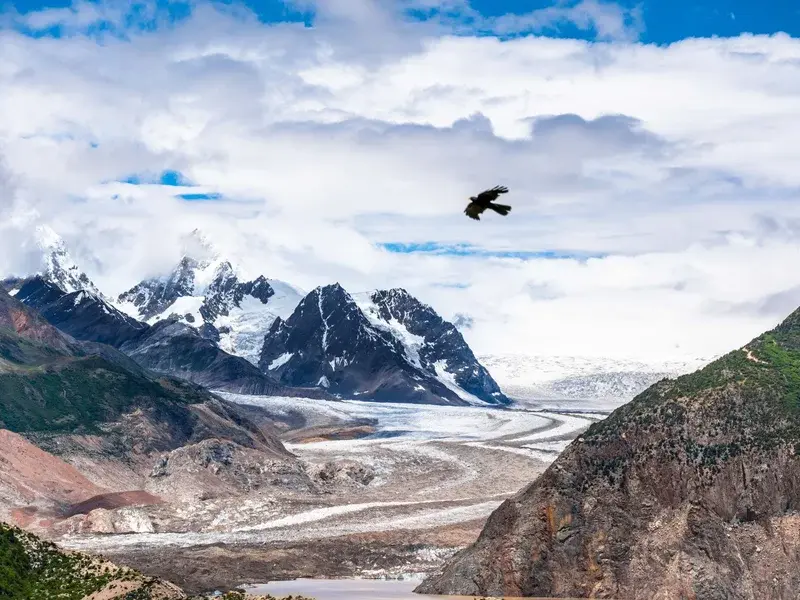
The Tongmai Natural Barrier sits between Bomi and Pailong, about 14 kilometers long. The road was carved into the cliff face along the right bank of the Palong Zangbo River—barely wide enough for a single large vehicle, with unstable shale overhead ready to collapse at any moment, and the raging river dozens of meters below. G318 was squeezed to its absolute limit here: river, cliff, and road all crammed together with zero buffer zone. In 2016, the Tongmai Grand Bridge and five tunnels fully opened. The natural barrier became history. But this stretch of road's significance goes far beyond those four words "barrier became highway"—it encapsulates half a century of the Sichuan-Tibet Highway's destiny, and the price paid to build it.
🌉 Three Generations of Tongmai Bridges
When you drive through Tongmai now, you cross a red suspension bridge—the Tongmai Grand Bridge. It's more than just a bridge; it's a living fossil of three generations standing side by side.
First generation (1950s): A wooden temporary bridge that shook even when people walked on it. Destroyed countless times by monsoon floods. Soldiers rebuilt it every dry season, only to watch the next flood take it again.
Second generation (2000): A steel-cable suspension bridge, single-lane one-way. Vehicles queued to cross. The bridge deck would bounce up and down under weight. In August 2015, the old bridge was destroyed by floods—G318 was severed for 45 days, and the only way across was a ferry that ran when the water allowed.
Third generation (2016): Today's Tongmai Grand Bridge, two lanes, 258-meter main span. Three generations of bridges stand together in the same gorge—the old bridge's cable towers still rise beside the new one, like silent tombstones marking how far the road has come.
When crossing the Tongmai Grand Bridge, look to the right—the white cable towers of the old bridge are still there. They haven't been dismantled. They're telling every passerby: this is how we once came through.
🛣️ Five Tunnels: Five Seals on the Barrier
The Tongmai Barrier wasn't just a bridge—it was 14 kilometers of danger strung together. The five tunnels that opened in 2016 each sealed off one of the five most lethal points on this stretch:
- Tongmai Tunnel (longest): Pierced through the most collapse-prone shale mountain. The old road over this hill took the brunt of every landslide season.
- Flying Stone Cliff Tunnel: Sealed off a bend where rocks rained down from above. Locals called this spot "Falling Rocks Eat Flesh"—a stone hitting your vehicle meant death or crippling injury.
- Little Tiger Mouth Tunnel: A narrow bend carved from the cliff face, the old road just 3 meters wide. When trucks passed, their outer wheels hung over the river below. Drivers counted the meters.
- Palong Tunnels 1 & 2: Pierced through two debris-flow gullies. During monsoon season, these gullies washed out the road every few days, stranding convoys for a week at a time.
New road or old road?: There's a turnoff on the east side of the Tongmai Grand Bridge that loops onto sections of the old road. But most of the old route is now blocked by rockfall—just viewing those abandoned cliff-edge roadbeds from a distance is enough. Standing at the rail and looking down at the broken concrete shelf where vehicles once crawled is the most sobering view on the entire highway.
📍 Stops Worth Making at Tongmai Now
Don't just floor it through Tongmai. These spots are worth braking for:
1. Tongmai Grand Bridge Viewpoint (east side): Simple pull-off area where you can see three generations of bridges side by side. Best light: morning front-light for the new bridge, evening backlight for bridge silhouettes. Bring a wide-angle lens—the historical weight of all three bridges comes through only when they're in the same frame.
2. Palong Zangbo River Gorge: The gorge narrows to its tightest, fastest point at Tongmai—only 30-40 meters wide, the water jade-green from glacial minerals. Stand on the new bridge looking down and you'll see whirlpools in the river's center, hear the deep rumble of the current.
3. Pailong Hot Springs: About 3 km past Tongmai, you reach Pailong Township. It has natural hot springs (RMB 20/person)—soaking in an open-air pool by the river while the Palong Zangbo thunders past. Nowhere else on the entire G318 offers this experience. After a long day of passes, the hot water against the cold river air is the kind of contrast you remember for years.
🪨 The Monument You Might Miss
Below the Tongmai Bridge, by the river, stands a small monument—the names of the armed police soldiers who died building the bridge and the road. It's easy to miss at 40km/h, but worth the stop. The 318 was built and held open by people who never drove it for pleasure. Their names are the reason the barrier is now a viewpoint instead of a graveyard.
🧭 Practical Info: Making the Most of Tongmai
- Best season to cross: May to October. Avoid the monsoon peak (late July–August) if you can — the Palong Zangbo runs highest then and the gorge viewpoints get spray. Spring and early autumn give clear water and steady light.
- How long to stop: Budget 45–60 minutes if you want the bridge viewpoint, the monument, and Pailong Hot Springs. Rushing it wastes the one stretch on the 318 where the history is visible, not just felt.
- Where to pull over safely: Use the east-side viewpoint only. The bridge itself has no stopping lane — never brake mid-span to look; the traffic behind you has no room to slow.
- Combine with: Pair Tongmai with a night in Pailong for the hot springs, then push to Bomi the next morning. It breaks a long driving day into two gentle halves.
💬 What Do Our Travelers Say?
"I first drove the Sichuan-Tibet Highway in 2013. Tongmai was still the old road. Fourteen kilometers took three hours, my palms soaked with sweat. In 2024 I brought my son—Tongmai was already bridges and tunnels. He said, 'What's so dangerous about this?' I told him, 'Every meter you're driving on now was paid for with someone's life.'" — Chengdu Lao Wang ⭐⭐⭐⭐⭐
"Below Tongmai Bridge, by the river, there's a tiny monument—the names of the armed police soldiers who died building the bridge. I stood there for five minutes. After crossing, I drove in silence all the way to Bomi before recovering. G318 isn't just scenery—it's countless people's sacrifice." — Chongqing Xiao Liu ⭐⭐⭐⭐⭐
"I soaked in Pailong Hot Springs at dusk, the river roaring past my shoulder. My grandfather built roads in Tibet in the 70s and never talked about it. That night I finally understood why he went quiet whenever Tongmai came up." — Shenzhen, An ⭐⭐⭐⭐⭐
Tongmai Hasn't "Passed Into History"—It's Become a Different Kind of Landscape
Tongmai is no longer dangerous. But every time you pass through, what you see is a condensed history of China's highway engineering: three generations of bridges side by side, abandoned roadbeds on the cliff, five tunnels piercing through the mountain. If you drove the old Tongmai, you'll go quiet. If you only heard about it in the news—stop and take a look.
The barrier didn't disappear; it was absorbed. The cliffs that killed are now the walls the tunnels cut through, and the river that took lives now powers the current you watch from a safe rail. Tongmai teaches a lesson the whole 318 repeats in different accents: the road is never just a road. It's a record of who came before, what they survived, and what they built so the next person could simply enjoy the view. Slow down here, not because the road demands it anymore, but because the history does.
The next time you cross the Tongmai Grand Bridge in comfort, remember that the white cable towers of the old bridge are still standing to the right — not as ruins, but as witnesses. They watched a generation of drivers hold their breath, and they watched the tunnels finally let everyone breathe. Tongmai didn't lose its weight when it lost its danger; it traded one kind of weight for another. The fear is gone, but the gratitude it earned is not. Drive on, and carry a little of that silence with you to Lhasa. The 318 has many beautiful stretches, but Tongmai is the one that asks something of you before it shows you anything. Give it the few minutes it deserves, and it gives back a perspective no other pass on this highway can — the quiet certainty that the road you're enjoying was once someone else's ordeal, and that's precisely why you get to simply drive.
Craving a worry-free yet free-spirited journey?
Don't want to plan it yourself? Contact our senior trip designer now for a route and quote tailored to you.
Updated: August 2026 Author: RoamFun Senior Travel Consultant Questions? Contact us: vip@roamfun.net

RoamFun Senior Travel Consultant
Travel DesignerProfessional travel consultant, curating the most practical travel guides for you.