G318 Rainy Season Survival Guide: Landslides, Mudslides, Black Ice — How to Safely Navigate June to September
Every year from June to September, the Sichuan-Tibet Highway enters its rainy season. This is when the G318 is at its greenest — grasslands spread like carpets, and snowmelt cascades down mountainsides in waterfalls. But it's also the most dangerous: torrential rain washing out roadbeds, rockslides blocking mountain passes, rivers overflowing bridges — last July, a single landslide near Tongmai shut down the road for three full days.
Traveling the G318 in the rainy season isn't impossible — but you need to be ten times more prepared than in the dry season. This guide spills everything I've learned from years of guiding guests through the rainy season: which sections will slide, how to read road conditions in advance, what to do if your vehicle gets stuck, and when to turn back. Every hazard below has a name, a location, and a practical response — because in a season where the road changes by the hour, the difference between a great trip and a rescue mission is almost always preparation, not luck.
Here's the mindset shift that matters most: in the rainy season, the 318 stops being a road you "drive" and becomes a river you "negotiate." You don't conquer it; you cooperate with it. The drivers who love this road in summer aren't reckless — they're readers. They read the clouds, the mud, the river levels, and the silence where a rockslide is about to happen. This guide gives you that reading ability, section by section, so you can enjoy the fierce green beauty of a summer 318 with the confidence of someone who knows exactly when to stop and when to go. Master these rules and the rainy season becomes a privilege, not a gamble. Knowledge is the best rain gear there is.
🚙 Insider Advice: In the Rainy Season, a Hardcore Off-Roader Isn't Showing Off — It's Essential
During the rainy season on the G318, road conditions change by the hour. A perfectly fine paved road from yesterday can turn into knee-deep mud after one heavy downpour. Sedans and city SUVs on the G318 in the rainy season are a gamble — your undercarriage gets ripped open by rocks, your two-wheel drive gets stuck in the mud, and the towing fee costs more than your flight ticket.
A Toyota Prado, Land Cruiser, or similar hardcore 4x4 is the rainy season standard. High ground clearance handles water crossings, 4WD gets you unstuck, and the body structure withstands flying debris from rockslides. But most crucially — every Prado driver on the G318 carries a real-time road conditions map in their head. They know which section had a landslide this morning, which bridge has been washed out, where single-lane traffic control is in effect. You'll never find this information on any navigation app.
In the rainy season, absolutely do not drive yourself. Road conditions change too fast, and inexperienced drivers panic when they encounter mudslides — and panic leads to accidents. Hand the steering wheel to a local driver who's run this route hundreds of times. Your only two jobs: enjoy the scenery, and stay safe.
🗺️ High-Risk Section Map: Where Things Go Wrong Most Often
Danger Zone 1: Tianquan - Erlang Mountain
Between Ya'an and Kangding, the areas around both ends of the Erlang Mountain Tunnel have the highest frequency of rainy-season landslides on the entire G318. Ya'an sees rain over 200 days a year, and the mountain soil is loose — a moderate rainstorm can trigger small-scale landslides.
- Common risks: Small rockslides, slope failures, roadside drainage overflow
- Response: Check the weather forecast before crossing Erlang Mountain. If there's a heavy rain warning for the day, spend an extra night in Ya'an and wait it out. Don't gamble on crossing the mountain.
Danger Zone 2: Batang - Markam (Jinsha River Gorge)
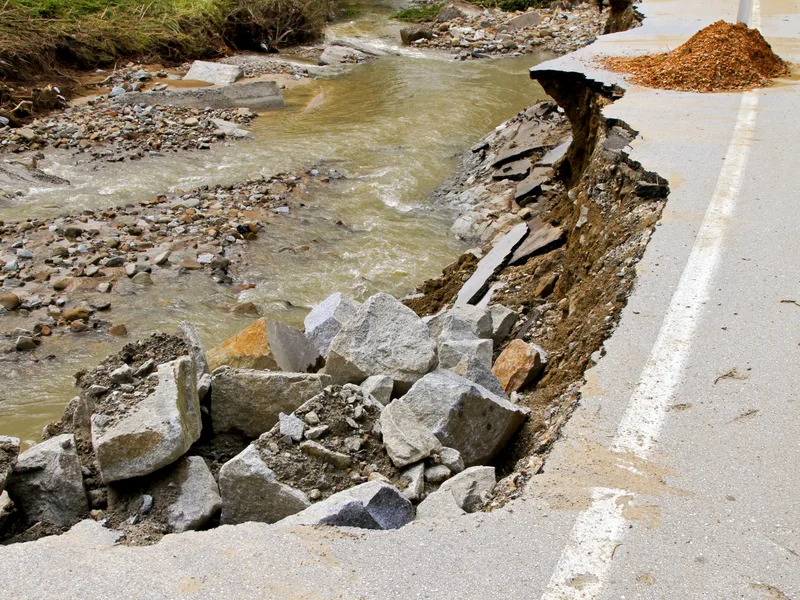
This is the "throat" of the Sichuan-Tibet Highway — the Jinsha River Bridge connects Sichuan and Tibet, and the gorge road is so narrow it's basically single-lane. When the Jinsha River swells in the rainy season, roadbed erosion is the norm.
- Common risks: Roadbed collapse, river water flooding the road, hours-long traffic jams
- Response: After Batang, fill up your tank and stock up on water and snacks. Traffic jams on this section can last two hours or an entire day. Don't drink too much water — there are no bathrooms in the gorge.
Danger Zone 3: Tongmai - Pailong (Tongmai Natural Barrier)
The Tongmai Natural Barrier was once the most terrifying 14 kilometers of the G318 — cliff on one side, the Parlung Tsangpo River on the other, with muddy roads, hairpin turns, and barely enough room for two vehicles. Tunnels and bridges have improved conditions significantly, but the rainy season still makes this an accident hotspot.
- Common risks: Tunnel entrance flooding, mudslides, road surface subsidence
- Response: The Tongmai section has a 30 km/h speed limit — don't complain, this speed was determined by human lives lost. If you see fresh mud on the road surface, a small landslide just happened — slow down, assess, then proceed.
Danger Zone 4: Ranwu - Bomi (Water-Damaged Roads)
The road from Ranwu Lake to Bomi runs alongside the Parlung Tsangpo River, with the road surface practically level with the water. When the river rises in the rainy season, the road becomes a river.
- Common risks: Water-damaged road surfaces, black ice (starting late September), roadbed scouring
- Response: When you encounter a flooded section, watch the vehicle ahead — if a big truck can make it through, a Prado can too. If even trucks won't attempt it, just wait for the water to recede.
🎒 Rainy Season Gear Checklist
⚠️ Don't say I didn't warn you: A regular raincoat is useless on the plateau — wind drives rain through every gap, and you'll be soaked through in five minutes. You need a proper waterproof-breathable shell jacket, rain pants, and waterproof shoe covers — the full three-piece system.
- Waterproof clothing: Gore-Tex shell jacket + pants, high-top waterproof hiking boots + shoe covers, waterproof backpack cover
- Electronics: Waterproof phone pouch, power bank in a sealed bag, camera rain cover
- Emergency tools: Folding shovel (self-rescue when stuck), tow strap, first-aid kit, headlamp
- Supplies: Compressed biscuits, bottled water ×2 days' worth, thermos
- Medications: Cold medicine (essential after getting rained on), loperamide (digestive issues spike in the rainy season), band-aids
💡 Honest Advice From Years on the Road
When you hit a landslide traffic jam, stay in the vehicle: Waiting in line at a landslide zone is rainy season normal. Stay in the car, keep the windows closed — rocks may still be falling from above. If you see people getting out to take selfies at the landslide site, stay far away from them.
Never camp on a riverbank: During the rainy season on the G318, river levels can rise one meter in 15 minutes — it can be raining upstream while you're under clear skies downstream. Seeing old campfire rings in a river valley doesn't mean it's safe — maybe the previous campers just got lucky.
What to do when a mudslide is coming: If you see the mountainside ahead starting to "flow" and hear a rumbling sound like thunder — abandon your vehicle immediately and run to higher ground. Run perpendicular to the mudslide's direction, not downhill along the gully. Your life is worth infinitely more than your vehicle.
Don't rush to hit the road right after rain stops: Rain stopping doesn't mean it's safe. Water seeping into the mountain actually increases landslide risk compared to during the rainfall. After the rain stops, wait and observe for at least 30 minutes before departing — that half hour could save your life.
Travel insurance is non-negotiable: For rainy season travel on the G318, get a policy that includes emergency rescue and medical evacuation. If you get stranded and need helicopter rescue, the bill without insurance will make you question every life choice.
💬 What RoamFun Travelers Say
"I did the G318 in July and got stuck at the Jinsha River Bridge for four hours. Everyone in the car was getting anxious, but the driver calmly pulled out bottled water and crackers from the trunk, handed them around, and said 'Traffic jams are part of the G318 experience — you get used to it.' In that moment, the jam suddenly didn't feel so frustrating anymore." — Awei, Shanghai ⭐⭐⭐⭐⭐
"Before departure, all the rainy season guides online scared me so much I almost canceled the trip. Then I got there and discovered — the G318 in the rainy season is genuinely beautiful. Clouds floating at mid-mountain, waterfalls everywhere, every shade of green saturated to the max. With the right driver and the right pace, the rainy season might actually be the most beautiful season." — Xiaoyou, Guangzhou ⭐⭐⭐⭐⭐
The Rainy Season Isn't the G318's Flaw — It's Its Other Personality
One last thing — the G318 in the rainy season will have traffic jams, you will get rained on, and you'll encounter all kinds of unexpected situations. But if you're willing to embrace that uncertainty, the rainy season rewards you with things the dry season never shows: mist-wrapped snow peaks, rivers roaring at full force, the scent of damp earth and pine needles in the air. This is a road bursting with life — on the condition that you respect it.
The rainy season tests you the way the dry season never can. It forces you to slow down, to wait, to admit you don't control the weather — and in exchange it shows you a version of the plateau that most travelers never see. The mist-wrapped peaks, the roar of full rivers, the air heavy with pine and earth — these are the rewards for the patient, the flexible, and the prepared. The travelers who love the summer 318 aren't the ones who raced through it; they're the ones who let it teach them the rhythm of the rain.
So when you plan your rainy-season crossing, plan to be surprised. Build in buffer days. Trust the local drivers who read the road for a living. Carry the gear on this list, respect the red zones, and know exactly when to turn back. Do all that, and the rain won't be a threat you endured — it'll be the backdrop to a trip you'll describe for years, with rivers in full spate and a green so vivid it looks painted. The 318 in summer asks for your respect and gives you its most alive season in return. That's a fair deal, and one worth making — provided you show up with the caution this guide spells out.
Craving a worry-free yet free-spirited journey?
Don't want to plan it yourself? Contact our senior trip designer now for a route and quote tailored to you.
Updated: August 2026 Author: RoamFun Senior Travel Consultant Questions? Contact us: vip@roamfun.net

RoamFun Senior Travel Consultant
Travel DesignerProfessional travel consultant, curating the most practical travel guides for you.