Nujiang 72 Bends Complete Guide: G318's Most Heart-Stopping 30 Kilometers
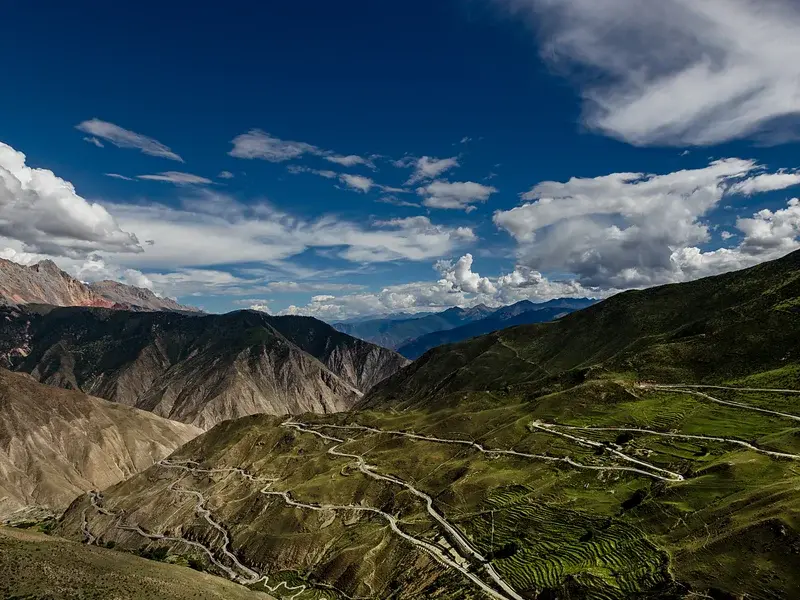
If you've ever seen a video of the Sichuan-Tibet Highway, one image is guaranteed to be there—a road coiling down from a mountain peak like a noodle flung onto a cliff face, bend within bend, turn after turn, plunging from the clouds deep into a river gorge. This is the Nujiang 72 Bends.
But the name is misleading. It's not 72 bends—people who've actually counted say 130-plus. From Yela Mountain Pass (4,658m) to the Nujiang Bridge (2,740m), the horizontal distance is only about 30 kilometers, but the altitude drops nearly 2,000 meters. That's one bend roughly every 230 meters—meaning you've barely straightened out of one turn before the next one is already in your face.
I've driven the Sichuan-Tibet Highway over a dozen times. Every single time I slow down at the 72 Bends. Not because I'm afraid—because over the years I've seen too many stories of accidents on this stretch. This guide tells you everything: how to get through safely, where to stop for photos, and what time is best. It's written to be read once, carefully, before you leave—so that when you crest Yela Pass and see the coiling ribbon below, you're not learning the rules on the road, you're already following them.
Here's the honest framing before the specifics: the 72 Bends are spectacular precisely because they're demanding, and the travelers who struggle on this stretch aren't the ones with bad cars—they're the ones who arrived without a plan for it. The brakes, the gear, the timing, the photo stops—every one of these is a decision you can make in advance. This guide turns those decisions into a checklist, so the only thing you have to think about at the pass is the scenery, which is the whole reason you're there. Master this one stretch, and it stops being the thing you dread and becomes the thing you'll photograph and retell with a grin.
🚗 The 72 Bends: A 30-Kilometer Roller Coaster
The full name is the "Yela Mountain Road." It starts near Bonda Town at the Yela Mountain Pass (4,658m) and ends at the Nujiang Bridge (2,740m). The entire stretch is on Yela Mountain's southern face—strong sun exposure and extreme temperature swings age the road surface rapidly, creating the killer combo of "steep grade + sharp turns + deteriorating pavement."
Section breakdown:
Upper section: Yela Pass → Viewpoint (~3 km) About 2 km past the pass, a simple pull-off area appears on the roadside—this is where you get the panoramic view of the 72 Bends. From here, the entire road looks like a giant python wrapped around the mountain, with the raging Nujiang River far below. Many people snap a photo here and drive on, thinking this is all there is—but you've only just reached the starting line.
Middle section: Viewpoint → Mid-mountain (~10 km) The most intense stretch. Continuous hairpin turns + a long downhill grade, most bends exceeding 120 degrees. The pavement has been pounded by heavy trucks for years, cracked like a tortoise shell. The key here is brake management—brake pads start heating up right from the pass, and by mid-mountain some trucks are already smoking. The trick: shift to a low gear (2nd-3rd for manual, S/L mode for automatic) and use engine braking instead of constant pedal braking. If you smell burning, pull over immediately to let the brakes cool.
Lower section: Mid-mountain → Nujiang Bridge (~17 km) Still plenty of bends, but the grade starts easing. Farmland and villages appear—Tongni Village, Gama Village. After the final big turn, the famous Nujiang Bridge appears. It spans the river with armed police on guard—photo stops are prohibited. You can take distant photos before reaching the bridge.
📸 How to Photograph the 72 Bends
1. Panorama shot (Yela Mountain Viewpoint): About 2 km past the pass. Use a wide-angle lens to pack all the bends from pass to mid-mountain into one frame. Morning before 10 AM: front light, the bends show the sharpest definition.
2. Bend close-up (mid-section roadside): About 5 km past the viewpoint, a small curve with safe parking. Use a telephoto lens to compress the space and stack multiple bends together. Best after rain when the wet road surface makes bends pop more vividly.
3. Drone perspective: The 72 Bends are made for aerial photography. But note: Yela Pass almost always has strong wind. Your drone needs at least level-5 wind resistance. Low temperatures severely impact battery life—in winter, a single battery might only last 15 minutes.
⏰ When Is the Safest Time to Cross?
| Window | Rating | Why |
|---|---|---|
| 7:00-10:00 AM | ⭐⭐⭐⭐⭐ Best | Few vehicles, good light, brakes still cold |
| 10:00 AM-2:00 PM | ⭐⭐⭐ | Traffic builds, truck brakes start smoking |
| 2:00-6:00 PM | ⭐⭐ | Backlight + hot pavement + peak truck density |
| 6:00 PM-dark | ⭐ | Never—no streetlights in bends |
Wake up early. Never cross the 72 Bends at dusk. After dark, the bends are pitch black, and oncoming headlights blind you. Every year, vehicles go over the edge at night here.
⚠️ 72 Bends Safety Checklist
- Check brakes before descending: Have a mechanic glance at your brake pad thickness in Bonda. Worn pads won't survive this stretch.
- Low gear downhill: Manual: 2nd-3rd gear. Automatic: switch to manual mode. Don't ride the brake pedal.
- Stay far from trucks: When their brakes are smoking, the driver can't smell it—but you will following behind.
- Never overtake in a bend: You see the coast is clear in this bend, but the next one reveals an oncoming truck. Nowhere to hide.
- Winter road surface: November through March, north-facing bends may have black ice. Decelerate immediately. Don't turn the wheel sharply.
❓ Common Questions About the 72 Bends
Is it really 72 bends, or more? The name is just branding—the official count is 130+, and by the time you add the smaller hairpins you stop counting. It doesn't matter; the point is relentless turning for 30 kilometers. Don't waste energy counting; spend it on the braking rhythm.
Can a sedan handle it? Yes, but with respect. The 72 Bends are paved, and a sedan with healthy brakes and a low gear will cross fine. The danger isn't the car—it's speed and overheated brakes on the descent. Take it slow, stay in low gear, and you'll be fine in any vehicle.
Do I need a 4x4? No. The 72 Bends don't require 4WD on clear days. Winter black ice changes that—chains or 4WD matter then. In summer, a regular car with good brakes is perfectly adequate.
What about passengers with motion sickness? The constant turning is brutal on susceptible passengers. Have them take motion-sickness medicine before the descent, sit in the front, and keep windows cracked. A passenger who's nauseous mid-bend is a distraction you don't need.
Can I stop at the Nujiang Bridge for a photo? No. The bridge is under armed-police guard and photography is prohibited. Take your distant shot from the road before the bridge, and put the camera away as you cross. Respect the military facility; the fine and the hassle aren't worth one frame.
💡 A Few Things About the 72 Bends
The 72 Bends aren't the "most dangerous" stretch—they're the "most demanding." Tongmai Natural Barrier used to be far more dangerous (now tunneled through). Jueba Mountain has even more bends. The 72 Bends became famous because they look so spectacular from above.
The armed police at Nujiang Bridge carry real weapons. Don't think "I'm just taking a photo"—they will demand you delete it. The bridge is a militarily controlled facility.
After crossing the Nujiang Bridge toward Baxoi, the road suddenly flattens, the valley widens. You'll feel like you've survived something. That feeling is one of the most unique experiences on the Sichuan-Tibet Highway.
💬 What Do Our Travelers Say?
"My first time through the 72 Bends was with a Chengdu motorcyclist heading to Tibet. He taught me 'low gear downhill, minimal braking'—I used that technique the entire rest of the Sichuan-Tibet Highway. He said this was his seventh ride and every time the 72 Bends still makes him sweat." — Chengdu Xiao Ma ⭐⭐⭐⭐⭐
"Took my girlfriend on her first Sichuan-Tibet trip. She has severe bend phobia. At the 72 Bends she kept her eyes shut the whole way while I drove, counting bends out loud—'128, 129, 130.' At the Nujiang Bridge she finally opened her eyes, saw the river and armed guards, and said, 'We made it out alive.'" — Chongqing Ah Jie ⭐⭐⭐⭐⭐
The 72 Bends Aren't the End of the Sichuan-Tibet Highway—But They're Your Most Unforgettable 30 Minutes
There's a saying among Sichuan-Tibet Highway veterans: you can brag in Chengdu that you're driving to Lhasa, but the 72 Bends will tell you—slow down, staying alive matters most. After the Nujiang Bridge, your understanding of the word "敬畏" (reverence) will be completely different.
And that's exactly the point of the 72 Bends. It's the road's way of reminding you, in the most spectacular way possible, that the plateau is not to be taken for granted. The 130-plus bends aren't there to defeat you; they're there to slow you down enough to feel the scale of the place—the drop of nearly 2,000 meters, the river roaring far below, the trucks with smoking brakes, and the thin air that thins your patience. Cross it the right way—early, in low gear, brakes cold, eyes ahead—and you'll arrive at the far side not just safely, but with a quiet pride that no photo can capture. When you finally pull over past the Nujiang Bridge and the valley opens wide, let yourself feel it: you've earned the next stretch. That feeling, not the bends themselves, is what travelers carry home from the 72 Bends—and why they slow down here every single time, veterans included.
Come back to this guide the night before you cross. Check your brake pads in Bonda, plan your early start, warn your motion-sick passenger, and put the phone away at the bridge. Then, when you crest Yela Pass and see the ribbon of asphalt coiling down into the gorge, you won't feel fear—you'll feel the opposite of it. You'll feel prepared, which on this road is the closest thing to calm there is. The 72 Bends will test your brakes and your patience, but not your luck, because you've already done the work. Cross them with respect, and they'll reward you with the most unforgettable half-hour of the entire Sichuan-Tibet Highway—the one you'll brag about in Chengdu, and the one that reminds you, gently, that staying alive is the point. That's the whole secret, and now it's yours.
Craving a worry-free yet free-spirited journey?
Don't want to plan it yourself? Contact our senior trip designer now for a route and quote tailored to you.
Updated: August 2026 Author: RoamFun Senior Travel Consultant Questions? Contact us: vip@roamfun.net

RoamFun Senior Travel Consultant
Travel DesignerProfessional travel consultant, curating the most practical travel guides for you.