Sichuan-Tibet Highway Food Map: Real Eating Experiences from Ya'an to Lhasa
Many friends ask me: what can you eat on the Sichuan-Tibet Highway? Is it instant noodles and pickled vegetables every day?
Not at all. This route is the convergence zone of Sichuan cuisine and Tibetan food — Sichuan's numbing-spicy freshness combined with Tibetan butter tea and tsampa. Over 2,000km, the food is far more diverse than you'd expect — the key is knowing where to eat and what to order.
This isn't a food blogger's restaurant review — it's the real eating and drinking experience of someone who's run this route for over a decade. No fancy plating, just genuine "delicious."
And "delicious" on the 318 has its own rules. The food here isn't just fuel or pleasure — it's strategy. At 4,000 meters, what you eat and when you eat it affects how you feel on the passes, how you sleep at night, and whether you'll have energy for the next day's drive. A too-heavy lunch at Litang can cost you an afternoon; a proper breakfast can carry you across a pass you'd otherwise struggle to climb. So this guide is part food map, part survival logic — where to find the real flavors, what to order so you're not eating cardboard for a week, and how to eat smart so the altitude doesn't punish your appetite. Read it once, and you'll cross the 318 fed, happy, and never once staring at a sad bowl of instant noodles. Follow the day-by-day stops and you'll taste each region's signature — Ya'an's pounded chicken, Kangding's slow-stewed yak, Batang's hand-rolled noodles, Lulang's legendary stone pot, Lhasa's endless sweet tea. The 318 is a feast disguised as a road trip, if you know where the tables are. And this guide points straight at every one of them, so you never eat hungry twice.
🚙 Honest Advice: The Logic of Eating on the Sichuan-Tibet Highway
Eating on the Sichuan-Tibet Highway is different from the city. In the city, you search for what you want; on the plateau, some places have only 2-3 restaurants on an entire street, with no alternatives.
Where buses stop is usually contracted restaurants partnered with travel agencies — you know, mediocre food, high prices. Self-driving, you don't know which places locals eat at versus which ones target tourists.
With a Prado on the Sichuan-Tibet route, the drivers are locals or have run the route for years. Which restaurant serves fresh not frozen yak beef, which makes butter tea fresh instead of from powder, which roadside hole-in-the-wall has the best flavor — this information is 100x more reliable than food apps.
Also: at high altitudes, digesting a meal may consume more oxygen than walking a kilometer. So don't overeat at lunch — 70% full is right. Close your eyes for 20 minutes in the car afterward — better than any medicine.
🗺️ What to Eat at Each Stop
Day 1: Ya'an — Ya Fish + Bangbang Chicken
Ya'an is the culinary starting point of the Sichuan-Tibet Highway. Ya fish (Ya'an's specialty split-belly fish) is a must — clay pot stewed, white broth, tender meat. "Ya fish" you eat elsewhere is mostly fake — genuine Ya fish has a sword-shaped bone in its skull.
Bangbang chicken isn't the vacuum-packed kind from supermarkets. Ya'an's version uses wooden sticks to pound the chicken tender, then dresses it with chili oil, Sichuan pepper, and sesame — fragrant and numbing, perfect with rice.
Where to eat: Ya'an old town riverside road, look for restaurants with 5-6 tables of locals out front. Avoid nicely decorated restaurants near the highway exit — those target passers-through.
Day 2: Kangding — Yak Beef Hotpot
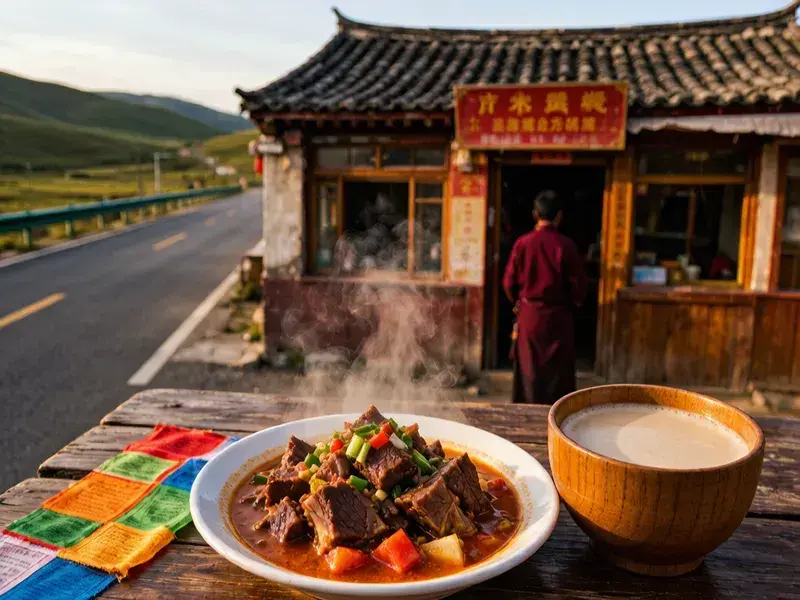
In Kangding at ~2,500m, yak beef makes its appearance. Kangding's yak hotpot isn't like regular hotpot — not for swishing, but a large pot of pre-stewed bone-in yak beef + radish + potato, served ready to scoop.
Where to eat: Soup pot shops in Kangding old town pedestrian street. Telltale sign: a large iron pot stewing outside the door. Yak beef stewed over a day falls apart at the touch of chopsticks.
Day 3: Litang — Highland Cod (If Just Passing Through, Don't Eat)
Litang has a local favorite — highland cod, very tender. But I don't recommend eating a full meal in Litang — at 4,014m, sitting down for a meal is as taxing as running a kilometer.
Recommendation: Buy some yak jerky in Litang to snack on; eat a proper meal in Batang. Batang at 2,580m lets you eat comfortably.
Day 4: Batang — Tibetan Noodles + Tibetan Buns
Batang is one of the lowest-altitude county towns on the route — eat hearty. Batang's Tibetan noodles are distinctive — hand-rolled, thicker than Lhasa's, broth from yak bones, topped with scallions and chili powder.
Don't miss Tibetan buns — thin skin, generous filling of yak beef + onion, dipped in chili sauce. Ten per order, 20 RMB — incredible value.
Day 5: Zuogong/Bangda — Dough Flakes
In eastern Tibet, the staple gradually shifts from rice to wheat. From Zuogong to Bangda, roadside halal noodle shops and Tibetan restaurants increase. Dough flakes (pulled dough pieces) are the most substantial here — fresh-pulled flakes tossed into yak beef soup with greens, served steaming.
A bowl of hot dough flakes on the plateau is better than any medicine — carbs for energy, hot broth warms the stomach, beef for protein.
Day 6: Lulang — Stone Pot Chicken (The Culinary Peak of the Entire Route)
Lulang stone pot chicken — I'm not exaggerating, people drive back from Lhasa specifically to eat it.
The stone pot is carved from Motuo soapstone — slow but even heat conduction, producing broth completely different from iron or aluminum pots. The chicken is Tibetan free-range — firm but not tough. The broth includes palm-leaf ginseng, matsutake, goji berries, and red dates, simmered 4-5 hours until white as milk.
How to spot fakes:
- Check the pot — genuine Motuo stone pots are black with natural stone texture, rough surface. Fakes are molded, smooth and uniform.
- Check the broth — genuine stone pot chicken broth is milky white (minerals released during cooking). Fakes are watery and clear.
- Check the restaurant — where local drivers eat, the parking lot is full of Prados and Land Cruisers. If it's all tour buses, find another.
Where to eat: Lulang International Tourism Town — recommend "Lulang Stone Pot Chicken Main Store" and "He Dama Stone Pot Chicken." 80-120 RMB per person.
Day 7: Lhasa — Sweet Tea House + Tibetan Noodles
In Lhasa, the first thing isn't visiting the Potala Palace — it's sitting in a sweet tea house.
Guangming Gangqiong Sweet Tea House, Lhasa's most famous. A pot of sweet tea is 8 RMB, a cup is 1 RMB — bring your own cup, put 1 RMB on the table and someone comes to fill it. The tea house is filled with Tibetan elders returning from prayer, students after school, businessmen making deals — this is the real Lhasa.
Pair with a bowl of Tibetan noodles — slightly firm (alkaline noodles), beef broth very fresh, topped with scallions and chili. A bowl of noodles + a pot of tea = Lhasa's most authentic breakfast.
🎒 Practical Checklist: Food to Bring Without Regret
⚠️ Don't say I didn't warn you: Food safety on the plateau requires extra caution. High altitude means lower boiling point (water boils at 80-something degrees), so things don't cook as thoroughly. Avoid roadside cold dishes and pre-cut fruit — you don't know how long they've been sitting out.
- Bring yourself: Thermos (hot water anytime), chocolate/Snickers (quick energy), preserved plum/dried tangerine peel (motion sickness prevention), instant milk tea/instant butter tea mix (lifesaver when accommodation is poor)
- Don't eat randomly: Raw yak jerky — not everyone can digest it; roadside yogurt — hygiene uncertain; alcohol at high altitude — accelerates dehydration
💡 Heart-to-Heart Advice
Eat earlier than city habits: The plateau gets dark late, but restaurants close early. Many towns have nothing to eat after 8 PM. So lunch around 11:30, dinner before 18:00 — don't follow city schedules.
Breakfast full, lunch good, dinner light: This is the iron law of Sichuan-Tibet dining. Breakfast needs to last until noon (no food on the road); too much dinner affects sleep.
Tibetan food isn't for everyone: Butter tea is salty, tsampa has a porridge-like texture, air-dried yak jerky chews like wood. Try it, but don't expect every meal. Sichuan restaurants are in every county town along the route, and the flavor isn't far from Chengdu.
Don't eat at scenic area entrances: Restaurants at Midui Glacier and Laigu Glacier entrances are 50%+ more expensive than in town, with half the flavor. Walk 2km further to town for cheaper and better.
📸 Don't Just Snap Randomly — These Spots Are Stunning
- Ya'an old town riverside road: 5 PM sunset, riverside teahouse + old buildings — human interest shot.
- Kangding Liuliu City: Evening when Zeduo River lights illuminate, shoot reflections from the bridge.
- Lulang stone pot chicken restaurant: Photograph the bubbling stone pot — steam + broth color + Tibetan decor = maximum appetite appeal.
- Lhasa sweet tea house: Long wooden tables + enamel cups + the tea pourer — lighting so good it needs no editing.
💬 What RoamFun Travelers Say
"That stone pot chicken in Lulang — I drank five bowls of broth. The driver said the pot needs to start simmering four hours ahead, and the broth was white enough to glow. After returning to Chengdu, every chicken I ate felt like something was missing." — Lao Wu, Shanghai ⭐⭐⭐⭐⭐
"Used to think Tibetan food was just butter tea and tsampa. This time I discovered Tibetan noodles and buns are amazing. At that Batang bun shop, I ate two orders by myself — different from Shanghai xiaolongbao, it's a rugged kind of savory." — Xiaolu, Hangzhou ⭐⭐⭐⭐⭐
You're Not Just Eating Food — You're Tasting the Human Warmth of This Road
On the Sichuan-Tibet Highway, the best restaurant isn't Michelin — it's a hole-in-the-wall that's been open 20 years. The owner might not speak Mandarin well, but after you finish a bowl of soup, he'll ask if you want more — free of charge.
That's the true flavor of the 318.
And it's a flavor you can't taste anywhere else. The stone pot chicken that simmers for four hours on the stove, the sweet tea refilled by a hand that's been pouring it for forty years, the free second bowl from a man who barely speaks your language — these aren't on any menu, and they're the reason the 318 is remembered long after the passes blur together. The food on this road does more than feed you; it introduces you to the people who live here, and through them, to a way of life that measures wealth in hospitality rather than in anything money buys.
So eat like a local, and eat where the locals eat. Skip the scenic-area tourist trap, order the stone pot chicken from the place full of Prados, drink your sweet tea slow, and let the food open doors that guidebooks never mention. By the time you reach Lhasa and toast the trip with one last cup, you'll understand the real lesson of the 318's food: the road feeds more than your stomach. It feeds the part of you that's tired of eating alone, in a hurry, or in the dark. That's the meal worth the whole journey, and it's served free, everywhere, to anyone willing to sit down.
When you're home and scrolling past the photos, your mouth will water for the stone pot chicken, and your chest will warm at the memory of that free second bowl. The passes will blur into a single line of grey, but the meals — the sizzling yak hotpot in Kangding, the dough flakes on a cold Zuogong evening, the sweet tea that never ran out in Lhasa — those stay sharp forever. That's the quiet truth the food map teaches: you'll forget most of the road, but you'll never forget a meal that tasted like being welcome. So order the thing you can't pronounce, sit where the locals sit, and let the 318 feed you the way it feeds everyone who slows down enough to ask. That's the last and best instruction on this map.
Craving a worry-free yet free-spirited journey?
Don't want to plan it yourself? Contact our senior trip designer now for a route and quote tailored to you.
Updated: August 2026 Author: RoamFun Senior Travel Consultant Questions? Contact us: vip@roamfun.net

RoamFun Senior Travel Consultant
Travel DesignerProfessional travel consultant, curating the most practical travel guides for you.