Sichuan-Tibet Highway Budget Travel Ultimate Guide: The Real Ledger of Completing the 318 for 3,000 RMB Per Person
First, a reality check: those online posts about "completing the Sichuan-Tibet Highway for 2,000 RMB per person" — check the publish date. Most are from before 2016. Back then, gas was cheap, tickets hadn't increased, and 15 RMB bought a full meal along the route. It's 2026 now — those numbers need to double to be realistic.
But that doesn't mean the Sichuan-Tibet Highway is a bottomless money pit. This guide breaks down food, lodging, transport, and tickets to tell you the real cost of budget travel, where the money goes, where you can save, and where you absolutely cannot cut corners. Done right, a budget traveler can cross the 318 for around 4,000 RMB per person and finish with both the scenery and their wallet intact — but only if they spend on the right things and skip the traps that bleed money without giving anything back.
Here's the honest framing before the numbers: on the 318, the cheapest option is rarely the smartest one. A free hitchhike that strands you at a pass costs more in lost time and risk than a paid carpool ever will. A 100 RMB tent night at 4,000m costs you a miserable next day. So this isn't a guide to spending as little as possible — it's a guide to spending deliberately, so every yuan buys either a memory, a safe ride, or a good night's sleep. Read the full ledger below, then decide where to be cheap and where to be smart. Every number in it comes from real crossings, and every suggestion has been tested by travelers who wanted both the scenery and their savings intact. Spend wisely, and the 318 becomes the trip of a lifetime that didn't cost a lifetime of savings. That's the promise of good budgeting.
🚙 Honest Advice: The Biggest Budget Save Is "Not Driving Yourself"
Many think carpooling or joining a small group is more expensive than self-driving. You've got the math backwards.
Self-driving: fuel 2,200km × 0.8 RMB/km ≈ 1,760 RMB, tolls ~300 RMB, total ~2,000 RMB. But that's not counting vehicle wear and depreciation (a highland trip costs at least 2,000 RMB in vehicle value), or potential towing fees (plateau towing starts at 1,500 RMB).
So the real cost of self-driving the Sichuan-Tibet Highway, split 4 ways, is 1,500-2,000 RMB per person minimum — and you still have to worry about road conditions, driving with altitude sickness, and finding parking.
Carpooling (small group chartered car): Chengdu to Lhasa 8 days, including vehicle + fuel + tolls + driver's meals and accommodation, 2,500-3,500 RMB per person. Seems more expensive than self-driving, but you don't worry about anything — the driver cares for you during altitude sickness, knows detours for landslides, and knows where to stop at every viewpoint.
Therefore, the best budget strategy for the Sichuan-Tibet Highway is: share a Prado with several companions. 4 people per vehicle, lowest per-person cost, highest comfort. More freedom than a bus (stop when you want), less hassle than self-driving (no road condition worries), safer than solo backpacking (on the plateau, if something happens alone, nobody knows).
🗺️ Expense Breakdown, Item by Item
Basic Cost Breakdown (8 Days Chengdu-Lhasa)
| Item | Budget Plan | Comfort Plan |
|---|---|---|
| Transport (carpool) | ¥2,000-2,500/person | ¥3,000-4,000/person |
| Accommodation (8 nights) | ¥400-600 (¥50-80/night) | ¥1,200-2,000 |
| Food (8 days) | ¥600-800 (¥80-100/day) | ¥1,200-1,600 |
| Tickets | ¥400-600 | ¥600-800 |
| Other | ¥200-400 (snacks/medicine/misc) | ¥500-800 |
| Total | ¥3,600-4,900/person | ¥6,500-9,600/person |
These numbers are from real trips. Around 4,000 RMB per person for the budget plan is reliable; below 3,500 means significant sacrifices in food and lodging.
How to Save on Transport
- Carpooling is the most efficient: 4 people sharing a Prado, ~2,500 RMB per person for 8 days. Includes fuel, tolls, driver's meals and accommodation. Slightly more than a bus, but freedom is on a completely different level.
- Don't take the bus: Chengdu to Lhasa has a long-distance bus (~600 RMB), but it can't stop anywhere, and the best scenery flashes past the window. You spend 600 RMB just to "arrive in Lhasa" without experiencing anything along the way.
- Don't pure-hitchhike: Hitchhiking is indeed free, but the uncertainty is too high — you might wait 2-3 hours at a pass, or get dropped halfway. Waiting on the plateau carries real risk.
How to Save on Accommodation
- Hostel dorm beds: Kangding, Nyingchi, and Lhasa have hostels at 40-60 RMB/night. But Litang, Zuogong, and Ranwu don't have proper hostels — only small inns (80-120 RMB/room, split two ways = 40-60 RMB/person).
- Don't book singles: For couples or friends, a double room is 30%+ cheaper than two singles.
- Avoid viral hotels: Those "snow mountain view from your window" viral hotels in Lulang cost 1,000+ RMB in peak season. Town guesthouses are 200-300, clean and hygienic, and you can still see snow mountains — from the courtyard, for free.
- Don't stay in Xinduqiao, Litang, or Ranwu: High-altitude lodging is both expensive and uncomfortable. Drive an extra hour to lower-altitude county towns; rooms are 50-100 RMB cheaper and you'll actually sleep.
How to Save on Food
- Breakfast on the street: Steamed buns + soy milk + eggs, 8-10 RMB per person.
- Lunch on the road: Bring bread, sausage, and fruit. Roadside shops for noodles or fried rice, 15-25 RMB per person.
- Dinner better but don't overeat: Find Sichuan restaurants where locals eat, order 2-3 dishes to share, 30-45 RMB per person.
- Sweet tea is 10x better value than coffee: Lhasa sweet tea houses charge 1 RMB/cup; sit all afternoon. A latte at a café starts at 35 RMB.
How to Save on Tickets
- Skip what's not worth it: Midui Glacier (50 RMB ticket + 36 RMB shuttle) and Laigu Glacier (30 RMB) are great value. Yarlung Tsangpo Grand Canyon (150 RMB + 90 RMB shuttle) is poor value — you can already see the canyon's grandeur from the road.
- Bring your student ID: Almost all attractions offer half-price student tickets.
- Some of the best scenery is free: Zeduo Mountain, Kazila Mountain, Maoya Grassland, Nu River 72 Bends — the most spectacular scenery on the Sichuan-Tibet Highway requires no tickets at all.
🎒 Practical Checklist: Budget-Saving Essentials
⚠️ Don't say I didn't warn you: The most expensive cost of budget travel isn't food, lodging, or transport — it's getting sick. A cold on the plateau = at least 2 days unable to travel + 3 days accommodation + potential medical costs. Saving money premise is ensuring basic safety and health.
- Thermos — hot water on the plateau costs 5 RMB/cup; bring your own and refill free at inns
- Instant noodles + sausages — pack 2 meals' worth; arriving late when restaurants are closed means no going hungry
- Self-carry common medicines — plateau pharmacy prices are doubled
- Power bank — some rural inn rooms don't have enough outlets
- Trash bags — collect your own food waste in the car; respect the environment
💡 Heart-to-Heart Advice
"Budget travel" and "self-torture" are different things: Not paying for lodging and sleeping in a tent by the road isn't budget travel — it's self-torture. Sleeping in a tent at 4,000m: one, it's cold (nights below minus 10°C); two, it's unsafe; three, poor rest means you feel worse the next day. Saving 100 RMB on accommodation to suffer all the next day — that "saving" isn't worth it.
Don't skimp on what matters, like insurance: A highland travel accident insurance policy costs 50-100 RMB, covering altitude sickness emergency and evacuation. This is your "regret insurance" — hope you never need it, but can't be without it.
Sharing costs with companions is the most effective saving method: Solo on the Sichuan-Tibet Highway, carpooling and hotels are full price. Two people: accommodation splits in half. Four people: carpooling per-person cost is lowest, and two hotel rooms cost less than singles.
Don't engage in "compensatory shopping" in Lhasa: Many people think "since I came all this way" and buy a pile of useless souvenirs on Barkhor Street. Tibetan knives can't be taken on planes, dzi beads are mostly glass fakes, and saffron costs more than on the mainland. Buy just two things: postcards (mail to yourself) and sweet tea powder (brew at home).
📸 Don't Just Snap Randomly — These Spots Are Stunning
- Hostel common area: Backpackers from around the world chatting together — phone wide-angle for atmosphere.
- Roadside breakfast stall: Steamer baskets billowing steam + distant snow mountains — down-to-earth yet stylish.
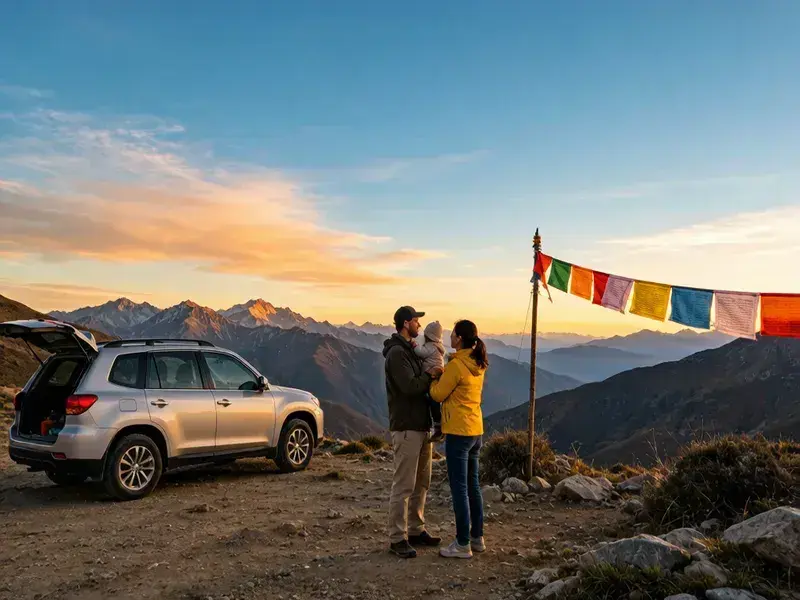
- Carpool team photo: At a pass, four people standing in front of the Prado — car + people + snow mountains. The most classic budget travel memory photo.
💬 What RoamFun Travelers Say
"Just graduated, budget only 4,000 RMB. Two of us shared a Prado, stayed in hostels and family inns. Not much money, but no shortage of experiences — eating instant noodles by Sister Lakes watching snow mountains felt better than Michelin." — Xiao Chen, Chengdu college sophomore ⭐⭐⭐⭐⭐
"Thought 2,000-3,000 RMB for carpooling was expensive before departure. On day 3 at the Nu River 72 Bends, the driver said there was a landslide ahead, made a few calls and found a detour. That moment I felt the money was so worth it — alone, I might have waited all day." — Xiao Li, Wuhan ⭐⭐⭐⭐⭐
Budget Travel Isn't About Spending the Least — It's About Spending on What Matters
After running the Sichuan-Tibet route for over a decade, I've seen that the best budget travelers aren't those who spend the least — they're those who get the most value from every cent. Share a reliable car, sleep in a room where you can actually rest, eat a hot meal — then devote all remaining energy and money to the scenery along the road.
The travelers who finish the 318 and still talk about it with affection aren't the ones who checked the cheapest box on every item. They're the ones who were stingy in the right places — skip the overpriced souvenir, skip the viral hotel, skip the café latte — and generous where it counts: a safe car, an oxygen room at 3,700m, a proper travel-insurance policy. That's the real budget math of this road. The scenery is free; the trouble is expensive. Spend to avoid the trouble, save everywhere else, and you'll come home with a full memory card and a bank balance you don't dread checking.
There's also a quieter reward to traveling the 318 on a budget: it changes what you notice. When you're not buried in a glossy itinerary, you see the free stuff — the steaming breakfast stall against a snow peak, the family inn where the owner insists on refilling your thermos, the carpool team that becomes friends by day three. Those are the moments the expensive trips pay extra to miss. Budget travel isn't a downgrade of the experience; it's a refocus of it, onto the things that actually matter. And on the 318, the things that matter are nearly all free — the passes, the grasslands, the morning light, and the company you keep. That's the ledger worth keeping, and the one that pays you back for years.
Craving a worry-free yet free-spirited journey?
Don't want to plan it yourself? Contact our senior trip designer now for a route and quote tailored to you.
Updated: August 2026 Author: RoamFun Senior Travel Consultant Questions? Contact us: vip@roamfun.net

RoamFun Senior Travel Consultant
Travel DesignerProfessional travel consultant, curating the most practical travel guides for you.