G318 Sichuan-Tibet Highway Accommodation Guide: Where to Stay and Where to Absolutely Avoid
After running the Sichuan-Tibet route for years, accommodation is one of the most frequently asked questions. Online guides either list a bunch of hotel names you can't remember, or contain outdated information from years ago. This guide cuts the fluff and gives you the real accommodation situation at every stop along the route — recommended and avoid.
First, reassurance: the Sichuan-Tibet Highway is no longer the "only guesthouses" era of ten years ago. Kangding, Nyingchi, and Bome all have 4-star standard hotels. The rooms are warm, the showers mostly work, and the worst you'll usually face is a squeaky bed or a cold patch. But the traps are still there — and they're not where you'd guess. The danger isn't dirty sheets; it's altitude. The worst "hotel mistake" on this road isn't choosing a bad room, it's choosing a bad elevation. Get the elevation right and almost any room works; get it wrong and even a five-star suite won't save your night. That's why this guide is organized around nightly stops rather than hotel names — because a hotel name is forgettable, but knowing to sleep at 2,580m instead of 4,014m will decide how you feel on every pass the next day. Read it through once, and you'll carry a mental map of where to lay your head that no reservation app can give you. There's real money to be saved and real sleep to be gained here — both of which pay off immediately, and both of which the fancy booking sites will never mention because they sort by price, not by altitude. You're here for a better guide than an app can give, and one that treats your sleep as seriously as your sightseeing. Rest is the foundation of the whole trip.
🚙 Honest Advice: Choosing the Right Stop Is More Important Than Choosing the Right Hotel
Accommodation logic on the Sichuan-Tibet Highway is completely different from city travel. In cities, you choose by star rating; on the plateau, you choose by altitude + distance.
Example: Xinduqiao has nice homestays and hotels — beautiful decor, affordable, high online ratings. But at 3,460m — driving from Chengdu (500m) to Xinduqiao in one day, you'll likely have headache, insomnia, or even vomiting at night. It's not the hotel's fault — your body can't adapt to the altitude fast enough. Every night you spend above 3,500m on this trip is a gamble; every night below it is a recovery.
So the first principle of Sichuan-Tibet accommodation: stay low when possible, stay in county towns over villages. The altitude of your bed matters more than the quality of your mattress. A mediocre hotel at 2,600m beats a beautiful homestay at 3,800m every single time.
A Prado on the Sichuan-Tibet route has a hidden accommodation advantage: size. You don't need to worry about how far the hotel is from the main road — the driver provides pickup and drop-off. Many scenic homestays are 1-2km down side roads that buses can't enter; the Prado handles them easily. This opens up lakeside and mountain-facing stays that bus travelers simply can't reach.
🗺️ Where to Stay Each Night — All Marked
Day 1 Stop: Kangding (2,560m) ⭐⭐⭐⭐⭐
Recommended:
- Kangding city center hotels — most choices, Zeduo River downstairs, evening stroll to Qingge Square. Recommend hotels near Paoma Mountain side — quieter.
- Boutique inns near Liuliu City — Tibetan-style decor, good value.
Avoid:
- Roadside inns at the foot of Zeduo Mountain — altitude already 3,000m+, terrible conditions, just camp beds.
- Xinduqiao — the #1 accommodation trap on the Sichuan-Tibet Highway. At 3,460m, staying here on your first night is asking for misery. No matter how beautiful the online photos, don't stay in Xinduqiao on night one.
Day 2 Stop: Yajiang (2,640m) ⭐⭐⭐⭐⭐
Recommended:
- Yajiang county riverside hotels — low altitude, convenient, Sichuan restaurants downstairs. 200-400 RMB.
- Yalong River inns — open your window to river sounds, excellent for sleep.
Avoid:
- Litang (4,014m) — another big trap. Many guides recommend a night in Litang to "experience the world's highest city." My advice: unless you've been above 3,500m for over 5 days and are fully adapted, don't. The novelty of the altitude is not worth the insomnia.
Day 3 Stop: Batang (2,580m) ⭐⭐⭐⭐⭐
Recommended:
- Batang city center — one of the lowest-altitude county towns on the route, under 2,600m, the most restful night's sleep of the whole trip.
- Homestays near the Tsopu Valley entrance — close to the scenic area, first wave into the valley in the morning.
Avoid:
- Around Haizi Mountain — no decent lodging, elevation 4,600m+. Don't be fooled by roadside "Lodging" signs; they mean a cot in a shack, not a room.
Day 4 Stop: Zuogong (3,750m) ⭐⭐⭐
Honest take: Zuogong is the "watershed" of accommodation on the Sichuan-Tibet route. Above 3,750m, no matter where you stay, someone won't sleep well. Budget for oxygen.
Recommended:
- Hotels on Zuogong's main road — with oxygen supply (oxygen generators), 300-500 RMB. Spending an extra two hundred for an oxygen room is worth it.
- New town area — cleaner than the old town, larger rooms.
Avoid:
- Near Dongda Mountain — elevation 5,000m+, minus ten degrees and no heating, only passing truckers stay here.
Day 5 Stop: Ranwu (3,960m) ⭐⭐⭐
Ranwu's accommodation has improved a lot in recent years, but the high altitude is a hard limit that won't change.
Recommended:
- Lakeside resort hotels at Ranwu Lake — open the window to the lake, 600-1,000 RMB. Pricier but with a view and oxygen.
- Family-run guesthouses in Ranwu town — 200-400 RMB, good value, local owners, warm hospitality.
Avoid:
- Isolated homestays far from the town — in winter they can lose water and power, and the road may not even be passable.
Day 6 Stop: Nyingchi / Lulang (2,900m) ⭐⭐⭐⭐⭐
Recommended:
- Lulang International Tourist Town — stone pot chicken street, the highest hotel standard on the entire route. Major chains like Evergrande and Poly have hotels here; off-season from 600+ RMB.
- Nyingchi city — plenty of five-star options, and cheaper than Lhasa for comparable quality.
Day 7 Stop: Lhasa (3,650m) ⭐⭐⭐⭐
Lhasa needs little introduction — from hostels to five-star hotels, it's all here. One piece of advice: don't shower on your first night in Lhasa (prevents colds and worsened altitude sickness). Stay anywhere you like, but take it easy.
🎒 Plateau Lodging Kit
⚠️ Don't say I didn't warn you: "Radiant floor heating" and "air conditioning" at plateau hotels are often decorative in winter — unstable voltage and frozen pipes are common. A portable hot water bottle is more reliable than any heating.
- Portable humidifier (USB) — plateau humidity is often below 20%; without it, your nose may bleed by morning.
- Earplugs — town hotels have poor soundproofing; dogs downstairs, footsteps upstairs.
- Disposable sheets / sleeping bag liner — some Dongda Mountain to Zuogong inns are basic.
- Slippers — many town hotels don't provide disposable ones.
- Thermos + instant noodles — if you arrive late and restaurants are closed, at least you have something hot.
💡 Heart-to-Heart Advice
Don't book all hotels in advance: The 318's road conditions are unpredictable — landslides, roadworks, one-way closures. Today's plan may change tomorrow. Book the first two nights, then book as you go. Even in peak season (July-August), booking a day ahead is fine.
Is an oxygen room worth the extra money? In low-altitude places like Batang and Nyingchi, no. But in 3,700m+ places like Zuogong and Ranwu, spending 100-200 RMB extra for an oxygen room buys you a night of quality sleep. It's the best-value upgrade on the route.
Homestays carry risk: Rural homestays have inconsistent hygiene standards and hot water supply. If you're sensitive to cleanliness, choose chain hotels or proper hotels rated 4.5+.
Stone pot chicken authentication: Lulang has 20+ stone pot chicken restaurants. How to tell which is authentic? Look at the pot — genuine Motuo stone pots are black with natural stone texture, rough to touch. Fakes are industrially molded, smooth and uniform.
📸 Don't Just Snap Randomly — These Spots Are Stunning
- Kangding Liuliu City at night: 8 PM when Zeduo River lights illuminate, shoot from Qingge Square bridge — river + lights + mountain backdrop.
- Lulang Zhaxigang Village: Tibetan houses + distant snow mountains + meadow; best at 7 AM before mist clears.
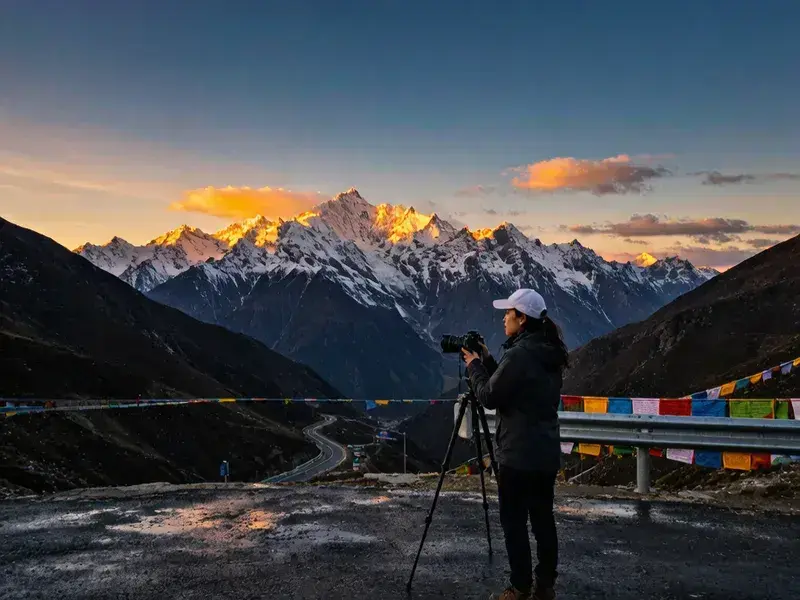
- Ranwu Lake hotel balcony: Open the window to the lake — set up a tripod for time-lapse.
💬 What RoamFun Travelers Say
"Was most worried about accommodation before departure; read various posts saying Sichuan-Tibet conditions were harsh. Turns out it was completely unnecessary — Lulang's hotel was better than Chengdu's, and the Ranwu Lake one had snow mountain reflections right outside the window. Only mistake was being talked into staying in Xinduqiao on the first night — headache all night." — Xiao Chen, Beijing ⭐⭐⭐⭐⭐
"The oxygen room in Zuogong was lifesaving money. Two companions in the group stayed in regular rooms without oxygen — next morning they had dark circles and said they didn't sleep all night." — Alin, Shenzhen ⭐⭐⭐⭐
"I followed the 'book first two nights only' advice and it saved my trip. A landslide closed the road past Bomi and everyone who'd pre-booked everything had to tear up their plan. I just booked the new stop on the spot." — Zhou, Nanjing ⭐⭐⭐⭐⭐
Stay Right — the 318 Is Half-Won
The most beautiful thing about the Sichuan-Tibet Highway is the scenery; the most grueling is your physical condition. And physical condition is 80% determined by how well you slept the night before. Don't over-save on accommodation — on the plateau, spending 200 extra RMB for a good night's sleep is better than anything you could eat.
The travelers who finish the 318 with energy to spare aren't the ones with the cheapest bookings; they're the ones who slept low, slept well, and treated each night as preparation for the next pass. Your body is your most important vehicle on this road, and its fuel is sleep. Choose your stops by altitude, spend the extra money where the oxygen runs thin, and the mornings will be bright and the headaches few. Get the nights right, and the 318 becomes what it should be — a long, stunning drive you finish feeling strong, not a gauntlet you barely survive.
Accommodation on the 318 isn't a logistics detail to dismiss; it's the single biggest lever you have over the whole trip. You can't control the weather, the traffic, or your first-pass blood oxygen. But you can control where you sleep — and that one choice ripples through every sunrise, every pass, and every photo you're alert enough to enjoy. Pack your earplugs, book your first two nights, trust the altitude rule, and treat a good night's sleep as the most valuable souvenir you'll buy on this road. Do that, and the mountains will meet you rested, curious, and ready — which is exactly how a trip like this deserves to be met. Sleep low, wake early, and let the plateau's mornings do the rest — they're the quietest, clearest hours on the whole road, and they belong to the well-rested, the early risers who see the 318 at its best.
Craving a worry-free yet free-spirited journey?
Don't want to plan it yourself? Contact our senior trip designer now for a route and quote tailored to you.
Updated: August 2026 Author: RoamFun Senior Travel Consultant Questions? Contact us: vip@roamfun.net

RoamFun Senior Travel Consultant
Travel DesignerProfessional travel consultant, curating the most practical travel guides for you.