Online Sichuan-Tibet Highway Guides Are Dozens of Pages Long — Here's a Veteran Driver's Day-by-Day Plan
I've driven G318 for fifteen years, from Chengdu to Lhasa. With my eyes closed, I know what scenery lies past every curve. Those online guides run dozens of pages with endless alternative options — you finish reading and still don't know when to depart, where to stay, or what time to wake up the next day.
So no fluff here. Eleven days — what time to leave, how long to drive, which town to sleep in, what the altitude is, and what to watch for on the road — all planned out. Just follow along.
The Real Talk: 11 Days Is the Minimum for a Comfortable Sichuan-Tibet Highway Trip
The Sichuan-Tibet Highway spans 2,140km, with elevation rising from 500m to 5,000m and back down to 3,600m. Online you'll find 7-day and 9-day versions — not impossible, but you'll spend the entire trip driving and won't even want to see the Potala Palace when you reach Lhasa.
Eleven days is the most comfortable pace I've tested — at most 7-8 hours of driving per day, with time to stop for scenery, and energy left to explore when you reach your overnight stop.
| Route Characteristics | Recommended Vehicle | Reason |
|---|---|---|
| Chengdu-Kangding (paved) | GL8/GAC M8 | Highway + national road, prioritize comfort |
| Kangding-Batang (mixed) | Toyota Prado | Zheduo Mountain + Kazila Mountain, high altitude and many curves |
| Batang-Lhasa (rough sections) | Tank 300/Prado | Nu River 72 Bends, Tongmai Danger, requires higher clearance |
The 11-Day Day-by-Day Itinerary
Day 1: Chengdu — Kangding (Elevation 2,560m)
Driving: 280km, about 4 hours. Entirely highway.
- Today's keyword: Acclimatize. Don't rush — arrive early and rest.
- Key tips: Absolutely don't push straight to Xinduqiao. Xinduqiao is 3,460m — going from Chengdu's 500m to 3,500m in one day means you'll likely have a headache that night. Kangding at 2,560m is the perfect first highland acclimatization stop.
- Expert advice: Depart in the morning, eat Ya'an fish for lunch in Ya'an, and slowly drive to Kangding in the afternoon. Rest at the hotel upon arrival — don't take a hot shower. For dinner, go near Qingge Square for yak beef noodles — eat until 80% full.
Day 2: Kangding — Xinduqiao — Yajiang (Elevation 2,530m)
Driving: 200km, about 5 hours. Cross Zheduo Mountain (4,298m).
- Today's keyword: Cross your first snow mountain. Zheduo Mountain is the first 4,000m+ pass on the Sichuan-Tibet Highway and where many people experience altitude sickness for the first time.
- Road conditions: Zheduo Mountain has many curves and large trucks. Snow may trigger traffic control — check weather before departing. The summit has a viewing platform — stop for 10 minutes for photos and leave. Don't linger.
- Expert advice: Xinduqiao is a photographer's paradise — but the most beautiful section is 10km along the river valley toward Tagong, not in the town itself. After photos, continue to Yajiang for the night — at 2,530m, it's nearly 1,000m lower than Xinduqiao, so you'll sleep well.
Day 3: Yajiang — Litang — Batang (Elevation 2,580m)
Driving: 300km, about 6 hours. Cross Kazila Mountain (4,718m) and Haizi Mountain (4,685m).
- Today's keyword: Heaven Road 18 Bends + Sister Lakes. Past Yajiang is the famous Heaven Road 18 Bends — curves so sharp they look like a tangled yarn ball on GPS. Kazila Mountain is one of the highest sections — driving here makes you drowsy (a sign of oxygen deprivation) — stop frequently to rest.
- Key tips: Litang is the "World's Highest Town" at 4,014m. Many want to stay overnight "for the experience" — my advice: don't. The altitude sickness probability from sleeping in Litang is too high. Continue to Batang at 2,580m — much more comfortable.
- Expert advice: After the Haizi Mountain pass, there's a viewing platform for Sister Lakes — two adjacent turquoise lakes with snow mountain backdrop. Stop here for 10 minutes of photos — today's best scenery.
Day 4: Batang — Markam — Zuogong (Elevation 3,750m)
Driving: 260km, about 6 hours. Enter Tibet, crossing Zongla Mountain (4,150m), Lawu Mountain (4,376m), and Dongda Mountain (5,130m).
- Today's keyword: Entering Tibet + highest point. Cross the Jinsha River Bridge and you're officially in Tibet. Dongda Mountain at 5,130m is the highest point of the entire Sichuan-Tibet Highway — step out of the car and walk a few paces to feel what "not enough air" means.
- Road conditions: The Jinsha River Bridge to Markam section frequently has landslides and road work — the worst road conditions. Conditions improve past Markam.
- Expert advice: Today's focus isn't scenery but altitude adaptation. Zuogong at 3,750m is the first mandatory high-altitude overnight stop. Have hot soup for dinner and sleep early. Trouble sleeping is normal — breathe deeply, don't panic.
Day 5: Zuogong — Bangda — Baxoi (Elevation 3,260m)
Driving: 200km, about 5 hours. Cross Yela Mountain (4,658m), descend the Nu River 72 Bends.
- Today's keyword: 72 Bends. After Yela Mountain comes the most spectacular road section on the Sichuan-Tibet Highway — the Nu River 72 Bends, spiraling down from 4,658m to 2,740m in the Nu River Canyon. Over 30km of continuous downhill with so many curves you'll question reality.
- Key tips: When descending the 72 Bends, use low gears to control speed — don't ride the brakes continuously or brake pads will overheat and fail. Find a pull-off every 10km or so to let brakes cool.
- Expert advice: Baxoi is an underrated overnight stop — at 3,260m, it's lower than Zuogong, so you'll sleep better tonight. The town is small but has more dining options than Zuogong.
Day 6: Baxoi — Ranwu Lake — Bome (Elevation 2,750m)
Driving: 220km, about 5 hours. Cross Anjula Mountain (4,475m).
- Today's keyword: Ranwu Lake. One of the most beautiful lakes on the Sichuan-Tibet Highway. In spring and autumn, the water is mirror-like turquoise, reflecting the distant Laigu Glacier. In summer rainy season, the water turns muddy — so the most beautiful seasons for the Sichuan-Tibet Highway are May and October.
- Expert advice: Ranwu Lake has an upper and lower lake. The lower lake is roadside and crowded with tourists. The upper lake requires driving 20km further in but is nearly empty — with more open water and more complete reflections. If time permits, go to the upper lake — you won't be disappointed.
- Accommodation tip: Bome sits at only 2,750m — the most comfortable night of the entire trip. The town is surrounded by primeval forest and snow mountains. Oxygen levels are much higher than before — sleep well.
Day 7: Bome — Tongmai — Lulang — Nyingchi (Elevation 2,900m)
Driving: 230km, about 5 hours.
- Today's keyword: From plateau to Jiangnan. On the Bome-Nyingchi section, vegetation shifts from alpine meadow to dense forest, the air becomes humid, oxygen levels rise, and you'll feel fully alive again. The Tongmai Danger, formerly the most dangerous section of the Sichuan-Tibet Highway, now has tunnels and bridges — passing in 10 minutes.
- Expert advice: Lulang's stone pot chicken is the best meal on the entire Sichuan-Tibet Highway. The stone pot is made of Motuo soapstone, the chicken is free-range Tibetan, stewed with hand-shaped ginseng and matsutake. Stop in Lulang for lunch — about 80 RMB per person, absolutely worth it.
Day 8: Nyingchi — Gongbo'gyamda — Maizhokunggar — Lhasa (Elevation 3,650m)
Driving: 400km, about 6 hours. The longest day, but all good roads.
- Today's keyword: Arrived in Lhasa. Nyingchi to Lhasa now uses the Linla Expressway with excellent road conditions. The final section crosses Mila Mountain Pass (5,013m) — the last 5,000m+ pass on the Sichuan-Tibet Highway. After Mila Mountain, it's all downhill — you'll spot the Potala Palace's golden roof in the distance.
- Expert advice: Don't get overexcited upon reaching Lhasa — don't run, don't drink alcohol. At 3,650m, though lower than the passes you've crossed, you still need a day or two to adapt. In the evening, stroll slowly through Barkhor Street and have a pot of sweet tea to celebrate completing China's most beautiful highway.
Essential Checklist: The Most Overlooked Items for 11 Days on the Road
Don't say I didn't warn you: Gas stations are far apart on the Sichuan-Tibet Highway. After Kangding, you may go 100-200km without one. Fill up at half a tank — don't gamble on how far the next station is.
- Check daily: Engine oil, brake pads, tire pressure — altitude pressure changes affect tire pressure too
- Carry with you: ID card (checked multiple times daily at checkpoints), driver's license, vehicle registration, border pass (only needed for Everest or Ngari)
- Vehicle essentials: Snow chains (even in summer, passes may have snow), tow rope, jumper cables, spare wiper blades
- Food & drink: Thermos with hot water, glucose, chocolate, self-heating rice — don't count on restaurants all along the route
- Altitude sickness meds: Glucose oral solution is the most effective; rhodiola's psychological effect exceeds its actual effect
Honest Advice From the Heart
The most beautiful part of the Sichuan-Tibet Highway isn't Lhasa — it's every day on the road. Ranwu Lake's reflections, the 72 Bends' spectacle, Lulang's stone pot chicken, Bome's primeval forest — these are things you won't see in Lhasa. Don't fixate on the endpoint — every day on the road deserves slowing down to experience.
I really don't recommend overnighting in Litang. I know many guides say Litang is beautiful with the "World's Highest Town" gimmick. But in groups I've led, over half of those who stayed in Litang got altitude sickness. You still have to drive the next day — no need to trade sleep for a "stayed in the world's highest town" badge.
The Nu River 72 Bends look terrifying but are fine if you use low gears for speed control and don't ride the brakes. The real danger isn't the curves themselves — it's relaxing your guard after the 72 Bends thinking "finally done." After descending to the Nu River Canyon, there are still dozens of kilometers of cliff road — don't lose focus.
Top 10 Must-Stop Photo Spots on the Sichuan-Tibet Highway
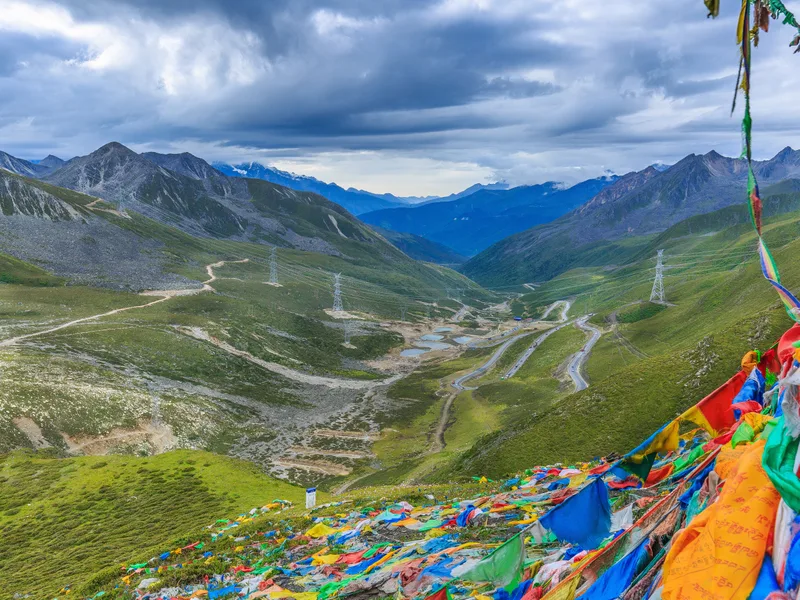
- Zheduo Mountain Pass (4,298m): First snow mountain pass, wide-angle panorama, prayer flags as foreground
- Heaven Road 18 Bends: Roadside platform, telephoto for full curve overview
- Haizi Mountain Sister Lakes: Best afternoon light, both lakes in frame, telephoto for compressed perspective
- Dongda Mountain Pass (5,130m): Photo with the elevation sign — proof you were here
- Nu River 72 Bends: Yela Mountain viewing platform, high vantage with wide-angle for the full spiral
- Upper Ranwu Lake: Morning with no wind gives most complete reflections, long exposure for mirror surface
- Lulang Forest Sea: Best for drone photography — meadow + forest + snow mountain in one frame
- Sejila Mountain Pass: Lucky to see Namcha Barwa Peak, best afternoon light
- Mila Mountain Pass (5,013m): The ceremonial feel of the final snow mountain pass
- Potala Palace: Don't rush to shoot the front in Lhasa — go to Yaowang Mountain viewing platform for the side angle, fewer people and better composition
What RoamFun Travelers Say
"After 11 days on the Sichuan-Tibet Highway, the most unforgettable part wasn't the Potala Palace — it was that morning at Ranwu Lake. The sun had just risen, the lake surface was mirror-calm, distant snow mountains reflected in the water, so quiet you could hear your own breathing. Thanks to our driver-guide for taking us to the upper lake — so few people, just our group." — Lao Wang, Dalian ⭐⭐⭐⭐⭐
"My dad is over 60 and insisted on self-driving the Sichuan-Tibet Highway — I couldn't stop him. We eventually arranged a chartered car with RoamFun, and a professional driver took us the whole way. In hindsight, the best decision — the 72 Bends section made my legs shake just looking at it; I can't imagine my dad driving it. Upon reaching Lhasa, the old man cried from emotion, saying he'd fulfilled a half-lifetime dream." — Aqiang, Hefei ⭐⭐⭐⭐⭐
2,000km of Road — by the End, You Won't Want It to Finish
The Sichuan-Tibet Highway has a magic — when you depart, you long for Lhasa, but upon arriving, you miss everything along the way. Prayer flags fluttering in the wind at Zheduo Mountain, Ranwu Lake's reflections like a painting, the aroma of Lulang's stone pot chicken filling the entire town.
On this road, no kilometer is wasted — every one is scenery.
Don't want to drive yourself across 14 snow mountains?
Hand the wheel to RoamFun's 15-year Sichuan-Tibet Highway veterans. You just enjoy the scenery, take photos, and remember the most beautiful stretch of road of your life.
Updated: July 2026 Author: RoamFun Senior Travel Consultant Questions? Contact: vip@roamfun.net
Craving a worry-free yet free-spirited journey?
Don't want to plan it yourself? Contact our senior trip designer now for a route and quote tailored to you.

RoamFun Senior Travel Consultant
Travel DesignerProfessional travel consultant, curating the most practical travel guides for you.