Sichuan-Tibet Highway Vehicle & Gear Complete Guide: SUV or Sedan? 2026 Latest Tibet Entry Guide
The 318 spans 2,200km, crossing 14 mountain passes above 4,000m, through rainy-season landslide zones and winter black-ice belts. What vehicle you choose and what gear you bring — these two questions determine whether you'll see scenery all the way or experience thrills all the way. Get them right and the mountain is a pleasure; get them wrong and it's a survival exercise.
Those online posts claiming "sedans can do the 318" don't tell you how many times the sedan's undercarriage scraped on washboard roads, or how many times it slid on Haizi Mountain's black-ice curves. This isn't theory — it's practical experience from completing 5 trips on the 318, covering vehicle selection, gear, and high-altitude driving techniques. The goal of this guide is simple: walk away knowing exactly what to drive, what to pack, and what to do when the road turns hostile. The 318 doesn't punish the unprepared with drama; it punishes them with a tow truck bill and a ruined schedule. Every year, well-meaning drivers in the wrong car with the wrong kit turn a two-week dream into a roadside ordeal — and almost all of it is preventable with an afternoon of preparation before Chengdu. This guide condenses five runs of the highway into the decisions that actually matter, so you can skip the expensive mistakes and get straight to the part where the window fills with snow mountains. Read it once in Chengdu before you fuel up, and the chances of a breakdown ruining your trip drop from "likely" to "rare." The mountain rewards the prepared and barely notices the rest — so be the one it rewards. Your future self, coasting past a broken-down sedan at a pass, will thank the you reading this in Chengdu. Preparation is the only luck the 318 respects.
🚙 Honest Advice: Sedans Can Make It — But Do You Really Want to Use One?
Sedans typically have 12-15cm ground clearance. Past Litang on the 318, washboard road mode begins — the surface is corrugated with ridges from truck traffic, and the sedan's undercarriage scrapes back and forth like a washboard. You stop caring — because the undercarriage guard has already been scraped off, and the next scrape is the oil pan. A sedan that completes the 318 does so in spite of itself, not because of good planning.
High-altitude power loss: Above 4,500m, naturally aspirated engines lose about 30% power. A 1.6L sedan fully loaded with four people climbing Haizi Mountain — flooring the gas feels like crawling. Turbo engines fare better, but neither likes thin air. On a pass where a truck is creeping in the right lane, you want acceleration in reserve, not a prayer.
The Prado is the most sensible vehicle for the 318. High ground clearance, 4WD, spacious interior, and repairable at every county town along the route — parts are stocked in Kangding, Litang, Batang, even remote Baxoi. Most importantly — an experienced driver holds the wheel. You don't worry about what gear for braking or how fast to take a curve; you just watch for when the snow mountains appear outside your window. If you're renting, pick the vehicle the local drivers actually use, not the one the rental app discounts deepest.
🗺️ Vehicle Inspection Checklist
Must-Check Before Departure
- Tires: Reduce tire pressure by 0.2-0.3 bar (atmospheric pressure is lower at altitude; standard pressure becomes too high, reducing grip). At least one spare tire, preferably two — a sidewall tear on a washboard stretch is common and a second spare is the difference between a delay and a disaster.
- Brakes: If brake pad wear exceeds 50%, replace before departure — the Nu River 72 Bends' continuous descent consumes brakes beyond imagination. New pads bed in over the first 200km, so replace them in Chengdu, not at the last town.
- Coolant: Switch to -35°C type. Plateau nights can drop to minus 10-20°C; standard coolant will freeze solid and crack the block by morning.
- Windshield washer fluid: -30°C type. Spray it at a pass and watch the water instantly freeze on your windshield — this isn't a joke, it's how people drive blind into a rockfall.
- Battery: Cold cranking amps drop with temperature. A battery at 60% in Chengdu is a no-start at 4,000m. Test it before you leave.
Core High-Altitude Driving Techniques
- Long descents: Use L-gear or low gear for engine braking. Brakes are only for speed reduction, not continuous application. Smelling something burning = brake pads overheating; pull over immediately and let them cool naturally — douse them with water and they warp.
- Black-ice curves: When temperature is below 5°C, tunnel entrances/exits, bridge surfaces, and shaded curves will have black ice. Reduce entry speed to below 20; don't brake mid-curve. If the rear steps out, steer into the slide, don't fight it.
- Refueling strategy: Fill up at half tank. Gas station spacing on the 318 is uneven — expecting to refuel at the next station might mean driving 150km to find one, and some close at dusk. Top off at every pump you see working.
🎒 Practical Checklist: 318 Vehicle Essentials
⚠️ Don't say I didn't warn you: Towing fees on the 318 start at 5,000 RMB. Preparing your own emergency tools is more useful than buying extra insurance.
- Tire chains (essential October-April; practice installing once before departure — doing it for the first time at 4,000m in a snowstorm is a memory you don't want)
- Air pump + tire repair kit + tow rope (8-ton minimum)
- Spare key (keep with a companion — a locked-out car at a pass is a tow-truck special)
- Glucose + ibuprofen + thermos + at least 2L drinking water
- Trash bags (no trash cans at mountain passes — pack it in, pack it out)
- Jump starter (the small lithium kind — a dead battery at a pass is fixable in two minutes with one)
💡 Heart-to-Heart Advice
Don't rent an unfamiliar car for Tibet: Brake sensitivity, steering feel, body dimensions — things that take a year to become automatic in the city start from zero in a new car. On Zeduo Mountain's sharp curves, your "automatic response" to the vehicle hasn't been established — one mistake means a cliff.
Driving with altitude sickness ≈ drunk driving: Above 4,500m, reaction speed, judgment, and attention all decline. When you start yawning, vision blurs, or get drowsy — pull over immediately, rest + oxygen + glucose. Don't push through. The road will wait; your reflexes won't come back on command.
The most expensive cost on the 318 is "I thought I could make it": When the road ahead has fallen rocks or water depth is uncertain — the correct response is one word: stop. Not slow down — stop. The 318 is not a place to rush, and the tow truck that pulls you out will invoice you for the lesson.
📸 Don't Just Snap Randomly — These Spots Are Stunning
- Xinduqiao poplar tunnel: Poplar trees interweaving overhead — shoot forward from inside the car.
- Nu River 72 Bends panorama: Telephoto from the viewpoint compresses the switchbacks into layered folds.
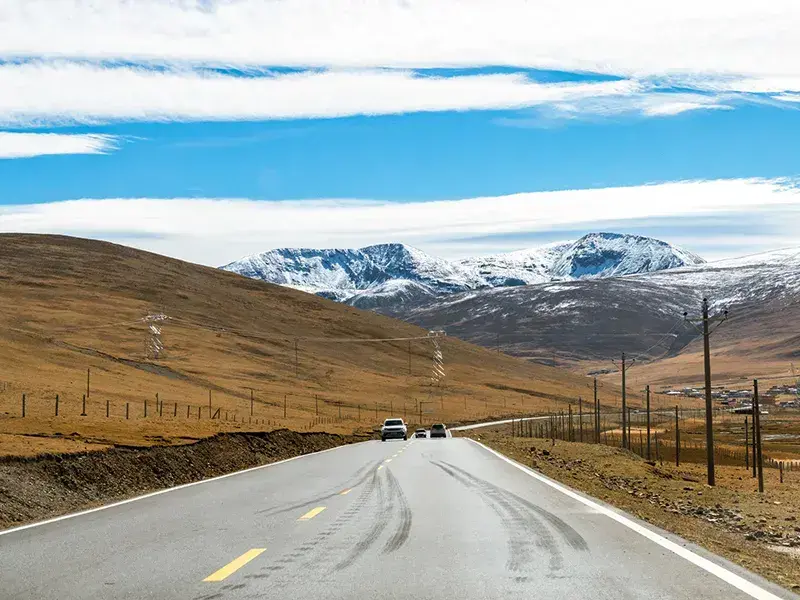
- Maoya Grassland highway shot: Straight road + distant snow mountains, 4 PM side light.
- Haizi Mountain pass: before 9 AM, the glacial rocks catch low sun — wide angle for the surreal boulder field.
🌦️ Adjust Your Kit by Season
The 318 changes character month to month, and so should your loadout.
- Winter (Nov–Mar): Chains mandatory, -35°C everything, spare battery, sleeping bag rated to -15°C in case you're stuck. Some passes close; check daily.
- Spring (Apr–May): Best balance — chains optional but carry them, meltwater on low roads, watch for late snow on eastern passes.
- Summer (Jun–Aug): Rain gear and a windshield scraper for mud, watch for landslides after storms, coolant matters less but humidity rots seals.
- Autumn (Sep–Oct): The golden window — dry roads, clear passes, chains for early snow only. The most forgiving season to learn the highway.
Season rule of thumb: Whatever the forecast says in Chengdu, pack for 15°C colder at the passes. The plateau doesn't read the lowland weather app.
💬 What RoamFun Travelers Say
"Wanted to self-drive before departure. Past Zeduo Mountain, something felt wrong — headache, drowsiness, slow reactions. Handed the wheel to the experienced driver and moved to the back seat. Later at the Nu River 72 Bends, saw a self-drive SUV with smoking brakes by the road — so glad I didn't push it." — Aliang, Beijing ⭐⭐⭐⭐⭐
"Brought a full trunk of gear — the most useful turned out to be tire chains and an air pump. Those 'Tibet gadgets' basically went unused." — Xiaojiang, Chongqing ⭐⭐⭐⭐
"I ignored the half-tank rule and coasted into Batang on fumes because the last station was closed. Never again — now I fill at every pump. The 30-minute detour saves a potential 150km walk of shame." — Wen, Hangzhou ⭐⭐⭐⭐⭐
Right Car + Right Driver = the 318 Is an Experience, Not a Challenge
Your vehicle is your most important partner on the 318. Choose a reliable car and a reliable driver — recline the rear seat and watch snow mountains and yaks drift past your window. That's the proper way to experience the 318. The road will test the car, but it's the driver's judgment that keeps the car on the road. Prepare both, and the 318 stops being a checklist of hazards and becomes what it was always meant to be: a long, slow, beautiful drive through some of the harshest and most generous landscape on the planet. The drivers who remember the 318 fondly are rarely the ones who brought the most gear — they're the ones who brought the right gear and a driver who knew the road. Spend your preparation budget on the car and the person behind the wheel, not on the gadgets that end up in the trunk unused. Do that, and every pass becomes a photo stop instead of a panic stop. The highway asks for respect, not fear — give it the right machine and the right hands, and it gives back a trip you'll tell people about for years. Whether you arrive in a Prado or a rented sedan, what separates a good 318 from a bad one is almost never the badge on the hood. It's the half-hour in Chengdu ticking items off this list, and the humility to hand the wheel to someone who knows the passes. Do the boring part before you leave, and the road takes care of the beautiful part while you ride. That's the whole secret of the 318: the less you fight the preparation, the more the mountain gives back. Get the car right, get the driver right, and the rest is just the window filling with white.
Craving a worry-free yet free-spirited journey?
Don't want to plan it yourself? Contact our senior trip designer now for a route and quote tailored to you.
Updated: August 2026 Author: RoamFun Senior Travel Consultant Questions? Contact us: vip@roamfun.net

RoamFun Senior Travel Consultant
Travel DesignerProfessional travel consultant, curating the most practical travel guides for you.