Hard Truths Only Worth Sharing After Completing the G318 Sichuan-Tibet Highway: Avoiding Every Hidden Trap
Those online posts hyping the 318 as "the drive of a lifetime" and "the road of life" only show you snow mountains, grasslands, and golden sunrises — they don't tell you that vehicles go off cliffs on this road every day, and every year people are carried down due to altitude sickness. Social media filters out the flat tires at 2 a.m., the gas station with a two-hour queue, the hotel that looked great in photos but had no heating at 4,000m, and the silent panic of a first-time driver whose blood oxygen just dropped below 80% at a mountain pass.
Listen to me: the 318 is beautiful, but beauty comes at a price. This guide doesn't talk about scenery — it focuses on the traps nobody tells you about, from being tricked into buying useless gear before departure, to being blocked by yaks on the road, to feeling like jumping out of the car at a mountain pass due to altitude sickness. If you're planning your first Sichuan-Tibet run, treat this as the chapter the influencers quietly edited out. Read it once before you leave and you'll dodge most of the pain that ruins other people's trips. The road will still be there, the snow mountains will still be white, but you'll arrive in Lhasa in one piece instead of in an ambulance.
I've driven this corridor more times than I can count, and every season brings a different version of the same lesson: the mountain doesn't care about your itinerary. The travelers who enjoy the 318 most are rarely the bravest — they're the ones who prepared for discomfort and packed patience instead of ego. The advice below is blunt because the plateau is blunt. There's no polite way to say "your rental car's brakes failed on a 40km descent," so I'd rather warn you now than read about you later.
🚙 Honest Advice: Don't Romanticize "Self-Driving the 318"
Those TikTok videos of "one person, one car, driving the 318" — you watch them with adrenaline pumping. But the video doesn't show you that the blogger might have a support vehicle following behind, or might have stopped at a pass for half an hour of oxygen, or might have quietly flown the car partway on a trailer. The algorithm sells you freedom; the mountain sells you reality.
Driving the 318 yourself means simultaneously managing four things: road conditions (landslides, black ice, falling rocks), your body (altitude headache, drowsiness, slowed reactions), your vehicle (brake overheating, power loss at altitude), and navigation (many junctions, poor signal, GPS failure). At 5,000m with blood oxygen at 75%, are you sure you can still make the right driving decisions? Most people can't, and the road doesn't forgive hesitation.
The Prado is the vehicle proven on the Sichuan-Tibet route for decades. High ground clearance prevents bottoming out on rough roads, 4WD provides confidence on icy passes, and the spacious rear seat allows stretching out for sleep. More importantly — having an experienced driver handle all the road pressure means you save your energy for the scenery outside the window, not how hard to press the gas pedal. If budget allows, a local veteran co-driver is the single best insurance you can buy on this road.
🗺️ Trap-Avoidance Checklist, Segment by Segment
Chengdu-Kangding Section: The First Trap Is "Rushing"
Too many people drive from Chengdu to Xinduqiao (3,460m) on day one, ascending from 500m to 3,500m in a single day. Headache, insomnia, and vomiting arrive that night. The correct approach: stay the first night in Kangding (2,560m) or Ya'an. There's no shortcut to altitude acclimatization — just climb slowly. Plan a buffer day; if you feel rough in Kangding, rest a day rather than push on. The extra 24 hours in Kangding often saves you three miserable days later.
Zeduo Mountain Pass (4,298m): Don't Jump Around
The first 4,000+m pass. The scenery is stunning and you're excited — then you start jumping for photos. After that, your blood oxygen plummets and you'll have a headache for half a day. Don't stay more than 15 minutes. Take photos and descend immediately. The golden-hour shot of Gongga is worth waking up early for, not worth fainting over.
Litang-Batang Section: Don't Eat a Full Meal in Litang
Litang is at 4,014m. Sitting down for a full meal at 4,000m consumes as much oxygen as running 1km. Pass through with photos and eat lunch in Batang (2,580m) instead. Litang itself is worth a short photo stop for the vast grassland horizon, but keep moving. The lower you eat, the better you'll feel in the afternoon.
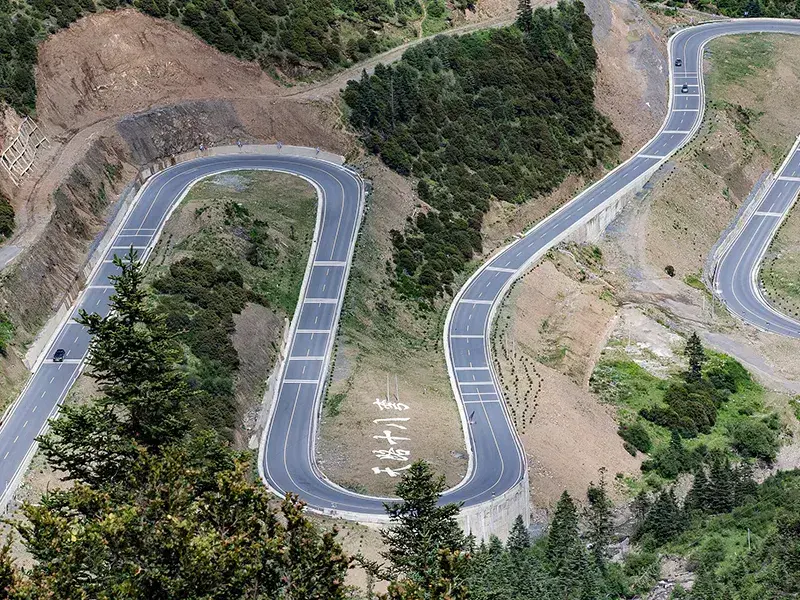
Nu River 72 Bends: Don't Ride the Brakes Continuously
40km descent from 4,658m to 2,740m. Continuous braking for 5 minutes will overheat them — then brake failure. Use low gear or L-gear for engine braking; brakes are only for speed reduction. Test your brakes gently at the top before committing to the descent, and pull over briefly halfway if you smell burning. This is the single most dangerous stretch for rookie drivers.
Dongda Mountain (5,130m): Don't Stop — Look From the Car Window
The highest point on the Sichuan-Tibet Highway. 5,130m is no place to linger. Glance from the car window and keep going. Even a five-minute stop here can trigger a brutal headache that lasts until the next town.
🎒 Practical Checklist: What You Actually Need on the 318
⚠️ Don't say I didn't warn you: Don't buy a pile of "Tibet travel gadgets" — vehicle oxygen generators, satellite phones, rooftop tents — 90% go unused and eat your trunk space. What actually saves you is the following.
- Ibuprofen + glucose + montmorillonite powder
- Thermos (hot water anytime — more effective than oxygen)
- Portable pulse oximeter (cheap, check morning and evening)
- ID card + driver's license + border permit (required for Ngari and some passes)
- Cash (many county gas stations and restaurants only accept cash)
- Sunscreen + lip balm (plateau UV burns fast)
- A basic tow rope and tire repair kit
💡 Heart-to-Heart Advice
"Don't use oxygen for altitude sickness" is the biggest misconception: For mild headaches, drinking water and resting to let it pass is correct. But if blood oxygen drops below 80%, persistent vomiting, or lips turning purple — you must use oxygen or descend. Your life is more important than your pride.
Staying in Xinduqiao is the 318's first trap: At 3,460m, first-time highland travelers staying here — 90% get headaches at night. Drive another hour to Yajiang (2,640m); 60 extra km for a good night's sleep.
Yaks don't fear cars — don't honk: Compensating for one yak starts at 8,000 RMB. When yaks cross the road — stop and wait for them to pass. Honking startles them into running, which is more dangerous.
Fuel strategy matters: Don't enter remote stretches below half a tank. Some stations close early or run out; top off whenever you see a working pump. Keep a small jerry can only if legally permitted and safely stored.
📸 Don't Just Snap Randomly — These Spots Are Stunning
- Zeduo Mountain Pass: Before 8 AM, shoot Gongga mountain range golden sunrise. Then leave — don't jump around.
- Maoya Grassland: July, slopes covered in wildflowers; 4 PM side light gives best three-dimensionality.
- Nu River 72 Bends: 4-5 PM side-backlight for the switchbacks; include a person as foreground for scale.
- Ranwu Lake: dawn reflection of snow peaks — arrive the night before and sleep in the car or a lakeside guesthouse.
💬 What RoamFun Travelers Say
"Made a 50-page itinerary before departure, but 90% of what happened on the road wasn't in it — yaks blocking the road, snow at passes, brake overheating. Without the experienced driver, I would have been stuck at Zeduo Mountain on day one." — Ahao, Guangzhou ⭐⭐⭐⭐⭐
"The biggest trap was acting tough. Jumped around at Dongda Mountain and had a headache all day. The veteran was right — on the plateau, don't show off." — Xiaowei, Chengdu ⭐⭐⭐⭐
"I almost skipped the border permit and would have been turned back at the checkpoint. The pre-trip checklist from RoamFun saved the whole trip." — Lin, Shenzhen ⭐⭐⭐⭐⭐
💰 Budget Traps: Where the Money Actually Leaks
The biggest financial surprises on the 318 aren't the obvious ones. Fuel is reasonable, tolls are low, and guesthouses are cheap — but the leaks add up: a tow truck on a remote stretch (800–2,000 RMB depending on distance), a yak-compensation payout (starts at 8,000 RMB per animal), a hotel "heating fee" nobody mentioned (50–150 RMB/night at altitude), and the "scenic area shuttle" you didn't know was mandatory. Budget an extra 2,000–3,000 RMB buffer on top of your fuel and lodging estimate, and don't let a friendly local "guide" at a pass talk you into a side trip you didn't plan. The most expensive mistake is the one that ends the trip early.
The 318's Traps Are All Hidden — Know Where They Are and You Won't Step In
Veterans who've completed the Sichuan-Tibet Highway share a consensus: the most beautiful thing isn't Lhasa — it's the traps you didn't fall into along the way. Know where the traps are in advance, and the rest is just enjoying the scenery. The 318 rewards preparation and punishes ego. Climb slowly, brake smart, carry cash, respect the yaks, and never let pride talk you out of oxygen when your body is screaming for it. Most "horror stories" on this road share one root cause: someone rushed, someone showed off, or someone didn't listen. You don't need to be a hero to drive the 318 — you need to be humble, patient, and a little bit afraid. Do that, and the road gives you the trip of a lifetime instead of a cautionary tale.
The 318 will test you in ways a city highway never will, and the travelers who come back smiling are the ones who treated the mountain as a partner, not an opponent. Plan for the worst, hope for the best, and let the snow mountains do the rest. When you finally roll into Lhasa and touch the golden roof of the Potala, you'll understand why everyone says the journey changes you — and you'll know you earned every kilometer of it. The traps along the way aren't there to stop you; they're there to slow you down enough to actually see the place. Drive the 318 once with your eyes open, and you'll never look at a "scenic highway" post the same way again.
If there's one sentence to take home, it's this: the 318 is not a checklist to conquer, it's a place to negotiate with. The road will offer you glory and grief in the same afternoon, sometimes in the same hour. The drivers who make it look easy are the ones who admitted, early and often, that the mountain is bigger than their plan. Pack light on pride, heavy on preparation, and the 318 will hand you a story worth telling — not a lesson worth forgetting. That's the whole point of going: not to arrive, but to come back changed.
Craving a worry-free yet free-spirited journey?
Don't want to plan it yourself? Contact our senior trip designer now for a route and quote tailored to you.
Updated: August 2026 Author: RoamFun Senior Travel Consultant Questions? Contact us: vip@roamfun.net

RoamFun Senior Travel Consultant
Travel DesignerProfessional travel consultant, curating the most practical travel guides for you.