
Hemu Village Four Seasons Guide: Xinjiang's Most Fairytale-Like Village
You've seen the video—dawn piercing through birch trees, golden light spilling onto smoke rising from wooden cabins, the entire village steeped in honey-colored warmth. This isn't a filter. This is Hemu Village in autumn.
Hemu is a Tuvan settlement. The Tuvans are a branch of the Mongolian people—only about 300,000 worldwide, with fewer than 3,000 in China, half of whom live in Hemu. They dwell in log cabins, speak Tuvan, practice Tibetan Buddhism and Shamanism, and have lived in this Altay Mountain valley for centuries.
📅 Hemu Through Four Seasons
| Season | Months | Highlights | Crowd Level |
|---|---|---|---|
| Summer | Jun-Aug | Emerald valley + cool escape | ⭐⭐⭐ |
| Autumn | Mid-Sep to early Oct | Golden birch + morning mist | ⭐⭐⭐⭐⭐ |
| Winter | Nov-Mar | Snow-covered cabins + almost no tourists | ⭐ |
| Spring | Apr-May | Melting snow + early wildflowers | ⭐ |
🍂 Autumn: Hemu's Crowning Moment
From late September to early October, the birch forests around Hemu transform from emerald to gold in just two weeks. Around 7 AM, cold valley air meets the village's warmth, forming a thin mist above the rooftops—this is Hemu's classic "morning mist + cooking smoke + golden birch" tableau.
How to photograph it: Wake at 6 AM, climb to the hillside viewpoint behind the village (~20 minutes). As the sun rises over the eastern peaks, light slants into the valley, and the mist catches gold. The entire spectacle lasts about 1-1.5 hours. Book accommodation at least a month in advance—Hemu has fewer than 100 guesthouses, fully booked late September through early October.
❄️ Winter: Hemu's Other World
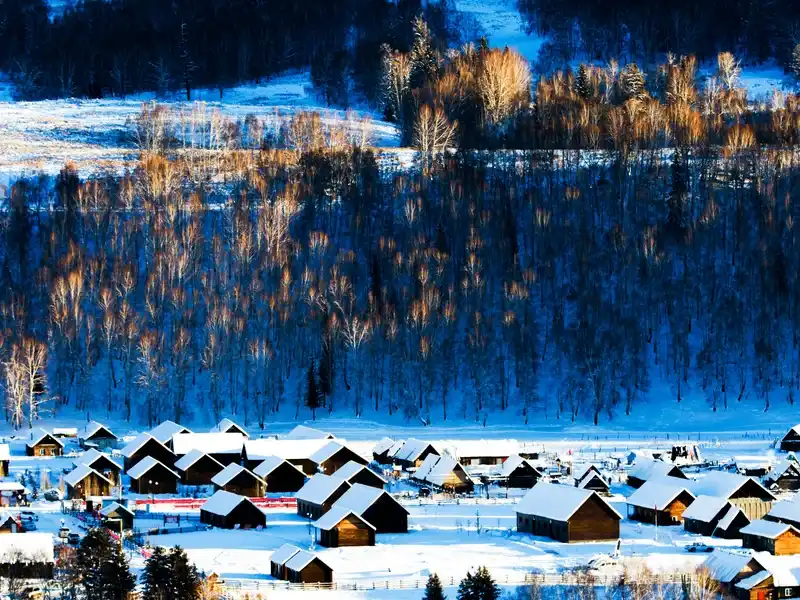
Covered in over a meter of snow, birch branches become black lines against white, cabin roofs piled thick—the entire scene is monochrome, broken only by warm yellow light from cabin windows. Below -20°C, but the quiet is absolute.
🎵 Tuvan Culture
Hemu's draw isn't only scenery—it's Tuvan culture: the Suur (a traditional reed instrument, recognized as intangible cultural heritage), Khoomei (overtone singing), and Tuvan log cabins built without a single nail.
💬 What Do Our Travelers Say?
"Stayed two nights. Couldn't sleep the first—pine scent in the room, firewood crackling in the stove, wind moaning through the birch forest outside. All these sounds together beat any white-noise app. Next morning I pushed open the door to a foot of fresh snow—the entire world was black and white." — Guangzhou Lao Chen ⭐⭐⭐⭐⭐
"Autumn morning mist at Hemu—woke at 5 AM, walked to the viewpoint in darkness. Ten minutes before sunrise, everyone fell silent. Then the sun came out, golden light flooding the entire valley—smoke, mist, birch trees all turned gold simultaneously." — Chengdu Photographer Da Mai ⭐⭐⭐⭐⭐
Hemu Doesn't Need Filters—It Needs Time
Hemu asks you to slow down—sit in front of a cabin all afternoon, watching the wind move through the birch leaves.
Want a stress-free and free-spirited journey?
Don't want to plan? Contact our senior travel designers now for your custom itinerary and quote.
Last updated: July 2026 Author: RoamFun Senior Travel Consultant Questions? Reach us at: vip@roamfun.net
Craving a worry-free yet free-spirited journey?
Don't want to plan it yourself? Contact our senior trip designer now for a route and quote tailored to you.

RoamFun Senior Travel Consultant
Travel DesignerProfessional travel consultant, curating the most practical travel guides for you.