Xinjiang Flower-Watching Guide: From Tianshan Pink Snow to Ili Purple Seas—A Veteran's Guide to Hitting the Bloom Window Without Pitfalls
Many people's impression of Xinjiang stops at autumn Kanas or summer's Duku Highway, but true Xinjiang veterans know that spring and early summer here are a visual feast bombarded in turn by seas of color. From March's Pamir Plateau desert apricot blossoms, to April's Ili 10,000-mu wild apricot forests, to May's Sayram Lake ice-melt flower seas, June's Huocheng lavender and Zhaosu rapeseed—this vast land virtually holds the ceiling of China's spring-summer beauty.
Yet Xinjiang's bloom windows are extremely brief and heavily influenced by each year's temperatures—one misstep and you "perfectly miss it." Many travelers, having checked the wrong guide or underestimated the North-South Xinjiang span, end up sighing at bare branches. To help everyone truly reach those little-known niche sanctuaries and properly watch this natural spectacle, the RoamFun team draws on years of frontline guiding, scouting, and multi-vehicle debriefs to compile this no-hype, all-substance flower-hunting mastery guide.
📍 Overview at a Glance
| Attribute | Standard Reference |
|---|---|
| Best Season | Late March to mid-July (different flower categories bloom in sequence) |
| Suggested Duration | 8 - 11 days (Xinjiang is vast—don't pack the schedule too tight; deep travel is core) |
| Per-Person Budget | ¥6,000 - ¥12,000 (varies by custom group size and accommodation standard; light-luxury high-value focus) |
| Difficulty | Moderate. Some plateau areas (e.g., Taxkorgan) have mild altitude fluctuation; some sanctuary mountain roads are rugged and require professional driving support |
🗺️ Itinerary Suggestion
For flower-watching in Xinjiang, never blindly jump between North and South. Chasing "want it all" means 10 hours in the car daily. We recommend locking the core region by month.
Route A: Spring Prelude · Southern Xinjiang Pamir Plateau Apricot Blossoms (Late March - Early April)
- Day 1: Nationwide - Kashgar
- Morning/Afternoon: Arrive in Kashgar. After airport pickup, check into a quality downtown hotel and rest briefly.
- Evening: Wander Kashgar Old City, hear a rawap tune in a century-old teahouse, taste authentic baked buns and red willow kebabs.
- Day 2: Kashgar - Baisha Lake - Karakul Lake - Muztagh Ata - Taxkorgan (Tashkurgan)
- Morning: Drive west along the China-Pakistan Highway. As altitude climbs, the ice-blue Baisha Lake and Baisha Mountain suddenly appear—intense color contrast, visually stunning.
- Afternoon: Pass Karakul Lake, viewing "Father of Ice Mountains" Muztagh Ata in the distance. Then arrive in Taxkorgan to process border pass (if not done in advance).
- Pro Tip: Today's altitude climbs from about 1,300m to 3,100m. Drink warm water en route; avoid jumping around.
- Day 3: Taxkorgan - Panlong Ancient Road - Xiabandi Reservoir - Ta'er Township (apricot blossom village deep experience)
- Morning: Challenge the internet-viral "Panlong Ancient Road"—hundreds of curves across the big and small panlong.
- Afternoon: Push deep into the Yarkant River Valley. At Ta'er Township, photograph the famous "Happiness No. 5 Bridge"—century-old cold-fragrance ancient apricots shade both banks, pink-white petals falling on the jade-green river.
- Evening: Check into a local Tajik characteristic residence or experiential camp, feeling pure ethnic-cultural atmosphere.
- Day 4: Ta'er Township - Kukoxiluke Township - Kashgar
- Morning: Chase the last apricot-blossom snow at the slightly higher-altitude Kukoxiluke Township. Villages here are more pristine, and blooms fade later.
- Afternoon: Safely return along part of the Tasha Ancient Trail, arriving back in Kashgar downtown by evening.
Route B: The Main Event · Ili Valley Panoramic Flower Chase (Early April - Mid-June)
By specific month, the Ili's center of gravity shifts:
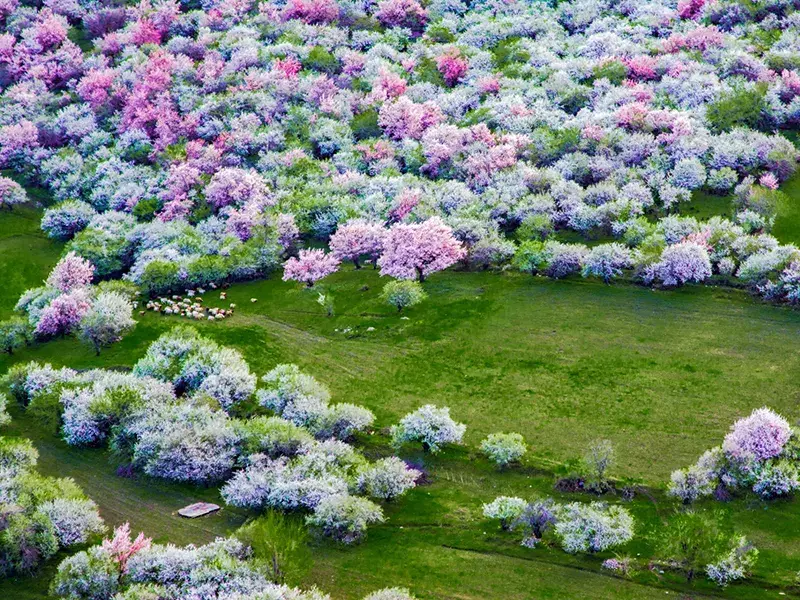
- Early-Mid April [Wild Apricot Wave]: Head straight for Xinyuan Tuergen Apricot Blossom Valley. Over 30,000 mu of primeval wild apricot forest left from the Middle Ages spills across the ridges. This severely tests vehicle clearance. On muddy post-rain dirt roads or steep slopes, our custom fleet's hardcore off-roaders like the "Tank 300" shine—high chassis, powerful 4WD—smoothly delivering quality-seeking travelers to the best viewpoints, sparing them the jolting fatigue of bad roads. Next, head to Huocheng Daxigou, where blooms run about a week later than Tuergen, and wild plum and cherry blossoms alternate blooming for a longer window.
- Late May - Early June [Sayram Ice-Break Flowers & Aerial Grassland]: Sayram Lake ice begins to melt—globeflowers, buttercups, and Tianshan primrose blanket the ground. Meanwhile, Nalati Aerial Grassland's wild lilies (ice-breaking flowers) push through the ice—towering snow peaks in the distance, green and blooms underfoot—layers maxed out.
- Mid-June - July [Purple Sea & Golden Waves]: Huocheng Lavender hits peak—10,000 mu of purple romance. Then cross the mountains—Zhaosu's million-mu rapeseed and perilla roll to the horizon, magnificently vast.
🎒 Pre-Departure Checklist
- **Documents**: Chinese mainland ID (carry on you—checkpoints are numerous); border pass (essential for Taxkorgan—can be processed in Kashgar, but best done in advance at your registered residence to save time).
- **Clothing**: March-April Xinjiang is still cold with unmelted Tianshan snow. You must bring windproof waterproof **hard-shell jacket + liner**, light down jacket, thermal underwear, fleece. Since flower-watching often means trekking up and down slopes, wear **high-top non-slip hiking boots**.
- **Medicine**: Rhodiola or altitude acclimation (for Southern Xinjiang backup), stomach meds, cold remedy, motion sickness pills (extremely many curves), high-moisture lip balm.
- **Electronics**: High-capacity power bank (cold drains phones fast), camera rain cover (Ili spring is rainy), multi-port charger.
- **Sun Protection**: High-SPF sunscreen (SPF50+), sunglasses, sun hat (plateau and grassland UV is intense).
💡 Practical Travel Tips
Realistic Expectations on Transportation: Xinjiang is enormous—any two points mean a 4-5 hour drive minimum. Choose an ordinary commercial vehicle and you'll often be forced to give up when hitting muddy side roads, mountain gravel, or unpaved tracks to niche photo spots—too low, not enough power—leaving you to squeeze onto buses at scenic-area gates with the ordinary crowds. Choosing a hardcore off-roader that balances off-road capability with cabin comfort is the core guarantee of a deep flower-watching trip. Our operations team strictly controls daily pure-drive time when designing routes—no fatiguing drives.
Realistic Expectations on Accommodation: Apricot blossom season and lavender season are Xinjiang's "super-hot" windows. Counties where Tuergen sits, or villages in Taxkorgan, have limited local reception capacity—quality hotels and guesthouses sell out half a month before bloom. Booking last-minute often means rough guesthouses. The RoamFun consultant team pre-blocks quality exclusive rooms at each core flower spot—so after a day of stunning blooms, you can take a satisfying hot shower and sleep soundly.
📸 Photography & Photo-Op Guide
- Tuergen Apricot Blossom Valley:
- Best Spot: Xianhua Terrace, Lieying Terrace, and the opposite ridge. Don't just stay on the ridge—walk down into the valley and use the slope for composition.
- Best Time: 1-2 hours after sunrise and 1 hour before sunset. Side-backlight traces the elegant mountain lines; apricot branches are backlit translucent, glowing tender pink-white—layers absolutely divine.
- Ta'er Township Happiness No. 5 Bridge:
- Best Spot: Stand on the bridge and use a drone for top-down shots. Kunlun snow peaks as background, blue-green Yarkant River in an S-curve, pink ancient apricots wrapping the bridge.
- Best Time: 3 PM - 5 PM, when sunlight crosses the canyon ridges and spills into the village—dappled light and shadow.
High-Conversion FAQ
Q1: What's the temperature like for Xinjiang spring flower-watching? Do I need short sleeves?
Xinjiang's spring (March-May) temperatures are wildly unstable. Overall it swings between $-10^\circ\text{C}$ and $20^\circ\text{C}$. In direct daytime sun it may feel warm, but day-night swings are extreme, often with wind or showers. Absolutely do not bring only summer clothes or short sleeves. Down jacket and fleece hard-shell are lifesaving gear. Only by June's lavender season can you wear a dress for noon photos—but mornings and evenings still need a jacket.
Q2: What if the flowers haven't bloomed or have already faded when I arrive due to weather?
This is exactly why we don't recommend blind "free travel." Xinjiang's bloom windows shift subtly by altitude, latitude, and hourly temperature. RoamFun's senior veteran leaders and forward scouting cars sync the truest bloom progress to the group chat daily. If a specific valley is pre-bloom or post-peak, our custom operations team triggers Plan B—leveraging the off-roader's capability to seamlessly switch you to another "substitute sanctuary" at slightly lower or higher altitude—ensuring you never go home empty-handed.
Q3: Will I get severe altitude sickness apricot-blossom watching on the Pamir Plateau?
The Southern Xinjiang flower route (e.g., Datong Township, Ta'er Township) sits mostly around 2,000m-2,500m—within the safe range; the vast majority of deep-travel enthusiasts adapt easily. The only higher points are Taxkorgan (about 3,100m) and the mountain passes en route. We carry emergency oxygen cylinders and professional blood-oxygen monitors in every vehicle. The itinerary uses a "stepladder adaptation" approach—as long as you stay relaxed and don't sprint around, you basically won't be troubled by altitude sickness.
Your Scenery Is Already on the Way
You've seen the delicate spring blooms beneath pavilions in misty Jiangnan. You must come see the great Northwest's splashed-ink, wildly vital life force. Whether the mountainside of pink beneath spring snow at the Tianshan's foot, or the globeflower sea blooming among ice shards at Sayram Lake—both are worth crossing a thousand kilometers for.
These fleeting beauties have only a 10-day shelf life each year. You don't need to spend time researching complex route threading, nor anxiety over not scoring a bloom-season hotel.
Updated: May 2026 Author: RoamFun Senior Travel Consultant Questions? Contact: vip@roamfun.net
Craving a worry-free yet free-spirited journey?
Don't want to plan it yourself? Contact our senior trip designer now for a route and quote tailored to you.

RoamFun Senior Travel Consultant
Travel DesignerProfessional travel consultant, curating the most practical travel guides for you.