Xinjiang Flower Season Calendar: A Month-by-Month Blooming Timetable from March Apricots to September Wildflowers
I've met far too many travelers who booked their flights, changed their hotels back and forth, only to arrive in Xinjiang and find the apricot blossoms had already fallen into a carpet of pale pink, or the lavender still just half-green, half-purple spikes. Flowers in Xinjiang are the most unforgiving things in the world—a week early and you get bare branches, a week late and you get bare twigs. The full bloom often lasts only seven or eight days, and whether you catch it or not comes down to how well you did your homework beforehand.
I'm not going to beat around the bush here. Straight to the substance: every flower in Xinjiang worth a dedicated trip, from March through September, laid out month by month in a single timetable. When it blooms, where it grows, the easiest way to get there, and every trap waiting for you—all spelled out one by one. Save this one article, and it beats scrolling through ten different guides.
📍 Quick Overview
| Attribute | Details |
|---|---|
| Best Flower Season | Late March to mid-July (different species bloom in relay as altitude rises) |
| Recommended Days | Don't overreach—lock onto 1-2 flower species per trip, 6-10 days of depth |
| Budget Per Person | RMB 6,000 - 12,000 (varies with flights, vehicle, and accommodation in peak/off season) |
| Difficulty | ★★★☆☆ (short bloom windows, huge distances; some spots are high-altitude or need a border permit) |
📅 Full-Year Bloom Timetable (Save This First)
Here's the single most important table up front. Want to chase a particular flower? Just match it up:
| Month | Flower | Best Viewing Spot | Key Reminder |
|---|---|---|---|
| Late Mar - Early Apr | Pamir Apricot Blossoms | Datong & Kukexiluge Townships, Taxkorgan | Border permit required; high altitude, short bloom |
| Early - Mid April | Turgen Wild Apricots | Turgen Apricot Valley, Xinyuan, Ili | Full bloom lasts only ~7 days |
| Early - Mid April | Wild Lilies (Snow Crocus) | Nalati, Kuerdening | Bloom right through the snow—don't miss them |
| Late Apr - May | Tianshan Red Poppies | Sangong Township, Huocheng; Gongliu | Flowers droop by midday—go early |
| Late May - June | Globeflowers & Androsace | Around Sayram Lake | Lake ice just melted—most photogenic |
| June | Grassland Wildflowers | Nalati, Kalajun, Tangbula | Bloom rises with altitude |
| Mid June - Mid July | Lavender | Lucaogou, Qingshuihe, Huocheng | Peak at late June to early July |
| Late June - Late July | Rapeseed Flowers | Zhaosu | One of China's largest rapeseed fields |
| July | Clary Sage & Sunflowers | Zhaosu, Tekes | Bloom alongside rapeseed, staggered |
| June - August | Alpine Meadow Wildflowers | Bayanbulak | Densest around Swan Lake |
| May - June | Kanas Wildflowers | Burqin, Altay | Autumn brings colorful forests instead |
Here's the honest truth to remember: flowers in Xinjiang bloom layer by layer as altitude rises. Within the same Ili River Valley, the apricot blossoms at the foothills are gone by early April, while the wildflowers on the highland meadows won't appear until June. So the biggest mistake in flower chasing is "seeing one guide and bolting toward a single spot"—you first need to figure out which altitude layer your target flower lives in.
🌸 Month-by-Month Bloom Calendar (This Is the Point)
Late March - Early April: Pamir Highland Apricot Blossoms
This is the earliest and wildest floral event in all of Xinjiang. Along the Taxkorgan River Valley, in Datong, Kukexiluge, and Ta'er Townships of Taxkorgan Tajik Autonomous County, the apricot trees spread out one by one. Unlike the manicured "scenic-area" feel of the Ili apricot valleys, here the blossoms are scattered around the Tajik families' earthen homes—tree after tree, framed by the distant Muztagh Ata peak and the Taxkorgan River rushing through the gorge. That collision of desolation and softness is something I still can't forget.
Pitfalls: You must apply for a border permit before going to Taxkorgan. These townships sit at 2,800-3,200 meters—cold mornings and evenings, blazing sun by day. The bloom is extremely sensitive to temperature: a warm winter can push it up to March 20, while a late cold snap can delay it to April 10. Always confirm repeatedly with locals before setting out.
Early - Mid April: Turgen Apricot Valley, Ili
The wild apricots of Turgen Township in Xinyuan County are the calling card of the Ili River Valley. Tens of thousands of acres of wild apricot forest blanket the hillsides, and at full bloom the pink-white sea of flowers ripples up the slopes layer by layer—"a Jiangnan beyond the Great Wall" is no exaggeration.
Pitfalls: The full bloom at Turgen lasts only about a week, no matter how you spin it. Many people look at last year's photos online and find this year doesn't match, precisely because they didn't nail those few days. The best strategy: don't lock your itinerary to a single date. Leave two or three days of flexibility, and rather than gambling on a fixed date, wait on standby in Yining ahead of time.
Early - Mid April: Nalati Wild Lilies (Snow Crocus)
This one is my personal hidden gem. In April, the Nalati grassland is still half snow, half grass. Before the snow has fully melted, the white crocus (locals call it "ding bing hua," the flower that pushes through ice) bursts out of the frozen earth, blooming against the lingering snow. The scene is strangely magical—like the grassland itself impatiently announcing spring.
Pitfalls: Snow crocus blooms are extremely short-lived, often gone after a single spring rain. To catch them, watch Nalati's real-time snow line and weather forecast closely—generally the most reliable window is around April 10.
Late April - May: Tianshan Red Poppies (Wild Poppies)
Around Sangong Township in Huocheng County and Gongliu, the Tianshan red poppies (botanically "Shirley poppies," which locals just call wild poppies) blanket the green meadows in fiery red, looking from a distance like the earth itself has caught fire.
Pitfalls: Wild poppies have a "moody" streak—once the midday sun beats down, the petals droop and curl up. They only stand tall in the early morning and late morning. So you must go early: set out at first light and be on site before 10 a.m. After noon, you've made the trip for nothing.
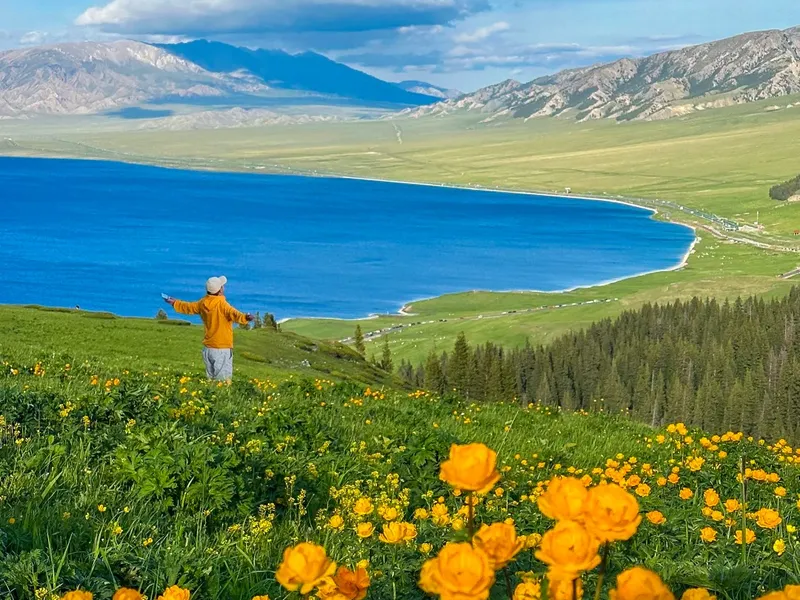
Late May - June: Sayram Lake Globeflowers
Sayram Lake is known as "the last teardrop of the Atlantic." In late May and early June, the lake ice has just melted, and the lakeside meadows burst with a dense carpet of globeflowers and androsace. Azure water, freshly melted floating ice, and a golden blanket of flowers—those three colors stacked together make, in my mind, the single greatest scene of early summer in Xinjiang.
Pitfalls: It's windy by the lake, and it feels noticeably colder than the forecast suggests. The Duku Highway is usually not yet fully open at this time, so the route detours through Guozigou—leave extra time on the road.
June: The Wildflower Sea of the Ili Grasslands
Nalati, Kalajun, and the Tangbula "Hundred-Mile Gallery" are all flowers in June. This is the time to hire an off-road vehicle and drive slowly along the river valley, pulling over whenever you spot a beautiful flower-covered slope. No need to rush between scenic spots—the road itself is the scenery.
Pitfalls: By June, Ili has entered peak tourist season, so book tickets and shuttle buses for popular scenic areas in advance. The truly comfortable way to play is to have your driver take you along unpaved back roads, avoiding the crowds of tour buses.
Mid June - Mid July: Huocheng Lavender
This is the "top stream" of Xinjiang's flower season. The lavender fields around Lucaogou and Qingshuihe Townships in Huocheng County rival Provence in scale. The Jieyou Gongzhu Lavender Garden is the popular check-in spot, but the real money shots are usually the unmanaged roadside fields, purple stretching to the horizon.
Pitfalls: Lavender peaks from late June to early July, then harvesting begins in mid-July, thinning out the farther you go. If you want that full-screen purple, don't drag it into mid-July.
Late June - Late July: Zhaosu Rapeseed Flowers
Zhaosu's rapeseed fields are among the largest in China, and because of the high altitude (around 1,800 meters), they bloom later than inland—perfectly picking up where early summer in Ili leaves off. The golden sea of flowers against distant snow mountains and galloping horses is wallpaper material in a single casual shot.
Pitfalls: Zhaosu sits at altitude, with big temperature swings between day and night. In July, clary sage and sunflowers bloom at the same time here, alternating purple and yellow—plan your route to see them all in one go.
June - August: Bayanbulak Highland Meadow Wildflowers
Bayanbulak is a highland wetland grassland. From June to August, its meadows bloom in wave after wave, especially around Swan Lake. Unlike Ili, it's not hot here—daytime highs in July are only around 20°C—making it the perfect combination of a summer escape and flower viewing.
Pitfalls: Bayanbulak's weather is unpredictable; you can get sun, rain, and snow in a single day, so pack accordingly. Shuttle bus frequency in the scenic area is limited—don't overpack your itinerary.
🎒 Pre-Trip Checklist for Flower Chasing
- **Documents**: Original ID card, border permit (essential for Taxkorgan on the Pamir Plateau)
- **Clothing** (onion-style layering): quick-dry base layer + fleece/light down + hard-shell jacket. Temperature swings are extreme, and it's especially windy at the flower fields
- **Medicine**: High-SPF sunscreen (intense highland UV), artificial tears (heavy pollen makes eyes itch), ibuprofen (for high-altitude headaches)
- **Electronics**: Large-capacity power bank, drone (aerial shots of flower seas are unbeatable—bring spare batteries and filters)
- **Other**: A pair of dirt-tolerant shoes (dew and mud in the fields), a lightweight tripod (essential for flower-sea portraits)
💡 A Few Honest Truths
Don't believe the nonsense that "you can see flowers in Xinjiang any month." Xinjiang's bloom windows are shockingly short—especially apricots and snow crocus. Miss those few days and it's gone for the year. Either stake out the spot in advance, or treat flower chasing as "serendipity"—don't bet your entire trip on a single flower.
Bloom dates shift every year; research done a month or two in advance is basically useless. Whether the previous year was a warm winter or a late cold snap can move the bloom by a week or more. A week before departure, always confirm in real time through local drivers, guesthouse owners, or official scenic-area channels—don't use last year's guide as this year's timetable.
The most worthwhile money in flower chasing is a local driver who knows the roads. Bloom is dynamic; the best fields are usually not on your GPS but on the back roads in a driver's head. He can help you dodge crowds, take shortcuts, and skip the patch that's already wilted, delivering you straight to the one that's blooming right now. That's the right way to chase flowers.
📸 These Shots Will Come Out Completely Different
- Pamir apricots + earthen homes + snow mountains: Stand behind a Tajik family's earthen house, use the apricot blossoms as foreground, and frame Muztagh Ata in—desolation and softness in one frame
- Sayram Lake globeflowers: Get low and shoot along the flower carpet, with globeflowers as foreground and lake water and floating ice as background, blue sky and white clouds mirrored on the surface
- Lavender fields: Pick an empty field, use a telephoto lens to compress the space, letting the purple rows stretch to the horizon
- Zhaosu rapeseed + snow mountains: Stand on a field ridge and shoot the golden sea against snow-mountain backdrops—colors are richest in the afternoon when backlit by the sun
💬 What RoamFun Travelers Say
"Last year I wanted to see the Turgen apricots but mistimed it and arrived to find only fallen petals. This year with RoamFun, my driver kept an eye on the local bloom the whole way, and we arrived right at full bloom—a sea of pink and white across the hillside. Totally worth it." — Azhe, Hangzhou ⭐⭐⭐⭐⭐
"The globeflowers at Sayram Lake were the most dreamlike scene I've ever witnessed. The lake glowed blue, the ground beneath my feet was all golden flowers, and when the wind blew it was like scattering gold dust. Our driver even took us around to the quieter eastern side of the lake, so our photos had not a single person in them." — Yoyo, Guangzhou ⭐⭐⭐⭐⭐
The Romance of Flower Chasing Belongs to No One Who Hesitates
Xinjiang's flowers are a grand show staged only once a year—and there are never any refunds. No matter how carefully you research or how many guides you bookmark, nothing beats a person who understands the bloom, leading you to stand in the right field on the right day.
Don't let "I'll see it next year" turn into a never-ending next year. The flowers will fade, but that memory of watching ten thousand acres of blossoms stretch to the horizon will stay with you forever, brighter than any photograph.
Craving a worry-free, free-spirited journey?
Don't want to plan? Contact our senior trip designer now for your custom route and quote.
Updated: August 2026 Author: RoamFun Senior Travel Consultant Questions welcome: vip@roamfun.net

RoamFun Senior Travel Consultant
Travel DesignerProfessional travel consultant, curating the most practical travel guides for you.