Xiahe to Langmusi: How Far? 190 km in 4 Hours — Segments, Road Conditions and Where to Stay
Let me describe a scene I've watched too many times. A client finishes at Labrang Monastery in Xiahe, looks at his watch — only 2 PM — and decides 190 km is nothing: a couple of hours' drive, so he'll do a day trip. Xiahe in the morning, Langmusi in the afternoon, photos, then drive back to Xiahe that night. Sounds efficient. What actually happens: he reaches Langmusi at 7 PM as the light fades, takes two photos in town, starts the dark drive back at nine, and gets in near midnight. The next day he tells me: that was basically nothing at all.
190 km. The app says 3.5 hours. In reality you should plan for 4 hours of driving and 6–7 hours with stops. It isn't bad roads — it's that Sangke Grassland and Gahai Lake sit in the middle, two places you will absolutely stop at, plus dense average-speed cameras on the G213 and yaks wandering across whenever they feel like it. Your average speed simply won't climb. Plan by the app's clock and you'll be driving in the dark.
This piece covers the mileage, road surface, speed cameras, fuel stops and where to sleep. By the end you'll know whether this leg should be a day trip or an overnight.
😤 Numbers First: 190 km / 4 Hours / Five Segments
| Segment | Distance | Pure driving | Road | Elevation |
|---|---|---|---|---|
| Xiahe → Sangke Grassland | ~15 km | 20 min | County road, smooth | 2,850→3,000 m |
| Sangke Grassland → Hezuo | ~50 km | 50 min | G213, good | 3,000→2,980 m |
| Hezuo → Luqu | ~80 km | 1.5 h | G213, good, many cameras | 2,980→3,200 m |
| Luqu → Gahai Lake | ~5 km | 10 min | G213, good | 3,200→3,480 m |
| Gahai Lake → Langmusi | ~40 km | 1 h | Provincial road, rolling | 3,480→3,300 m |
| Total | ~190 km | ~4 hours | Fully paved throughout | Max 3,480 m |
Add 40 minutes at Sangke, an hour at Gahai Lake and half an hour for lunch and you're at 6–7 hours. A day trip? That's eight hours of driving plus three hours of sightseeing — eleven hours minimum. Work out for yourself whether that's worth it.
🚗 Road and Vehicle: the Easiest Driving in Gannan
First the good news: the whole leg is paved, mostly national highway G213, smooth surface, no problem at all for an ordinary sedan. I've seen tiny city cars on it and I've seen coaches on it. It's nothing like the county road from Langmusi to Zhagana — no sustained switchbacks here.
Three things to keep in mind:
- Dense average-speed camera zones. Hezuo to Luqu is where people get caught most; limits swing between 60 and 80. Your app will announce them — let it.
- Yaks and sheep crossing. The stretch from Luqu toward Gahai Lake is the worst. Slow to under 30 when you see a herd and don't honk — it panics them into running at you.
- Afternoon showers in July and August. Wet surface plus early darkness on the plateau: try not to still be on the road after 4 PM.
🗺️ Segment by Segment: What to Watch For
Segment 1: Xiahe → Sangke Grassland (15 km, 20 minutes)
South out of Xiahe and the grassland appears almost immediately. In July and August the slopes are thick with wildflowers; turn off at a safe junction and stop for half an hour.
- Watch out: don't drive deep into the pasture and crush the grass — herders mind. Park on hardened ground at the roadside and walk a few steps in.
- Horse rides: 50–100 yuan a lap. Agree the price first — per lap or per hour. The child leading the horse may not speak Mandarin; gestures and a smile are enough.
Segment 2: Sangke Grassland → Hezuo (50 km, 50 minutes)
Back on the G213 heading south. Hezuo is the prefectural capital and the biggest supply point on this route.
- My tip: top up fuel and water in Hezuo, and pick up two oxygen canisters and some ibuprofen at a pharmacy while you're there. Options thin out after this.
- Optional stop: the Milarepa Pagoda is in Hezuo city, about 20 yuan, worth an hour if you're interested. In a hurry, take the ring road around the centre rather than getting stuck in traffic.
Segment 3: Hezuo → Luqu (80 km, 1.5 hours)
The longest segment, and the one with the most cameras and the most yaks. The scenery shifts gradually from river valley to alpine meadow.
- Watch out: lunch spots are thin on this stretch. Keep snacks in the car.
- My tip: get out and stand for a minute every hour. The climb is noticeable here (2,980→3,200 m) and sitting sealed in the car makes people feel stuffy.
Segment 4: Luqu → Gahai Lake (5 km, 10 minutes)
The highest point of the whole trip, 3,480 m. Gannan's largest freshwater lake, a plateau wetland where migratory birds gather in summer and the water mirrors the snow peaks. Around 30 yuan entry.
- Watch out: don't jump out and run. This is the most likely place on the route to feel something — sit for two minutes, then walk slowly.
- My tip: keep the stop under an hour, don't overstay it. Late-afternoon light is best; midday top light is flat.
Segment 5: Gahai Lake → Langmusi (40 km, 1 hour)
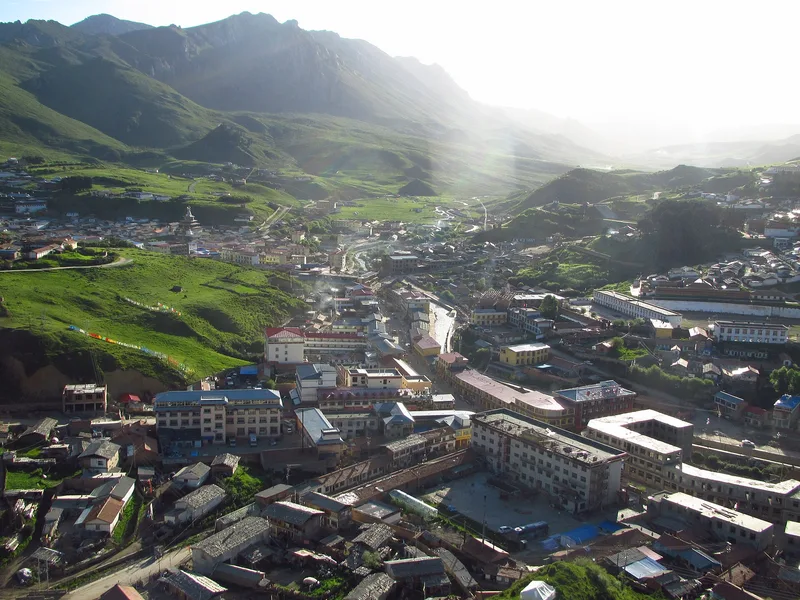
Provincial road, gently rolling, elevation descending. Langmusi straddles the Gansu–Sichuan border with the Bailong River running through the middle — Sertri Monastery on the north bank, Kirti on the south.
- My tip: stay the night. Climb the slope behind town at 6:30 AM for red walls, gold roofs and cooking smoke in the morning mist. It's one of the most moving sights in Gannan, and day-trippers never see it.
🎒 Practical Checklist
⚠️ Don't say I didn't warn you: a day trip means climbing up and straight back down, with no chance for your body to adapt — and then driving in the dark on top of it. Unless you genuinely can't spare the time, stay a night in Langmusi.
- Fuel: proper stations in Xiahe and Hezuo. Fill up in Hezuo. Langmusi only has a small station that may not carry every grade.
- Speed limits: dense average-speed cameras on the G213, mostly 60–80, especially Hezuo to Luqu.
- Cash: horse rides, grassland guesthouses and stalls are mostly cash-only. Bring two or three hundred yuan in small notes.
- Lodging: Langmusi guesthouses run 150–350 yuan a night. Book ahead in peak season (July–August and the October holiday).
- Tickets: Gahai Lake around 30 yuan, Kirti Monastery around 30 yuan, Sertri Monastery charged separately.
- Clothing: a shell jacket, no excuses. Mornings, evenings and passes drop below 5°C.
💡 A Few Honest Truths
190 km isn't far, but this leg deserves a full day. It strings together Sangke Grassland and Gahai Lake, two of Gannan's signature sights. Drive it flat out and you've paid for a stretch of road and nothing else.
Langmusi is the most passed-through place, and the one most worth staying in. Most people day-trip from Xiahe, take one photo and leave. Stay a night and you get the morning mist, the incense smoke, and a main street with nobody on it but you. None of that costs anything.
Don't miss the turn at Luqu. On the outskirts of Luqu, the G213 continues south toward Maqu and Jiuzhi; you turn southeast onto the provincial road for Langmusi. The sign is small and harder to read at night. If it's getting late, sleep in Luqu.
Don't gamble on the speed cameras. I've seen too many people open a fine notice after they got home. Drive to whatever limit the app announces — the scenery is actually better at sixty anyway.
📸 Don't Shoot Blindly — These Spots Work
- Sangke wildflower slopes: July and August, wide and low, flowers in front, mountains behind.
- The meadow highway south of Hezuo: yak herds drift into frame; a long lens compresses it beautifully.
- Gahai Lake birdwatching platform: dawn or dusk, water mirroring the snow peaks, long lens for birds.
- The viewpoint behind Langmusi: 6:30 AM, mist, cooking smoke and red-and-gold roofs together.
- Bailong River source gorge: just outside town, clear water, slow shutter for the flow.
💬 What Travellers Who Came With RoamFun Said
"We were going to day-trip it, then took the advice and stayed a night in Langmusi. At half past six the next morning I climbed the slope and had the whole street to myself — the sound of the Bailong River mixed with the monastery bell in the mist. That moment paid for everything." — Xiao Ye, Hangzhou ⭐⭐⭐⭐⭐
"There really are a lot of speed cameras on the Hezuo–Luqu stretch. I drove to the limit the whole way and checked afterwards: no fines. A friend who ignored them got two notices at home. Not worth saving." — Lao Liu, Chongqing ⭐⭐⭐⭐
190 km — the Smartest Plan Spends One Extra Night
I've driven this route more than twenty times and my advice has never changed: don't day-trip it. Eight hours of driving there and back plus three hours of sightseeing is eleven hours minimum, and what you get is two exhausted evenings and one dark drive. Staying a night costs a hundred or two in room rates and half a day — and buys you a complete morning, which is the moment Langmusi is actually beautiful.
Concretely: leave Xiahe at 8 AM, 40 minutes at Sangke Grassland, lunch and supplies in Hezuo, an hour at Gahai Lake, arrive in Langmusi around 4 or 5 PM, visit Kirti Monastery and sit in a teahouse on the main street, then leave after the morning mist the next day. Done that way, this leg is complete.
Three final small things: fill up in Hezuo, don't wait for the fuel light; drive to the posted limits, because I've seen too many people open fines after this trip; and in peak season book Langmusi accommodation in advance — the town doesn't have many rooms and you'll be stuck if you leave it late. Do those three and this leg rarely goes wrong.
Heading on to Zhagana? See Xiahe to Zhagana: How Far and How Long? (/travel-guide/gansu/gansu-xiahe-zhagana-distance-time-guide/); for how the elevation moves, see Altitude from Xiahe to Langmusi (/travel-guide/gansu/gansu-xiahe-langmusi-altitude-guide/).
Craving a worry-free yet free-spirited journey?
Don't want to plan it yourself? Contact our senior trip designer now for a route and quote tailored to you.
Updated: September 2026 Author: RoamFun Senior Travel Consultant Questions? Contact us: vip@roamfun.net

RoamFun Senior Travel Consultant
Travel DesignerProfessional travel consultant, curating the most practical travel guides for you.