Stunning! Zhagana + Seven-Color Danxia: 20 Essential Photo Spots for Epic Gansu Travel Photography
Many people fly all the way to the great northwest with cameras and drones galore, only to produce photos indistinguishable from everyone else's tourist shots. Either they shoot at noon under blazing sun—everything bleached white—or they can't find the right angle, turning a fairy-tale secret realm into a dusty hillside.
Last month I led a photography group back from Gansu. Those online speed-run guides only tell you "it's beautiful, come shoot"—but they don't tell you what time Zhagana's morning mist is most likely to clear, which Danxia viewing platform needs telephoto to produce ink-wash painting textures. Scenery is dead; light and angle are alive.
Listen to me, don't turn your precious travel photography into a "military march." Today, as an outdoor veteran with 15+ years in the northwest, I'm not playing games—I'm directly revealing the 20 epic photo spots our team uses for clients. With this guide, locked-in timing and spots, you too can blow up your social media!
🚙 Veteran's Straight Talk: Which Vehicle Best "Avoids Pitfalls"?
Fans often ask: "I have a full photography kit—can I rent a regular sedan for Gansu travel photography?"
Straight talk: If you're just skimming through, a sedan barely works. But if you want to capture truly stunning scenes, a sedan will frustrate you to death. We need to reach Zhagana for Tibetan village sunrise, Seven-Color Danxia for sunset—some heavenly angles are hidden on unpaved gravel paths or extremely steep dirt roads. Sedans have low clearance—any pothole means slowing down or getting stuck, let alone off-road crossing. Plus, photography gear is heavy (camera bodies, lenses, tripods, drones, multiple outfit changes)—a sedan trunk stuffed full means a cramped interior. Days and nights of long drives leave passengers with aching backs—what energy for creative work at the shooting spot?
For this visual feast geared toward ultimate photography, if traveling with friends, companions, or family, listen to me, go with a high-clearance Toyota Prado or a spacious 7-seat business van (like Buick GL8 or Trumpchi M8).
- Off-Road Crossing Top Choice (Toyota Prado): If you want to explore undeveloped nameless wilderness between Gannan and Zhangye, or shoot hardcore off-road action, the Prado's high clearance and powerful 4WD are your backbone. Rough roads, mud, gravel—drive right through. You can even drive to nameless hilltops and use the vehicle as a background for hardcore road-trip shots.
- Gear-Friendly / Comfortable Top Choice (7-Seat Van): If the itinerary is mainly standard routes, a 7-seat van is the perfect mobile photography studio. The massive trunk holds all telephoto lenses, tripods, and drone cases securely. The middle-row independent airline seats recline flat—during long drives, you can peacefully charge cameras and select photos on an iPad in the back, greatly preserving the photographer's energy.
- Leave Road Conditions to Professionals: Gansu travel photography's biggest taboo is fatigue driving. Hand the wheel to a local professional driver who knows every curve's speed limit, knows which mountain has the best light at what minute. You focus on spotting scenery from the window—arrive at the spot and start shooting. That's what quality travel photography should be.
🗺️ Hard-Earned Itinerary—Just Follow Along
This route is customized for photography enthusiasts and demanding travel photographers—no backtracking, timing locked to each day's best photographic light.
Day 1: Lanzhou - Linxia - Sangke Grassland - Xiahe
- Itinerary tip: From Lanzhou to Gannan, you'll pass many Hui-Tibetan cultural towns. When photographing in religious sites, never point a large lens at someone's face—especially praying devotees. Maintain basic respect.
- Road warning: About 240km total. Mountain roads increase after entering Gannan, altitude gradually rises. The business van's stable chassis greatly reduces dizziness from long mountain roads.
- Veteran's advice: Arrive at Labrang Monastery around 4 PM. Slanting sunlight gives the vermilion prayer wheel corridor walls the strongest texture. Don't shoot at the main entrance—walk along the outer prayer path, position at a corner, wait for a red-robed lama to pass, and snap at 1/200s—instant human element.
Day 2: Xiahe - Langmu Temple - Zhagana (First Sight of Stone City)
- Itinerary tip: For Langmu Temple's Namo Grand Canyon photography, absolutely don't go at noon. Canyon light is dead black and white—contrast too extreme for cameras to record. Enter the canyon after 3 PM.
- Road warning: About 300km total. Mountain roads from Langmu Temple to Diebu's Zhagana have extremely sharp curves and steep descents. In our Prado or business van, high visibility and comfortable seats save everyone a lot of suffering.
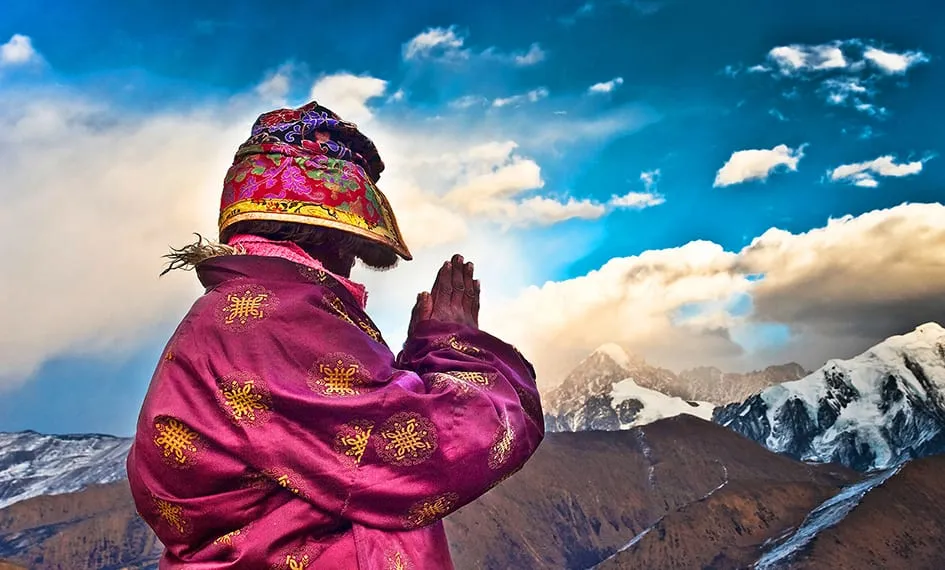
- Veteran's advice: Arrive at Zhagana before evening—don't rush to the scenic boardwalk. Have the driver take you to the nameless platform high in Yeri Village. When sunset's last rays hit the thousand-meter stone peaks, the entire stone city turns gold. Switch to telephoto, capture a close-up of century-old wooden houses beneath the peaks—this is the real-life nine-color Shambhala.
Day 3: Zhagana (Full-Day In-Depth Photography: Sunrise, Sea of Clouds, Ancient Tibetan Villages)
- Itinerary tip: Zhagana's biggest taboo is sleeping in. If you can't wake up, you've wasted the trip. Set up your tripod by 5:30 AM—don't squeeze into the crowded Platform 1.
- Road warning: All day traveling between Zhagana's four villages—steep, narrow roads that severely test the driver's mountain driving skills.
- Veteran's advice: Morning, position at the photography high points of Yeri Village or Dari Village. Morning mist wraps like a white ribbon between stone peaks and Tibetan villages—use an ND filter for slow-shutter sea of clouds, or fly a drone to 200m for overhead shots. Afternoon when sunlight is good, go to Fairy Meadow—have someone wear Tibetan clothing or a solid-color long dress stand in the meadow center, with the massive cliff stone city as background, capturing the epic feel of humanity dialoguing with sacred mountains.
Day 4: Zhagana - Rockwell Road - Hezuo - Linze/Zhangye
- Itinerary tip: If taking the hardcore "Rockwell Road" crossing to Zhangye, sedans absolutely shouldn't attempt it. Heavy rain can cause landslides and mud—let the driver adjust the route based on real-time weather.
- Road warning: Rockwell Road has nearly 100km of unpaved gravel—extremely bumpy. In a Toyota Prado, the powerful 4WD chassis and off-road suspension filter out most vibration, letting you pass steadily.
- Veteran's advice: Along Rockwell Road, the Gongbanamo Mountains and alpine meadows are incredibly desolate. Find a safe straight road section—have someone stand in the middle of the road (watch for traffic), camera low and far, use 200mm telephoto to compress space, shooting an endless hardcore road-trip epic.
Day 5: Zhangye (Seven-Color Danxia: Stunning Sunset and Macro Landforms)
- Itinerary tip: Never go to Seven-Color Danxia at noon! Direct midday sun makes mountains look grayish with no layering—pure roasting.
- Road warning: Main roads, excellent conditions.
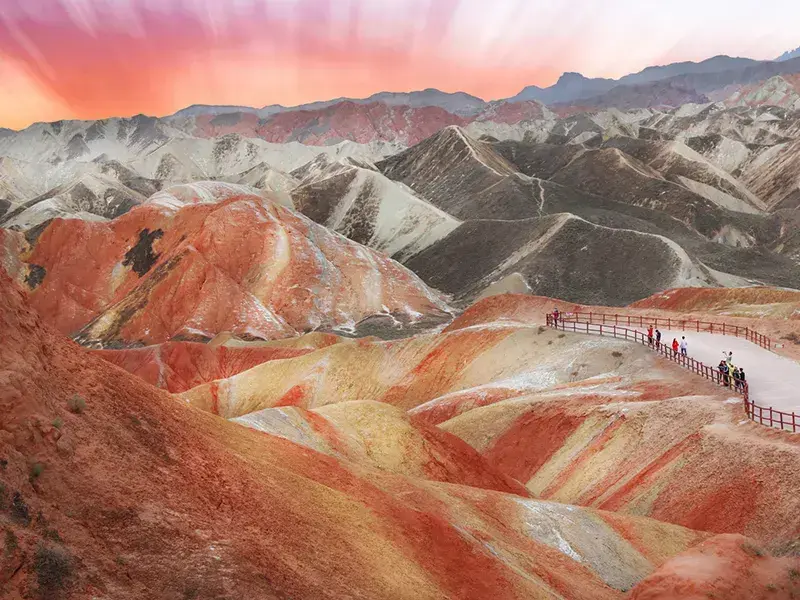
- Veteran's advice: Enter from the North Gate after 5:30 PM. The scenic area is large—commando photographers take the shuttle straight to Platform 4 (Hongxia Platform). In the twenty minutes after sunset, set your camera's white balance to "cloudy" or fine-tune color mode—looks average to the eye, but through the lens, the mountain's red, yellow, and cyan are fully activated, colors that take your breath away.
🎒 Practical List: Bring These to Suffer Less
⚠️ Don't say I didn't warn you: Travel photography's biggest fatal mistake is "prioritizing style over warmth, underestimating northwest wind and sand." Don't just bring a suitcase of thin summer dresses. Zhagana mornings are only 5-6°C—wind will freeze your hands until you can't press the shutter. And the great northwest's strong wind and sand are gear killers—without protection, your expensive lenses and drones will be destroyed in three days.
- Outfits & Color Coordination: To complement Zhagana's stone city and Danxia's intensity, avoid flashy patterns. Top choices: pure white, true red, bright yellow, earth khaki, or deep black. White long dresses look ethereal against green meadows and gray stone cities; true red shawls or dresses have unbeatable visual impact against Zhangye's Danxia. Bring a hardcore hard shell jacket—lifesaver for morning sunrise shoots.
- Gear Protection: Bring a sturdy air blower, lens wipes, and dust cover. Seven-Color Danxia and Gobi have massive wind and sand—change lenses quickly, ideally inside the car, or CMOS dust will have you crying in post-processing.
- Sun Protection & Moisturizing: High-SPF sunscreen, UV sunglasses (essential—plateau and Gobi sun is blinding, can't keep eyes open for photos without them). Prepare lip balm and high-moisture face masks—northwest dryness makes face makeup easily cakey.
- Essential Medicine: Rhodiola or glucose (for mild altitude on Rockwell Road), cold medicine (large temperature swings easily cause chills), berberine (prevent stomach issues from beef and lamb affecting shoots).
💡 Heart-to-Heart Truths
About drone regulations: Most of Gannan and Zhangye are drone-friendly, but specific monastery core zones like Labrang, and Danxia areas near low-altitude flight bases, are strict no-fly zones. Check the app warnings before takeoff—don't wait until your drone is shot down or you're fined to regret it.
About accommodation pitfalls: July-August peak season, Zhagana and Zhangye scenic village lodging is extremely expensive. Never book online "starry sky camping tents"—the photos are photoshopped. Reality: high altitude, cold nights, wind and sand, communal bathrooms with no hot water—exhausting you so much you can't shoot sunrise the next day. Stay with our fleet in Tibetan village boutique guesthouses with floor heating and large scenic windows.
About northwest dining: Northwest food is mainly noodles, beef, and lamb—heavy flavors. Travel photography often misses meal times waiting for light—have the driver stock the car with mineral water and high-calorie dry food (Snickers, beef jerky). After eating lamb, absolutely no ice-cold drinks or watermelon—lamb fat solidifying in the stomach causes severe diarrhea. Countless photographers have fallen into this trap.
📸 Don't Shoot Blindly—These Spots Are Stunning
- Spot 1 (Zhagana Yeri Village Morning): 6:30 AM, stand on the wooden boardwalk above Yeri Village. Use 70-200mm telephoto aimed at Dongwa Village opposite. Morning mist drifts at mid-mountain—century-old Tibetan village wooden roofs peek through, backed by thousand-meter cliffs—looks like a living ink-wash fairyland.
- Spot 2 (Zhagana Fairy Meadow): 3 PM, have the model in solid-color clothing sit on the meadow's wooden chair, lower the camera. Wide angle shooting upward captures near meadow, mid-ground person, and background massive stone city in one frame—epic spatial and saga feel.
- Spot 3 (Zhangye Seven-Color Danxia Platform 4): After 7 PM, sunset hits the ridge line. Walk to Platform 4's highest point—don't shoot flat light, find a ridge line where front light meets backlight. Lower exposure compensation by 0.7 stops (EV-0.7) to capture the mountain surface's colored stripes with silk-like flowing texture.
- Spot 4 (Labrang Monastery Vermilion Prayer Wheel Corridor): 4:30 PM, find an empty section of prayer wheel path. Photographer stands at the corridor's depth end, using a large-aperture prime (like 85mm F1.4). Model walks slowly along the red wall—use the slanting Tyndall light rays to capture the side silhouette, incredibly story-rich.
💬 What RoamFun Travelers Say
"As an amateur photography enthusiast, this Gansu trip was absolutely satisfying! Took the consultant's advice and chose the Toyota Prado—the driver was incredibly professional, Rockwell Road was super smooth. What moved me most was the driver knew several completely tourist-free wild photo spots, helped me and my friend shoot many aerial epics—great aesthetic sense!" — Shanghai, photographer Vivi ⭐⭐⭐⭐⭐
"Brought full gear and outfits. RoamFun arranged the Trumpchi M8 van. Hundreds of kilometers of driving, my friend and I slept soundly in the middle-row airline seats—fully preserved energy. Timing was spot-on—caught Zhagana's stunning morning sea of clouds and Danxia sunset. Photos blew up Xiaohongshu!" — Hangzhou, independent designer A Chun ⭐⭐⭐⭐⭐
🚙 Go Use Your Lens to Keep This Landscape for the Rest of Your Life
The great northwest's scenery never deigns to live in influencer filters. Its beauty carries the scent of earth, the coldness of stone, the hardcore and desolate character carved by millennium of wind and sand. When your lens captures the first golden morning ray piercing Zhagana's thick fog, when Seven-Color Danxia's vivid colors deepen and intensify on your monitor as the sun sets, in that moment you'll understand—some awe makes words pale. Only the shutter sound can prove it was once burning hot.
Don't waste your precious photography vacation on fatigue driving, complex route checking, and ticket scrambling. The best angles—leave them to veterans.
Want a worry-free yet free travel experience?
Don't want to plan? Contact our senior customizers now for your exclusive route and quote.
Updated: June 2026 Author: RoamFun Senior Travel Consultant Questions welcome: vip@roamfun.net
Craving a worry-free yet free-spirited journey?
Don't want to plan it yourself? Contact our senior trip designer now for a route and quote tailored to you.

RoamFun Senior Travel Consultant
Travel DesignerProfessional travel consultant, curating the most practical travel guides for you.