Tiantishan Grottoes Guide: "Ancestor of the Cave Temples" + How to Spend a Liangzhou Day in Wuwei
Bottom line: If the Mogao Grottoes are Dunhuang's crown, then Tiantishan is one of the "origins" of China's cave temples — its pioneering "Liangzhou style" influenced Yungang and Longmen. Tiantishan's most distinctive image is a great Buddha standing serenely by a reservoir. Link Tiantishan (2–3 hours) + Wuwei's Leitai Han Tomb and Confucian Temple into a Liangzhou day, and pass the excavation site of the Bronze Galloping Horse along the way.
Of all the grottoes along the Hexi Corridor, most travelers know only Mogao and few make a special stop for Tiantishan. Founded more than 1,600 years ago during the Northern Liang period, this cave complex is regarded by scholars as an ancestor of early Chinese cave-temple art. Its fame doesn't match its size — and precisely because of that, it has kept a rare quiet.
1. Tiantishan Grottoes: get to know it first
- Location: Zhangyi Township, Liangzhou District, Wuwei — about 45–50 km from downtown, 1–1.5 hours' drive.
- History: founded in the Northern Liang era (first half of the 5th century), built with the participation of the eminent monk Tan Yao, and continued through the Northern Wei into the Ming and Qing dynasties.
- Significance: the "Liangzhou style" developed here — central pillar caves, sculpture and mural conventions — deeply influenced the Yungang Grottoes and central-plains Buddhist art. Hence "ancestor of the cave temples."
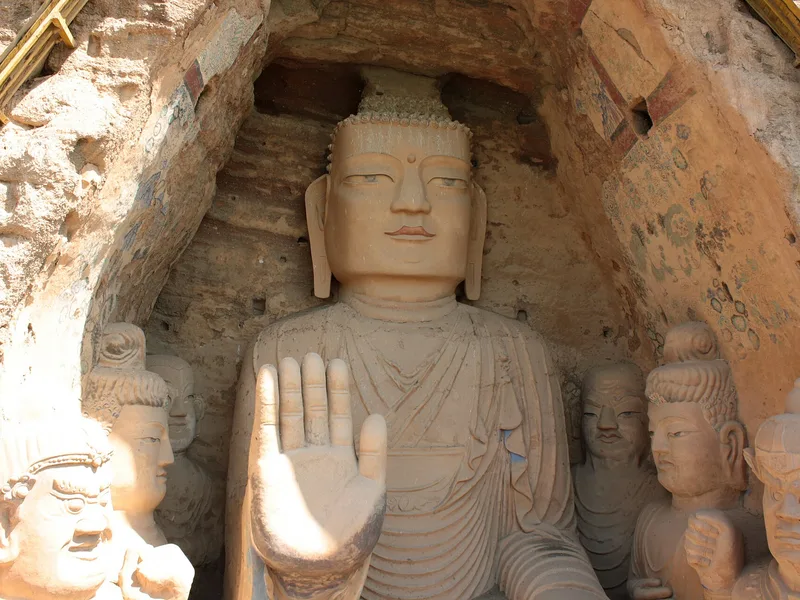
- Unique scene: the Huangyang River reservoir spreads out in front of the caves, with the great Buddha facing the water — mountain, water and Buddha in a single frame is unique in China.
2. Tickets and highlights
| Item | Details |
|---|---|
| Ticket | Reference price about 30–50 RMB/person (per the day's announcements) |
| Opening hours | About 9:00–17:00 (shorter in winter) |
| Main highlights | Open-air great Buddha, central pillar cave remains, mural fragments, Buddha reflection on the water |
Core highlights
- The great Buddha and the reservoir: the rock-carved seated Buddha gazes over the water; on clear days mountain, water and Buddha merge into one color — the best angle for photographs;
- Central pillar caves: Tiantishan's early caves adopted the central pillar form — a hallmark of the "Liangzhou style." Though time and the reservoir have damaged much, the layout is still readable;
- The relocation story: when the reservoir was built in 1958, some murals and painted sculptures were moved wholesale for preservation (they can now be seen in Wuwei, the provincial museum and elsewhere) — worth understanding when you visit;
- Small scenes nearby: the corridor in front of the caves and the layered distant mountains make for a slow, pleasant wander.
💡 Visitor numbers are low and the pace is free; hire a guide (or read up beforehand), otherwise it's easy to "see without understanding."
3. A Liangzhou one-day link-up route
Starting from town, this routing works best (chartered car or self-drive):
| Time | Plan |
|---|---|
| 8:30 | Depart Wuwei town for Tiantishan |
| 9:30–12:00 | Visit Tiantishan Grottoes |
| 12:30–13:30 | Return to town for lunch (Liangzhou "three-carriage set": xingmian noodles, cured meat, fu tea) |
| 14:00–15:30 | Leitai Han Tomb: excavation site of the Bronze Galloping Horse (see the tomb chamber and replica displays) |
| 16:00–17:30 | Wuwei Confucian Temple (largest Confucian temple in the northwest, forest of plaques) + Western Xia Museum (Western Xia stele) |
| 18:00 | If time allows, wander Liangzhou Old Street before heading back |
Wuwei was once called Liangzhou and stood as the metropolis of the Hexi region. Fold Tiantishan into a Wuwei itinerary and you'll see both the source of cave temples and a Han-dynasty legend in one go.
4. Transport and itinerary advice
- From Wuwei: there is no direct bus to Tiantishan — take a chartered car or self-drive (about 100 km round trip); hotel front desks can arrange a car, or join a small tour departing from Wuwei.
- From Lanzhou (2 days is better): Lanzhou→Wuwei high-speed rail takes about 1 hour. A one-day round trip is rushed; stay overnight in Wuwei to play Tiantishan and the town at ease.
- Into a Hexi Corridor itinerary: Tiantishan can slot into routes like "Lanzhou–Wuwei–Zhangye" or "Lanzhou–Wuwei–Tiantishan–Minqin" as a "cave-temple overture" before Mogao.
5. FAQ
Q1: Compared with Mogao, is Tiantishan worth the detour? A: The experiences are completely different: Mogao is for murals and scale; Tiantishan is for its "ancestor" status and the mood of mountain-water-Buddha in one frame. On a Hexi Corridor trip with time to spare, strongly consider adding one day in Wuwei.
Q2: Does Tiantishan involve lots of stairs? A: No. The Buddha and caves sit mostly along a mid-hill viewing walkway with few steps — seniors and children handle it easily.
Q3: Is the 'Buddha's feet touching the water' real? A: After the reservoir was built, the water rose and the Buddha's base was once at the waterline. Water levels and the waterfront platform layout shift over time, so check on-site — but the image of the "Buddha by the water" is always there.
Q4: What else must I see in Wuwei? A: The Leitai Han Tomb (Bronze Galloping Horse excavation site), the Wuwei Confucian Temple and the Western Xia Museum are the town's big three — together with Tiantishan they make a full day.
6. What travelers say
"Standing on the boardwalk before the great Buddha, the reservoir mirroring the mountain shadows — I suddenly understood 'true meaning lies here.' Few visitors; quiet enough to hear the wind." — culture traveler
"After hearing about the Liangzhou style, Yungang clicked into place. Go to Tiantishan before Mogao and the genealogy of Chinese cave temples becomes much clearer." — study-tour traveler
7. Summary
Tiantishan is small, but it is a "key" to understanding Chinese cave-temple art. The Buddha by the water, the thousand-year-old walls, the pioneering Liangzhou style — all make it worth turning a corner for. Give Tiantishan one morning and the afternoon to Leitai and the Confucian Temple in town — a Liangzhou day holds one of the heaviest and quietest chapters in Chinese history.
Craving a worry-free yet free-spirited journey?
Don't want to plan it yourself? Contact our senior trip designer now for a route and quote tailored to you.
Updated: September 2026 Author: RoamFun Senior Travel Consultant Questions? Contact us: vip@roamfun.net

RoamFun Senior Travel Consultant
Travel DesignerProfessional travel consultant, curating the most practical travel guides for you.