Tianshui Maijishan Grottoes Complete Guide: China's Most Underrated of the Four Great Grottoes
China's Four Great Grottoes—Dunhuang Mogao, Datong Yungang, Luoyang Longmen, Tianshui Maijishan. You've probably heard of the first three. The fourth?
Maijishan is uniquely famous for clay sculpture. Its sculptures have survived 1,600 years—the only Chinese grotto complex carved continuously across twelve dynasties, earning it the name "Museum of Eastern Sculpture."
If Mogao is the grandest and most famous of the four great grottoes, Maijishan is the warmest and most intimate, the one carved into a single dramatic cliff rather than spread across a vast desert site. Its sculptures are made of clay, not stone, and that single material difference changes everything: where stone stays cold and monumental, clay holds the warmth of the craftsman's hands, preserving not just forms but fingerprints, and a subtlety of expression that stone can't quite match. The result is a place that doesn't awe you from a distance but draws you closer and closer—especially the famous "Eastern Smile" in Cave 44, which many visitors say shifts and changes the longer you look, never quite settling into a single expression. This guide helps you see Maijishan properly, cave by cave, so you don't rush past the very thing that makes it unique. Whether you're a first-time visitor to Chinese grottoes or a seasoned Mogao veteran, the sections below give you the three levels to focus on, the practical details that make the visit smooth, and the one smile you shouldn't leave without seeing. And if you're weighing Maijishan against the other great grottoes, know this: it's the one that trades spectacle for intimacy, and the one that rewards a slow, quiet visit more than any of them. It may be the least famous of the four, but for many it's the most moving.
🏛️ How to See Maijishan
Three layers to focus on:
Lower level (Caves 1-50): The earliest caves, from Later Qin to Northern Wei. Bold, primitive sculpting with clear foreign influence—high noses, deep-set eyes, thin lips, echoing Gandharan and Indian Gupta styles.
Middle level (Caves 51-130): Late Northern Wei to Western Wei—the peak of Maijishan art. Here sits Cave 44's "Eastern Smile" (a Western Wei disciple figure with a subtly upturned mouth corner, called "the Mona Lisa of the East"). It predates da Vinci's smile by nearly a thousand years.
Upper level (Caves 131-221): Northern Zhou to Sui-Tang. During the Northern Zhou, Maijishan developed a unique "thin clay appliqué" technique—robe folds were laid on as thin sheets of clay rather than carved, so fine that the drapery wrinkles turn translucent. This technique is unmatched in any other Chinese grotto.
About that smile: the Ananda figure in Cave 44 was shaped 1,500 years ago when a craftsman captured a young monk bowing his head in a smile. The arch of the brows, the set of the lips, the droop of the eyelids—no single "S-curve" can sum it up. Stand before it for five minutes and you'll notice the smile changing. That's the magic of clay over stone.
🏔️ The Mountain and Its Story
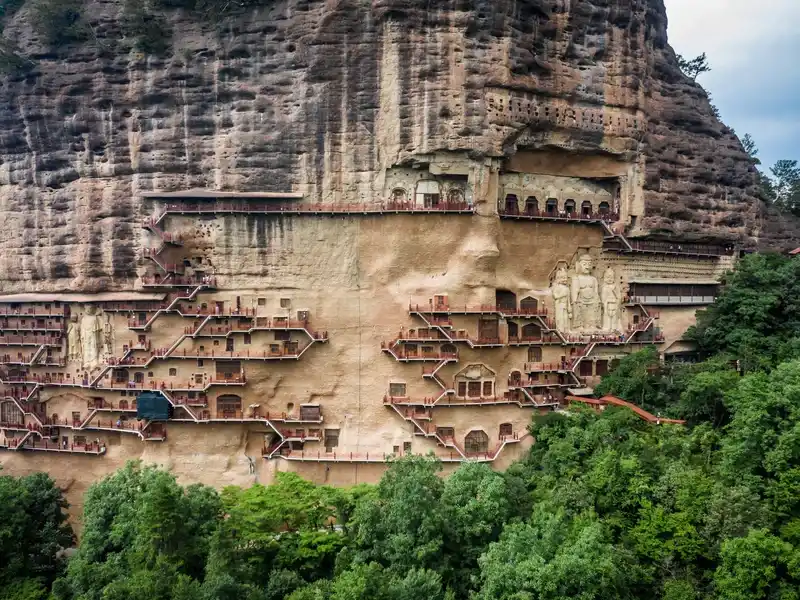
Maijishan means "Wheatstack Mountain"—a name that comes from its distinctive lone peak, which rises like a giant stack of grain to 142 meters above the surrounding forest. The grottoes cling to this single cliff face in a honeycomb of over 190 caves and 7,000+ clay sculptures, reached by elevated boardwalks that hug the rock. That dramatic setting—a sheer cliff studded with niches, reached by a skywalk—is part of why the site feels so different from the sprawling cave complexes elsewhere.
The site's spiritual and artistic lineage runs unbroken across twelve dynasties, from the Later Qin (4th century) through the Sui and Tang to later periods. That continuity is what makes it a "Museum of Eastern Sculpture": you can trace the evolution of Buddhist art—from the bold, foreign-influenced early figures, to the naturalism of the Northern Wei, to the distinctive thin-clay technique of the Northern Zhou—all in a single visit. Understanding that progression before you climb makes every cave you enter richer, because you'll be reading the story of Chinese sculpture unfolding in clay.
🎫 Practical Info
- Tickets: RMB 90 (grottoes + Ruiying Temple), shuttle RMB 15
- Hours: 8:00-17:30 (winter 8:30-17:00)
- Note: Cliff walkways may close in rain or snow (clay fears water). Check the forecast before you go
- Time: 2-3 hours. The caves cluster mid-mountain; the route is all elevated boardwalk—those with fear of heights, proceed with caution (walkways cling to the cliff face, up to 80+ meters above the ground)
🗺️ Tianshui 2-Day Itinerary
| Time | Day 1 | Day 2 |
|---|---|---|
| Morning | Maijishan Grottoes (go early) | Fuxi Temple + Tianshui Museum |
| Afternoon | Xianrenya Scenic Area | Head back or continue to Lanzhou |
| Evening | Tianshui Guagua in Qinzhou District | — |
Tianshui food: Tianshui Guagua (buckwheat jelly, the soul snack of Tianshui), Tianshui Spicy Rice Noodles (one of the birthplaces of Gansu malatang), Jiangshui Noodles (fermented sour soup noodles, a summer appetite-opener).
The Mogao comparison: where Mogao dazzles with murals and overwhelms with volume, Maijishan seduces with sculpture and scales itself to a single person's pace. Mogao's cave visits are quick and regimented; Maijishan lets you stand before a figure as long as you like. Both are essential, but they ask different things of you—Mogao demands awe, Maijishan demands attention. If you're building a Gansu grotto itinerary, don't skip either; the contrast between them is part of the point.
📸 Photography Guide
- No photography inside the caves (clay is light-sensitive)—let your eyes remember
- Best exterior vantage: the observation deck across from Maijishan, for the full lone peak + boardwalk + niches shot
- Autumn (late October): hillside red leaves + grottoes = Maijishan at peak beauty
🧭 Tips for a Deeper Visit
Go early, and go alone if you can: Maijishan's magic is quiet, and it multiplies when the boardwalks are half-empty. Arriving at opening time gets you ahead of the groups and gives the Eastern Smile the solitude it deserves.
Let your eyes linger: Because photography is prohibited inside the caves, the visit forces you into a more patient, direct kind of looking—a rare gift in an era of phone-first travel. Give each major figure a full minute; let the clay work its effect.
Read before you climb: A quick skim of the dynasty progression (below) transforms the visit. Knowing you're looking at a Northern Zhou thin-clay figure, not just "an old statue," turns a walk into an education.
Pair with Tianshui: The grottoes pair naturally with a day in Tianshui itself—Fuxi Temple, the museum, and the city's famous buckwheat jelly (guagua) round out a rich two-day stop.
💬 What Do Our Travelers Say?
"Maijishan moved me more than Mogao. Mogao is always a production line—queue, enter, five minutes, exit, next. Maijishan is different—I stood before Cave 44 alone for fifteen minutes. That day, the entire mountain might have had fewer than 50 visitors." — Xi'an Lao Ma ⭐⭐⭐⭐⭐
"Brought my art-student daughter. She said Mogao is 'magnificent,' Maijishan is 'warm.' Clay sculpture has more body heat than stone—you can see the craftsman's fingerprints preserved in the clay." — Chongqing Teacher Chen ⭐⭐⭐⭐⭐
If You've Already Seen Mogao—Maijishan Is Your Next Surprise
Mogao is "awe"; Maijishan is "tranquility." Mogao makes you look up at the height of human art; Maijishan lets you touch the warmth of a craftsman's fingertips from a thousand years ago.
Think back on this journey: Cave 44's "Eastern Smile" predates the Mona Lisa by nearly a thousand years. Stand before it and a clay figure shaped by a craftsman 1,500 years ago returns your gaze with a smile that seems to shift as you watch. The boardwalk hangs over the Qinling forest, wind threading through hundreds of niches. When you finally turn to leave, that 142-meter peak rises behind you like a giant haystack, its honeycomb of caves glowing in the afternoon sun.
Maijishan never rushes you. There are no long queues like Mogao, no grand plazas like Yungang—just a mountain waiting quietly deep in the hills for visitors who truly understand it. It rewards the slow look: the drape of clay robes, the curve of a smile, the way sixteen centuries stack one upon another.
If you've already seen Mogao, Maijishan is your next surprise. And if you haven't—there's no better place to begin.
Come to Maijishan with time and patience, and it will reward you the way it rewards every traveler who stops hurrying. Stand a while before Cave 44's smile, trace the translucent clay drapery with your eyes, and let the thousand-year fingerprints speak across the distance. The mountain doesn't need you to understand every dynasty; it only asks you to slow down enough to feel what sixteen centuries of quiet craft look like. When you finally descend the boardwalk, past the honeycomb of niches and the Qinling forest below, you'll understand why travelers who've seen all four great grottoes keep a special place in their memory for this one—the warm, unhurried, understated masterwork that waits quietly in the hills and asks to be truly looked at.
Craving a worry-free yet free-spirited journey?
Don't want to plan it yourself? Contact our senior trip designer now for a route and quote tailored to you.
Updated: August 2026 Author: RoamFun Senior Travel Consultant Questions? Contact us: vip@roamfun.net

RoamFun Senior Travel Consultant
Travel DesignerProfessional travel consultant, curating the most practical travel guides for you.