
Complete Gansu Photography Spot Guide: Danxia, Desert, Caves, Tibetan Monasteries—How to Capture Silk Road Epic Feel
Gansu is China's most geographically diverse province—Zhangye rainbow mountains, Mingsha Mountain camel silhouettes, Mogao millennium murals, Labrang prayer wheel practitioners, Jiayuguan desert fortress. Each subject is top-tier—but each golden window is only 15-30 minutes. Miss the light, miss everything. A photographer friend of mine calls Gansu "a province designed by a lighting director"—every scene has one perfect hour, and it waits for no one.
That's both the challenge and the gift of shooting here. The gift is that the light is so specific and so spectacular that a single well-timed frame carries the whole Silk Road feeling. The challenge is that the windows are short, the spots are scattered across more than 1,100 kilometers, and there's no second chance—the danxia sunset won't re-run tomorrow at the same hour, and the camel convoy moves on whether you're ready or not. Success in Gansu photography is 80% timing and 20% technique, which is exactly why this guide focuses on the when and where before the how.
This guide is built for the photographer who wants to come home with more than postcards. It breaks down five of the corridor's most iconic subjects—the rainbow danxia, the desert camels, the monastery prayer wheels, the fortress at dusk, and the Mogao caves—and for each one gives you the exact location, the golden window, and the lens to use. Read it once, plan your route around the hours it names, and you'll be standing in the right place when the light does its thing. The rest, as photographers like to say, is just pressing the shutter. Time your trip right and you can stack several golden windows in a single day—danxia at dusk, camels at dawn, a fortress at sunset—because the corridor's spots are spaced so a well-planned day can catch more than one perfect hour.
🚙 Veteran's Straight Talk
Gansu shooting spots are scattered across 1,100km of the Hexi Corridor. A veteran driver knows every spot's golden time—delivers you to Danxia Platform 4 one hour before sunset, drags you up at 6 AM for Mingsha Mountain sunrise camel convoys. The difference between catching and missing most Gansu light isn't your camera; it's whether you arrive with time to spare. A driver who's run this route a hundred times knows the traffic, the ticket queues, and the walk-in times that eat your golden minutes, and can shave a half-hour off your arrival when it matters most.
🗺️ Spot by Spot
Seven-Color Danxia Sunset (18:00-19:30)
Platform 4. Sun slants from behind—red layers burn, yellow layers glow. Wide-angle 16-35mm for panoramas + telephoto 70-200mm for local textures. CPL polarizer eliminates reflections and boosts saturation. The key here is position over focal length: walk to the far edge of Platform 4 for the cleanest foreground, and keep the horizon off-center so the sky's color gradient plays against the striped rock. Arrive an hour early, claim your spot, and let the sun come to you.
Mingsha Mountain Camel Convoy Silhouette (Sunrise or 20 Minutes After Sunset)
Photographer stands on dune top shooting down—camel convoy walks along the ridge line + sunset background. Telephoto 200mm compresses the distance between camels and sun. At sunrise, sun rises from the east—camel direction is opposite to sunset. The 20-minutes-after-sunset window is the hidden gem: the sky holds its warm gradient while the dune shadows deepen, giving the convoy a rim-lit silhouette that's softer than the harsh sunset glow.
Labrang Monastery Prayer Wheel Practitioners (7:00-8:30 AM)
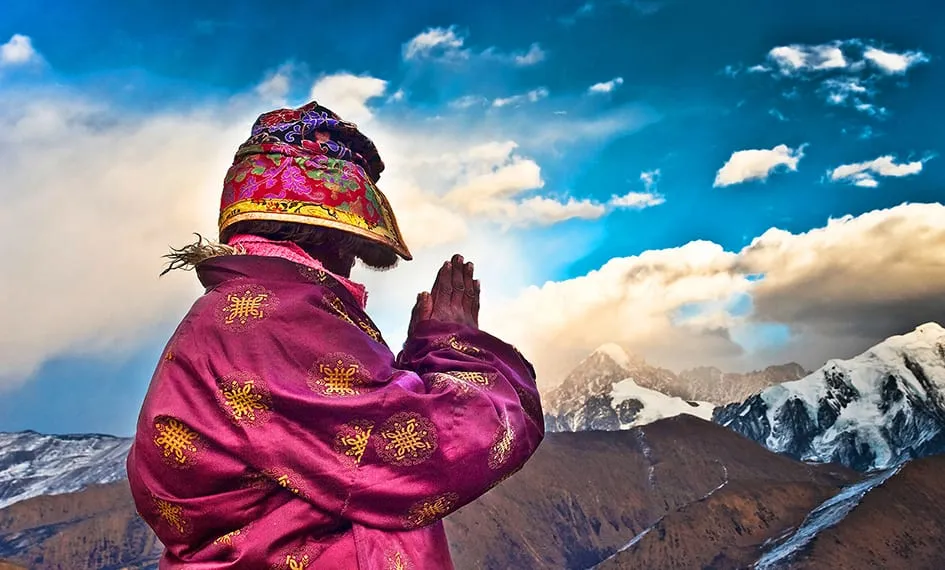
Morning light illuminates prayer wheel copper surfaces—praying elderly wrapped in golden rim light. Telephoto from distance—no faces, just hands + wheels. Shutter 1/250s or faster. The respectful distance matters: at Labrang, the worship is real, not staged for tourists. A long lens lets you capture the ritual without intruding on it, and the motion of turning wheels against sharp, static prayer-wheel rows is what makes the image breathe. Be quiet, be patient, and the golden hour hands you the monastery at its most authentic.
Jiayuguan Fortress Tower Sunset (18:00-19:30)
Shoot upward from outside the gate—fortress tower + sunset + wide-angle perspective. Shoot outward from the wall—Qilian snow mountains + Gobi + fortress tower corner as foreground. The double composition gives you two very different images from one sunset: the low-angle shot frames the tower heroically against the sky, while the wall-top shot pulls the whole fortress-and-wilderness relationship into a single frame. Both are worth the climb, and both reward a wide lens and a steady hand.
Mogao Caves Nine-Story Building (Morning Front Light)
Before 9 AM front-lit—rust-red building + blue sky + poplar trees. Medium telephoto compresses the Nine-Story Building + cliff cave cluster. The morning front light is what makes the rust-red facade glow against the clear desert sky, and the poplars add a vertical rhythm that breaks up the long cliff line. Shoot it early, before the tour groups arrive and the scaffolding of daytime traffic fills the frame.
🎒 Practical List
⚠️ Don't say I didn't warn you: Gansu has strong wind and sand—change lenses inside the car whenever possible. If sand gets in the lens, use an air blower, not a cloth. Spare batteries ×2. The desert cold also drains batteries fast—keep spares in an inner pocket near your body, and a UV filter on every lens as cheap insurance against the blowing grit.
🎒 What's in the Bag
- Lenses: A 16-35mm wide zoom for the danxia and fortress panoramas; a 70-200mm telephoto for the camel silhouettes and monastery detail. One ultra-wide + one tele covers 90% of the corridor's shots.
- Filters: CPL polarizer for the danxia and any water or sky shots; a UV filter on every lens as sand insurance.
- Camera care: A blower and a soft brush—not a cloth—for sand. Change lenses in the car, never in the open wind. A zip-lock with silica gel for the desert humidity swings.
- Tripod: Essential for the dawn camel and sunset fortress shots, and for long-exposure star trails at the desert camp at night.
Bonus spot: the Zhangye danxia at first light (6:00-6:30 AM) is nearly empty and catches the softest colors of the day. If you can't do both, the sunset is more dramatic, but the dawn is more peaceful and often free of the tour crowds entirely.
💡 Heart-to-Heart Truths
Gansu photography isn't about 'beauty'—it's about 'emptiness': Danxia colors are beautiful, camel silhouettes are beautiful—but what truly sets Gansu photography apart is the "sense of emptiness." Wide angle with generous negative space—give plenty to both sky and ground, let the emptiness speak for itself. The Gobi doesn't clutter the frame; it gives your subject room to breathe, and that scale is what makes a Gansu image unmistakably Gansu. Resist the urge to fill every corner—leave the void, and the desert does the rest.
💬 What RoamFun Travelers Say
"Waited two hours at Danxia. The last fifteen minutes of light dyed the mountains flame color—everyone else had left, only I captured the peak." — Guangzhou, @LaoShe ⭐⭐⭐⭐⭐
"The veteran driver knew the Danxia light down to the minute. He had me on Platform 4 an hour early, then said 'wait for the last fifteen minutes.' When the mountains caught fire, I was the only one still there. That shot is on my wall now." — Shanghai, photographer Chen ⭐⭐⭐⭐⭐
Photography in Gansu Rewards Patience and Light
Photography in Gansu rewards patience and light. Don't chase every spot—pick two or three, arrive early, and wait. The best picture is rarely the one you planned; it's the moment the light finally falls the way you hoped. Let the emptiness of the Gobi and the silence of the monasteries speak for themselves through your lens.
There's a reason the Silk Road photographers who return to Gansu year after year do so: the light here is never the same twice. The danxia re-colors every evening, the camel convoys shift with the sand, and the monasteries' prayer wheels turn to a rhythm that's older than your lens. You can't shoot it all, and you shouldn't try. Choose the two or three moments that matter most to you, arrive before the light, and let the place do what it does. That's the difference between a Gansu photo and a Gansu photograph—the first is a record, the second is a mood you carried home. Aim for the second, and you'll find that the corridor keeps giving, every trip, a new frame you didn't know was waiting.
The Hexi Corridor has been photographed for a hundred years, from the first Silk Road expeditions to the phones in every traveler's hand, and it still surprises. The danxia re-paints itself each evening, the dunes reshape overnight, and the monasteries' courtyards fill with different faces at every dawn. That endlessness is what makes Gansu a photographer's home rather than a one-stop shoot. So bring your lenses, bring your patience, and leave your rush at the Lanzhou airport. Stand in the right place at the right hour, let the emptiness speak, and the corridor will hand you the one thing every photographer is really chasing—a frame that feels like yours alone. The light will be there. The camels will come. And you'll be ready, exactly where this guide points you.
Craving a worry-free yet free-spirited journey?
Don't want to plan it yourself? Contact our senior trip designer now for a route and quote tailored to you.
Updated: August 2026 Author: RoamFun Senior Travel Consultant Questions? Contact us: vip@roamfun.net

RoamFun Senior Travel Consultant
Travel DesignerProfessional travel consultant, curating the most practical travel guides for you.