
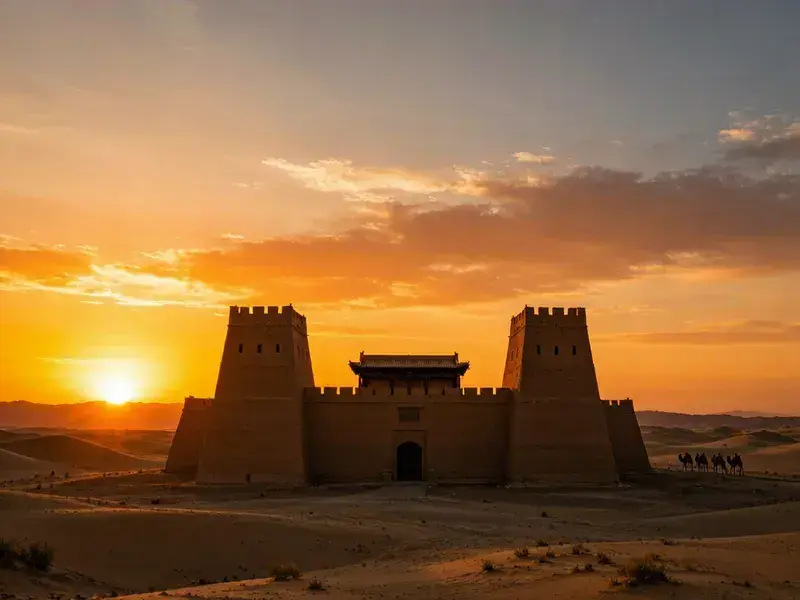
Jiayuguan + Yangguan + Yumenguan: Standing at the End of the Silk Road Watching Desert Smoke
"Why should the Qiang flute complain about willows, spring wind never crosses Yumenguan"—when Wang Zhihuan wrote this, Yumenguan was the Han Dynasty's westernmost pass. Beyond it lay the Western Regions, further west the unknown world. That was the "dead end" in the eyes of Tang Dynasty frontier poets two thousand years ago.
Today you stand before the Xiaofangpan City ruins at Yumenguan—nothing around but wind, Gobi, and the exact same sky as two thousand years ago. In that moment you understand why ancients wrote "spring wind never crosses Yumenguan"—it's not geography, it's psychology. Walking out of this city, you were no longer in China.
🚙 Veteran's Straight Talk: How to Connect the Three Passes
Jiayuguan is in Jiayuguan city (about 380km from Dunhuang). Yangguan and Yumenguan are 70-90km northwest of Dunhuang. The three passes aren't on one line—two days is most reasonable.
Day 1 Jiayuguan: Taxi or chartered car from Jiayuguan city directly to the fortress—half a day. Day 2 Dunhuang Western Route: Chartered car for a full day connecting Yumenguan + Yangguan + Yadan Devil City. A Prado for the western route—the final stretch to Yadan Devil City is Gobi dirt road where sedans easily get stuck in sand.
🗺️ Pass by Pass Breakdown
Jiayuguan — Westernmost Point of the Ming Great Wall
Jiayuguan is the Ming Great Wall's westernmost fortress. The entire fortress is well-preserved—gate towers, barbicans, arrow towers, corner towers—a complete Great Wall defense system. Standing on the west gate tower looking west—Qilian snow mountains' end on your left, boundless black Gobi on your right. The fortress floats like an island between heaven and earth.
Best time: Evening—sunset from behind hits the west gate tower, dyeing the entire fortress rust-red. The fortress shadow stretches across the Gobi—you stand where garrison soldiers stood 600 years ago.
Highlights: The "World's Greatest Fortress" plaque on the gate tower, Stone-Striking Swallow Echo (strike two stones at the wall base—it produces a swallow-like call, said to be the souls of swallows that once returned), Great Wall First Pier (7km south of Jiayuguan, the first beacon tower ruin of the Ming Great Wall).
Yumenguan — Where "Spring Wind" Stops
About 90km northwest of Dunhuang—a lone square rammed-earth fortress standing on the Gobi—this is the Han Dynasty Yumenguan ruin (Xiaofangpan City). Two thousand years of wind and sand erosion have left only an earthen mound, but the original fortress structure is still visible.
Standing before it—two thousand years ago, Zhang Qian walked out from here to pioneer the Western Regions, Huo Qubing led his army from here, countless merchant caravans set foot on the Silk Road from here. Walking out of this fortress in ancient times was equivalent to leaving the country today—no navigation, no supplies, only the unknown behind.
Note: At Yumenguan, don't only photograph Xiaofangpan City—walk 100 meters forward to the Shule River. The riverbed is dry but the channel marks remain. Two thousand years ago this river still flowed—garrison soldiers washed their horses here.
Yangguan — "West of Yangguan, No Old Friends"
Yangguan is about 60km south of Yumenguan, with only a beacon tower earthen mound remaining. Beside it stands a "Yangguan Ancient Site" stele—countless people photograph it. "I urge you to drink one more cup of wine, west of Yangguan no old friends"—Wang Wei's farewell poem made Yangguan synonymous with "parting" in Chinese culture.
Yangguan Avenue: Beside the ruins is an ancient road covered in gravel—this is the "Yangguan Avenue." For two thousand years, countless people walked this road leaving China. Walk on it—every piece of gravel underfoot may have been stepped on by a Han or Tang Dynasty traveler.
🎒 Practical List
⚠️ Don't say I didn't warn you: The Dunhuang western route (Yumenguan + Yangguan + Yadan Devil City) is entirely on the Gobi—not a single tree, no shade. Bring enough water and food. Summer noon surface temperatures exceed 50°C. Yadan Devil City's wind can blow you away—zip up your hard shell jacket.
- At least 2L drinking water + snacks (no supplies on the Gobi)
- Sun mask + sunglasses + long sleeves (comprehensive sand and sun protection)
- Hard shell jacket (Yadan Devil City has massive wind)
- Power bank (constant photography)
💡 Heart-to-Heart Truths
Don't be disappointed by a "dirt mound": Yangguan and Yumenguan are now only rammed-earth ruins—not the "majestic fortress" you see in documentaries. But think—this is a human creation from 2,000 years ago, standing on a Gobi where nothing else exists for two millennia. Being able to see its remaining form is itself a miracle.
Jiayuguan's Overhanging Great Wall can be skipped: The scenic area has an "Overhanging Great Wall" rebuilt in 1987—not an antiquity. Fine for photos but don't treat it as Great Wall heritage.
Returning from Yadan Devil City after sunset is night driving: About 180km from Devil City back to Dunhuang, mostly without streetlights. You'll cross the Gobi in complete darkness—stars overhead, darkness on both sides. Tell the driver: safety first—drive slowly.
📸 Don't Shoot Blindly—These Spots Are Stunning
- Jiayuguan West Gate Tower: Evening golden light on the west gate tower—stand below the fortress and shoot upward at the tower and sunset. Wide angle for the depth of walls extending into the Gobi.
- Yumenguan Xiaofangpan City: Stand north of the city ruin, shoot upward with wide angle—the rammed-earth fortress against blue sky and Gobi background. The emptiness of heaven and earth vs. the smallness of the wall creates powerful scale contrast.
- Yangguan Beacon Tower + Yangguan Avenue: Beacon tower as distant view, gravel of Yangguan Avenue underfoot—wide angle low angle. The road ancient travelers walked 2,000 years ago.
- Yadan Devil City Sunset: Stone pillars + sunset + Gobi—telephoto frames pillar silhouettes with the sun. When wind is strong, sand rolls into mini tornadoes on the ground.
💬 What RoamFun Travelers Say
"Before going, looking at photos, I thought Yumenguan was just a dirt mound—what's to see? Standing before it—nothing around but the sound of wind and the same sky as 2,000 years ago. Suddenly an image appeared—Zhang Qian riding out from here, turning back for one last look. In that instant, I understood 'spring wind never crosses Yumenguan.'" — Hangzhou, Xiao Xu ⭐⭐⭐⭐⭐
"Jiayuguan's best part isn't the fortress itself—it's standing on the wall looking west. Snow mountains stretching to the horizon on the left, boundless Gobi on the right. A garrison soldier 600 years ago saw this exact same view. Historical feeling isn't imagined—it's standing in the same spot, seeing the same thing." — Beijing, Lao Ding ⭐⭐⭐⭐⭐
Stand Here and You'll Know What "Distance" Means
Han and Tang Dynasty Chinese stood at Yumenguan and Yangguan looking out—that was the original definition of "distance." Two thousand years later you stand in the same spot—GPS can locate you, WiFi signal is full. But that feeling of "beyond this city is the unknown"—it's still in the wind.
Want a worry-free yet free travel experience?
Don't want to plan? Contact our senior customizers now for your exclusive route and quote.
Updated: June 2026 Author: RoamFun Senior Travel Consultant Questions welcome: vip@roamfun.net
Craving a worry-free yet free-spirited journey?
Don't want to plan it yourself? Contact our senior trip designer now for a route and quote tailored to you.

RoamFun Senior Travel Consultant
Travel DesignerProfessional travel consultant, curating the most practical travel guides for you.