Gannan Secret Realm: Labrang Monastery + Langmu Temple—A Spiritual Highland More Tibetan Than Tibet
Don't want to go as far, as high, or as rough as Tibet? Gannan is the perfect alternative. Average altitude 3000m—far friendlier than Tibet's 4000m+, much lower altitude sickness risk. But the Tibetan cultural density is just as rich.
Labrang Monastery—one of the six great monasteries of the Gelug sect of Tibetan Buddhism, with the world's longest prayer wheel corridor (about 3.5km, 1700+ prayer wheels), one of the highest academic institutions of Tibetan Buddhism (equivalent to Tibet's Peking University). Langmu Temple—straddling the border of Gansu and Sichuan provinces, with the Bailong River flowing through, alpine meadows + snow mountains + red walls and golden roofs, called "Eastern Switzerland."
🚙 Veteran's Straight Talk: How to Get to Gannan
Lanzhou to Gannan's Xiahe is about 250km, about 4 hours by car. The route passes through Linxia Hui Autonomous Prefecture—gradually transitioning from the Loess Plateau to the Qinghai-Tibet Plateau, the landscape change itself is a scenic zone.
A Prado for Gannan—overall road conditions are good but with many curves and steep grades (the section from Hezuo to Langmu Temple is a highland meadow highway). Veteran drivers know what time Labrang's morning chanting begins (6:00 AM when monks start chanting in the Great Assembly Hall), know which fork in Sangke Grassland leads to a wildflower slope with no tourists, know the road conditions to the sky burial platform opposite Langmu Temple.
🗺️ 3-Day Gannan Spiritual Journey
Day 1: Lanzhou — Xiahe (Labrang Monastery)
- Itinerary tip: After arriving in Xiahe, park at Labrang Monastery parking lot. Don't linger on the commercial street in front of the monastery—all shops selling fake Tibetan jewelry and Yiwu small commodities. Go straight into the monastery area.
- Veteran's advice: Arriving in the afternoon means missing morning chanting, but there's a better experience—the prayer wheel corridor. Start from the white stupa on the monastery's west side, walk clockwise around the monastery. 1700+ prayer wheels, turn each one by hand (over half an hour). The Tibetan elder walking beside you may have been doing this for decades—you turn one wheel in one second, he turns one wheel for a lifetime. Afterward, go to the hillside of the Buddha Unfolding Platform opposite the monastery—sit halfway up, watching Labrang's golden roofs glow in the sunset.
Day 2: Xiahe — Sangke Grassland — Langmu Temple
- Sangke Grassland: Depart Xiahe in the morning, head south about 15km to Sangke Grassland. In July, the meadow blooms with golden cinquefoil and Kelsang flowers, with low mountain ranges in the distance. Find a safe fork and drive in—you might have it all to yourself.
- Veteran's advice: Many Tibetan family lodges on Sangke Grassland offer horseback riding and yogurt. Agree on price before riding (per lap or per hour). The child leading the horse may not speak Mandarin—gestures and smiles are enough. Yak yogurt is extremely sour—add white sugar and stir well.
- Langmu Temple: Arrive in the afternoon. The monastery straddles the Gansu-Sichuan border—the Bailong River flows through it, with Gansu's Sachi Monastery on the north bank and Sichuan's Kirti Monastery on the south bank. The town has just one main street—Tibetan restaurants + Sichuan restaurants + outdoor gear shops.
Day 3: Langmu Temple Sunrise — Return
- Itinerary tip: Climb the hillside behind Langmu Temple at 6:00 AM to the viewing platform. The sun rises from the opposite ridge, the town wakes in morning mist—smoke rising from between Tibetan wooden houses and red walls with golden roofs. The hillside opposite Langmu Temple is the sky burial platform—generally not open to tourists. If it happens to be open, please respect: no photos, no noise, keep your distance.
- Veteran's advice: After sunrise, return to town and order a butter tea latte at Lisa Café (an old shop open for decades)—Tibetan + Western fusion, just like Langmu Temple itself.
🎒 Practical List
⚠️ Don't say I didn't warn you: Gannan's altitude is 2800-3500m—not extremely high but you may still have mild reactions on day one—headache, fatigue, loss of appetite. Ibuprofen + thermos + small frequent meals are the response. Don't compare with Tibet's high altitude—everyone reacts differently.
- Ibuprofen + thermos + glucose oral solution
- Hard shell jacket + fleece (large temperature swings, summer nights can drop below 10°C)
- Lip balm + sunscreen (plateau UV is no less than Tibet)
- Cash (Sangke Grassland horse riding and Tibetan stalls mostly only accept cash)
- Learn "Tashi Delek"—useful everywhere
💡 Heart-to-Heart Truths
Gannan isn't "Tibet's substitute"—it's itself: Gannan's Tibetan culture isn't a copy of Tibet—it's the Amdo Tibetan region, with different dialect, clothing, and architectural style from Lhasa. Don't measure Gannan by "how similar to Tibet"—Gannan is Gannan.
July is Gannan's most beautiful season: Grasslands are greenest, wildflowers most abundant. But also the rainiest—afternoon showers are highly likely. Keep a hard shell jacket with you. In September, the grasslands turn golden—another kind of beauty.
Staying one night in Langmu Temple is infinitely better than a day trip: Most tourists day-trip Langmu Temple from Xiahe—arrive, snap a photo, leave. But if you stay one night—opening your door in the morning to see red walls, golden roofs, and the Bailong River in morning mist, you'll be glad you stayed.
📸 Don't Shoot Blindly—These Spots Are Stunning
- Labrang Buddha Unfolding Platform panorama: 6 PM, golden sunset on golden roofs. Telephoto captures golden roofs + prayer wheel corridor + distant ridge.
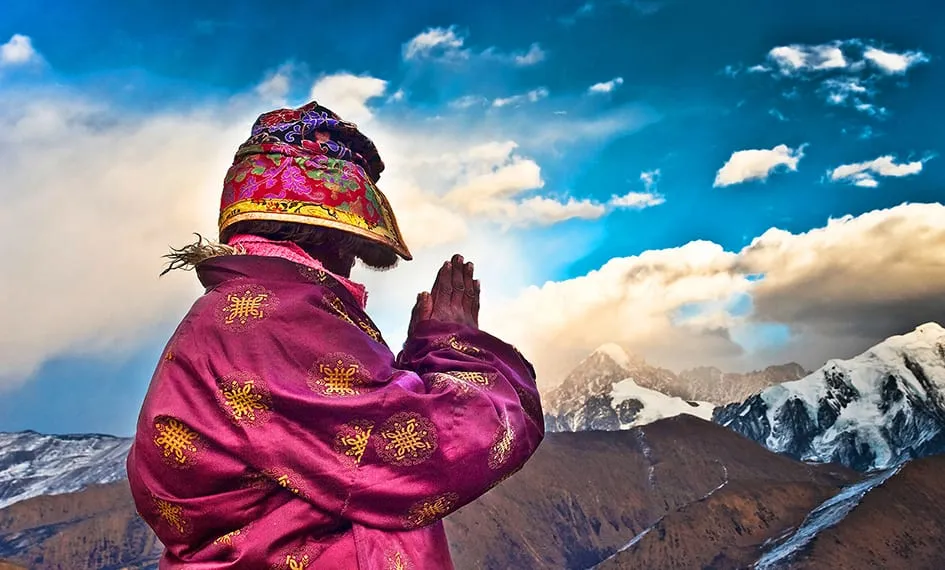
- Prayer wheel corridor human element: Afternoon side light + praying elderly + copper prayer wheel reflections. Telephoto from distance—no faces, just hands + wheels.
- Langmu Temple morning mist: 6:30 AM from hillside viewing platform toward town—smoke + red walls + golden roofs + morning mist.
- Sangke Grassland flower sea: July, wide angle low to the flowers—flowers as foreground, distant mountains as background.
💬 What RoamFun Travelers Say
"At Labrang, I followed an elderly man doing the kora. I turned 1700+ prayer wheels, my hands ached—he'd been doing it for decades. I asked: don't you get tired of reading the scripture on the wheels a thousand times? He smiled: it's not reading, it's grinding. Grinding these words into your heart—a lifetime isn't enough." — Chengdu, Xiao He ⭐⭐⭐⭐⭐
"Got up at 6:30 AM for Langmu Temple sunrise. The whole street was empty, just the sound of the Bailong River and distant monastery bells—in the morning mist, I couldn't tell which was real and which was hallucination. That moment, I felt 'Eastern Switzerland' wasn't praising Langmu Temple—it was underselling it." — Hangzhou, Xiao Ye ⭐⭐⭐⭐⭐
Gannan Doesn't Need You to Be Buddhist—Just to Believe in the Power of Silence
On Labrang's prayer wheel corridor, in Langmu Temple's predawn mist, in the wind blowing across Sangke Grassland—you need no faith. You just need to close your mouth, open your eyes, and feel that quiet power.
Want a worry-free yet free travel experience?
Don't want to plan? Contact our senior customizers now for your exclusive route and quote.
Updated: June 2026 Author: RoamFun Senior Travel Consultant Questions welcome: vip@roamfun.net
Craving a worry-free yet free-spirited journey?
Don't want to plan it yourself? Contact our senior trip designer now for a route and quote tailored to you.

RoamFun Senior Travel Consultant
Travel DesignerProfessional travel consultant, curating the most practical travel guides for you.